
Introduction: Salesforce Customer Attacks
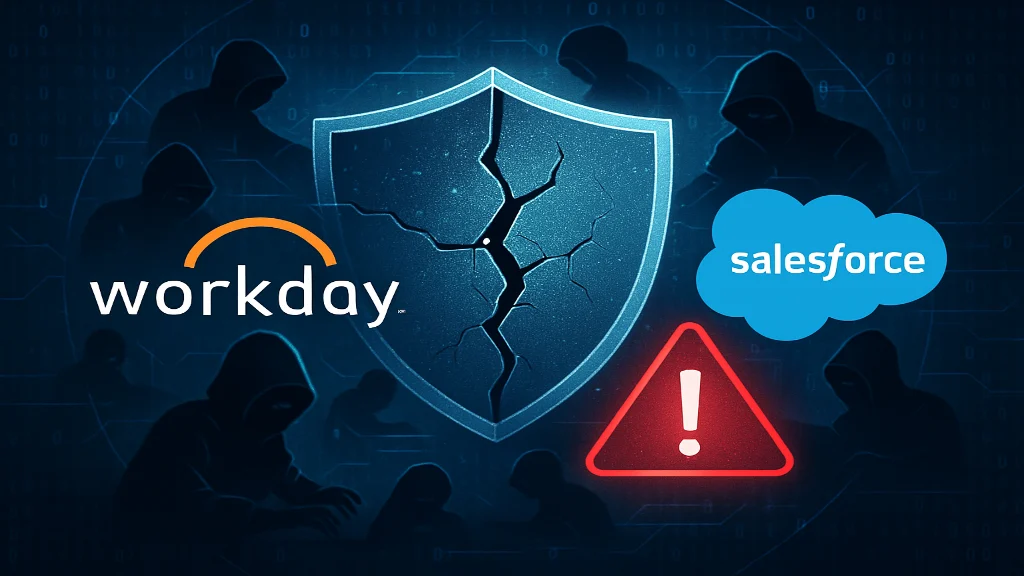
Recently, cybersecurity threats have grown in sophistication, with attackers leveraging stolen credentials to infiltrate enterprise systems. A recent report has uncovered a disturbing trend: a significant data breach involving Workday, a leading human capital management (HCM) platform, has been linked to a surge in cyberattacks targeting Salesforce customers. This breach has exposed sensitive employee data, which attackers now use in credential-stuffing and phishing campaigns to compromise corporate Salesforce environments.
This blog post will explore the details of the Workday breach, how it is connected to the rise in Salesforce attacks, the potential risks for businesses, and best practices for mitigating such threats. By understanding the attack vectors and implementing robust security measures, organizations can better protect themselves from these escalating threats.
Table of Contents
Introduction: Salesforce Customer Attacks1. Understanding the Workday Data Breach2. How the Workday Breach Fuels Salesforce Attacks3. Real-World Impact on Businesses4. How to Protect Your Organization5. The Role of Workday and Salesforce in Mitigating Risks6. Key Takeaways:
1. Understanding the Workday Data Breach
1.1 What Happened?
Workday, a cloud-based software provider specializing in HR, payroll, and financial management solutions, suffered a data breach that exposed employee credentials. While Workday has not publicly disclosed the full extent of the breach, cybersecurity researchers have identified that stolen login credentials from Workday are being sold on dark web marketplaces.
Attackers likely obtained these credentials through:
Phishing campaigns targeting Workday users.
Credential stuffing (using previously leaked passwords from other breaches).
Insider threats or third-party vendor compromises.
1.2 The Nature of the Exposed Data
The compromised data includes:
Employee usernames and passwords (some hashed, some in plaintext).
Personal identifiable information (PII) such as names, email addresses, and job roles.
Internal system access details, allowing attackers to map corporate structures.
This information is particularly dangerous because many employees reuse passwords across multiple platforms, including Salesforce.
2.1 Credential Stuffing Attacks
Since many organizations use both Workday and Salesforce, attackers are exploiting password reuse. They take the stolen Workday credentials and attempt to log in to Salesforce accounts. Given that:
Salesforce holds critical business data (customer records, financials, sales pipelines).
Many users do not enable multi-factor authentication (MFA).
Employees often reuse weak passwords.
Attackers can gain unauthorised access, leading to data theft, financial fraud, and further phishing attacks.
2.2 Phishing and Social Engineering
With access to Workday data, attackers craft highly targeted phishing emails, impersonating HR or IT departments to trick employees into:
Resetting passwords (leading to account takeovers).
Downloading malware disguised as “urgent” Workday or Salesforce updates.
Divulging additional credentials through fake login pages.
2.3 Business Email Compromise (BEC) and Financial Fraud
Once inside Salesforce, attackers can:
Redirect payments by modifying vendor details.
Extract sensitive customer data for resale on the dark web.
Impersonate executives to authorise fraudulent transactions.
3.1 Case Studies of Recent Attacks
Several organizations have reported incidents where:
unauthorised Salesforce logins from foreign IP addresses.
Tampered customer records (changed billing information).
Ransomware deployment after initial access via Salesforce.
3.2 Financial and Reputational Damage
Direct financial losses from fraud (often in the millions).
Regulatory fines (GDPR, CCPA violations due to data exposure).
Loss of customer trust, leading to churn and brand damage.
4.1 Immediate Actions
1. Password Resets & MFA Enforcement
Force password changes for all employees, especially those using Workday and Salesforce.
Mandate multi-factor authentication (MFA) on all corporate accounts.
2. Monitor for Credential Leaks
Use tools like Have I Been Pwned or dark web monitoring services to check if someone has exposed employee credentials.
3. Employee Security Training
Conduct phishing simulation exercises.
Educate staff on recognising suspicious emails and password hygiene.
4.2 Long-Term Security Measures
1. Zero Trust Architecture
Implement least-privilege access controls in Salesforce.
Use IP restrictions to block logins from unusual locations.
2. Advanced Threat Detection
Deploy User and Entity Behavior Analytics (UEBA) to detect abnormal login patterns.
Enable Salesforce Event Monitoring to track suspicious activities.
3. Regular Security Audits
Conduct penetration testing to identify vulnerabilities.
Review third-party vendor security (many breaches originate from suppliers).
5.1 Workday’s Responsibility
Enhance breach disclosure transparency to help customers respond faster.
Improve default security settings (e.g., mandatory MFA).
Increase anomaly detection for unusual login attempts.
5.2 Salesforce’s Security Features
Shield Platform encryption for sensitive data.
Session timeout policies to reduce exposure from idle sessions.
Integration with SIEM tools for real-time threat detection.
The Workday breach and its ripple effects on Salesforce attacks highlight a critical cybersecurity lesson: compromised credentials are the gateway to enterprise systems. Organizations must:
Assume that breaches may occur and prepare accordingly.
Adopt a proactive security posture with MFA, monitoring, and employee training.
Collaborate with SaaS providers to ensure robust defences.
By taking these steps, businesses can reduce the risk of falling victim to credential-based attacks and safeguard their most valuable data.
Part of the team turning Salesforce and AI strategy into shipped, measurable outcomes for enterprises across five regions.