

The 5 Biggest Salesforce Risks You Can’t Ignore in 2026
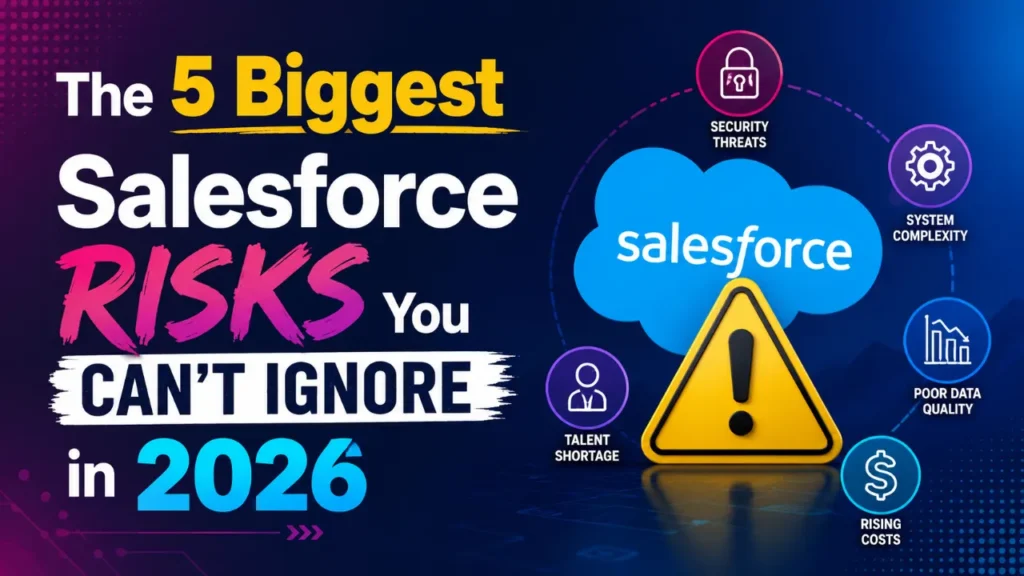
Salesforce continues to dominate the CRM market in 2026, but the platform is evolving faster than ever. AI-powered automation, Data Cloud adoption, Agentforce, stricter security regulations, and rising customer expectations are creating new opportunities—but they also introduce significant risks.
Many businesses invest heavily in Salesforce expecting immediate growth, only to discover that poor planning, weak governance, or outdated processes reduce ROI. Organizations that proactively address these challenges will be better positioned to maximize their Salesforce investment while maintaining security, compliance, and operational efficiency.
Here are the five biggest Salesforce risks organizations should pay close attention to in 2026.
Table of Contents
1. AI Governance and Agentforce Misconfiguration
Artificial intelligence has become a core part of the Salesforce ecosystem. Organizations are increasingly using Agentforce, AI-powered assistants, Prompt Builder, and automated workflows to improve productivity.
However, deploying AI without proper governance can create serious business risks.
Common challenges include:
- AI generating inaccurate or outdated responses
- Unauthorized access to sensitive customer information
- Poor prompt design leading to inconsistent outputs
- Lack of human review for business-critical decisions
- Insufficient monitoring of AI performance
Businesses should establish clear AI governance policies, define user permissions carefully, regularly review AI-generated content, and keep human oversight for important customer interactions.
2. Poor Data Quality Limiting Business Growth
AI is only as effective as the data it receives. In 2026, data quality has become one of the most critical success factors for Salesforce implementations.
Many organizations struggle with:
- Duplicate customer records
- Incomplete contact information
- Outdated accounts
- Inconsistent field values
- Data silos across multiple systems
Poor data quality impacts forecasting, reporting, marketing campaigns, sales productivity, and AI-generated insights.
Organizations should implement strong data governance practices, automate duplicate management, establish validation rules, and perform regular data cleansing to maintain reliable business information.
3. Increasing Security and Compliance Risks
Cybersecurity threats continue to grow, and customer data protection is receiving greater regulatory attention worldwide.
Businesses handling financial, healthcare, government, or enterprise customer information must strengthen Salesforce security.
Major security concerns include:
- Excessive user permissions
- Weak authentication policies
- Misconfigured sharing rules
- Third-party application vulnerabilities
- Insider security threats
Organizations should regularly audit user access, implement Multi-Factor Authentication (MFA), follow the principle of least privilege, monitor login activity, and review connected applications to reduce security risks.
Security should become an ongoing business process rather than a one-time implementation task.
4. Salesforce Technical Debt and Customization Overload
Many Salesforce environments have grown over several years through continuous customization. While customization provides flexibility, excessive technical debt creates long-term maintenance challenges.
Warning signs include:
- Hundreds of Apex classes with minimal documentation
- Complex Flows that are difficult to maintain
- Redundant automation
- Unused custom fields and objects
- Slow deployment cycles
- Performance issues
As Salesforce releases new platform updates throughout the year, older customizations may require frequent modifications, increasing development costs.
Organizations should regularly review their Salesforce architecture, remove unused components, simplify automation, and adopt scalable development best practices.
Reducing technical debt improves platform performance, lowers maintenance costs, and accelerates future innovation.
5. Rising Salesforce Costs Without Measurable ROI
Many businesses continue expanding their Salesforce ecosystem by adding new clouds, AI capabilities, third-party applications, and premium licenses.
While these investments can deliver value, organizations often fail to measure actual business outcomes.
Common cost-related issues include:
- Underutilized licenses
- Low user adoption
- Unused AppExchange applications
- Duplicate software tools
- Poor implementation planning
Without clear performance metrics, Salesforce spending can increase while productivity remains unchanged.
Businesses should define measurable KPIs before every implementation, monitor user adoption, evaluate license utilization regularly, and prioritize features that directly support business objectives.
A strategic approach ensures Salesforce investments generate sustainable long-term returns.
Best Practices to Reduce Salesforce Risks
Organizations can significantly reduce these challenges by following a proactive governance strategy.
Key recommendations include:
- Develop a comprehensive AI governance framework.
- Maintain high-quality, centralized customer data.
- Conduct regular security and compliance audits.
- Simplify customizations and eliminate technical debt.
- Track Salesforce ROI using measurable business KPIs.
- Provide ongoing user training and change management.
- Review system performance after every major Salesforce release.
- Continuously optimize automation and business processes.
These best practices help organizations remain agile while reducing operational and security risks.
Looking Ahead
Salesforce innovation will continue accelerating throughout 2026, particularly in artificial intelligence, automation, customer data platforms, and digital experiences. While these advancements create new business opportunities, they also require stronger governance, better security, and smarter operational planning.
Organizations that prioritize clean data, responsible AI adoption, scalable architecture, and continuous optimization will gain a competitive advantage. Those that ignore these emerging risks may face rising costs, reduced productivity, compliance challenges, and lower customer trust.
By addressing these five critical Salesforce risks today, businesses can build a more secure, efficient, and future-ready Salesforce environment that supports long-term growth and delivers measurable business value in 2026.