

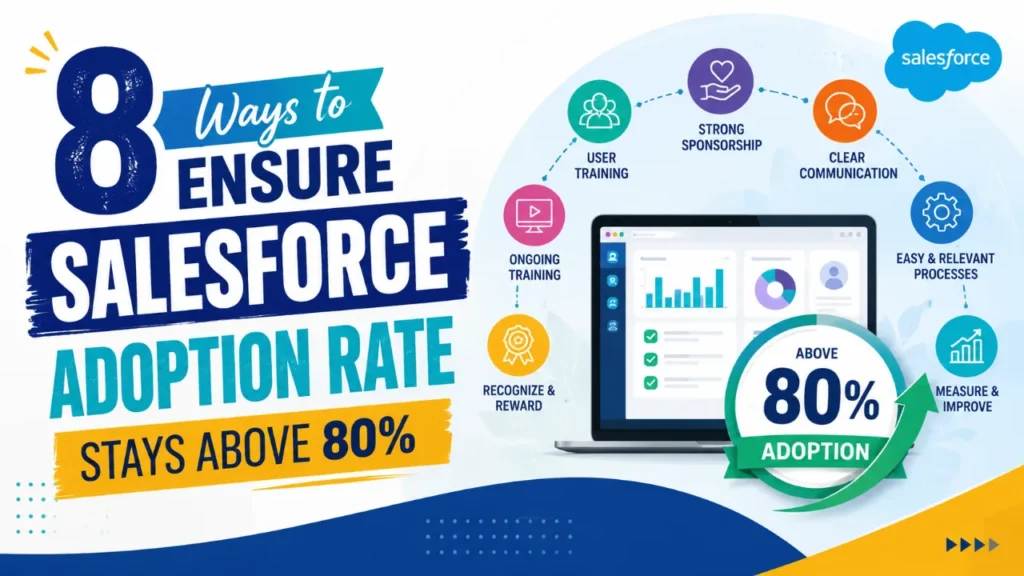
8 Ways to Ensure Salesforce Adoption Rate Stays Above 80%
Introduction
Salesforce is powerful. But power means nothing if your team doesn’t use it.
Every year, organizations spend millions implementing Salesforce, only to watch adoption rates plummet to 40-50%. Users log in reluctantly. Data quality suffers. Reports become unreliable. And the ROI? It disappears.
Here’s the harsh truth: A low adoption rate isn’t a technology problem—it’s a people problem.
The good news? Adoption doesn’t have to be difficult. Companies that follow proven adoption strategies consistently achieve and maintain 80%+ adoption rates, unlocking the full value of their Salesforce investment. This guide shares 8 actionable strategies that work, drawn from implementation best practices and real-world success stories.
By the end of this article, you’ll have a clear roadmap to ensure your team embraces Salesforce and keeps adoption rates above 80%.
Table of Contents
1. Start with a Clear Change Management Strategy
Before you even activate Salesforce, you need a change management plan.
Too many organizations skip this step, jumping straight to implementation. They assume users will adopt because the system is mandated. They don’t. Users resist change when they don’t understand why it’s happening or what’s in it for them.
Define Your Adoption Goals
Start by asking: What does success look like? Is 80% adoption your target? 90%? Define this before implementation begins. Make sure your goal is specific—not “everyone will use it,” but “80% of the sales team will log in daily and update opportunities within 24 hours.”
Share these goals transparently with your organization. When employees understand the target and why it matters (faster reporting, better customer insights, less manual work), they’re more likely to support the initiative.
Create a Change Management Roadmap
Map out your adoption timeline. When will Salesforce go live? When will each department start using it? What milestones indicate progress?
Your roadmap should include:
- Pre-launch communication (announce the change, explain benefits)
- Training rollout schedule
- Go-live support plan
- Post-launch reinforcement (weeks 2-12)
- Success metrics and review points
A mid-sized software company we’ve worked with created a 16-week adoption roadmap, breaking it into phases: awareness (weeks 1-2), training (weeks 3-6), go-live (week 7), stabilization (weeks 8-12), and optimization (weeks 13-16). This clarity reduced resistance and kept teams aligned.
2. Involve Users Early in Implementation
Users resist what they don’t understand. But users embrace what they help build.
Form User Groups During Planning
Don’t wait until Salesforce is ready to involve your team. Include 2-3 power users from each department in the implementation planning phase. Let them see the system being configured. Let them provide feedback on workflows and field requirements.
This serves two purposes:
- You build a system that actually fits how people work
- These users become advocates who understand why decisions were made
Gather Feedback from Power Users
Your power users—the naturally tech-savvy employees in each department—become your change agents. Give them early access to Salesforce. Ask them for detailed feedback. Incorporate their suggestions where possible.
When a sales manager sees their suggested workflow implemented in Salesforce, they tell their team, “This system listens to us. Let’s make it work.”
A financial services company did this exceptionally well. They created a “user advisory board” of 12 power users who met bi-weekly during implementation. These 12 became unofficial ambassadors who helped their colleagues navigate the new system after launch.
3. Provide Comprehensive Training Programs
Training isn’t a one-time event. It’s an ongoing process.
Deliver Role-Based Training
Sales admins don’t need to learn Service Cloud. Accountants don’t need to learn complex Flows. Design training for each role’s specific needs.
Break your organization into groups:
- Sales reps
- Sales managers
- Admins
- Finance users
- Executive leadership
For each group, create training that covers only what they need. This reduces overwhelm and makes learning relevant.
Combine Multiple Training Formats
Different people learn differently. Combine:
- Live workshops (interactive, builds community)
- On-demand videos (self-paced, reference-able)
- Quick reference guides (for common tasks)
- 1-on-1 coaching (for struggling users)
- Peer learning sessions (users teaching users)
A manufacturing company we supported did this brilliantly. They ran 4 live training sessions before go-live, recorded them for people who missed sessions, created laminated quick-reference cards for daily tasks, and assigned “Salesforce buddies” who checked in with their peers daily.
The result? 87% adoption rate within 30 days of go-live.
4. Make Salesforce Easy to Use
Complexity kills adoption.
Customize the User Interface for Each Role
Out-of-the-box Salesforce shows 50+ fields on a standard record. Most users need 10. Use page layouts and lightning pages to show each role only what matters to them.
Remove navigation items they don’t need. Simplify record views. Every extra click is an adoption barrier.
Reduce Clicks and Complexity
If a salesman needs 5 clicks to log a call in Salesforce but 2 clicks in his old CRM, he’ll stick with the old system. Design workflows that reduce friction.
Consider:
- Auto-fill fields based on user context
- Create quick-action buttons for common tasks
- Use flows to automate multi-step processes
- Build dashboards that answer questions without manual reporting
A technology consulting firm implemented a custom “Daily Sales Dashboard” that loaded when reps opened Salesforce. It showed their pipeline, upcoming calls, and client news in one glance—eliminating the need to navigate multiple screens.
Adoption jumped 15% in that department alone.
5. Create Internal Champions and Super Users
You can’t support 500 users from IT. But 10 super users can support 500.
Identify Power Users Early
During implementation, identify employees who are:
- Tech-savvy and quick to learn
- Respected by their peers
- Patient teachers
- Motivated to help
Ask them directly: “Would you be interested in becoming a Salesforce champion in your department?”
Give Champions Training, Authority, and Recognition
Train your champions thoroughly. Give them admin access to their department’s Salesforce instance. Let them solve problems. Create a formal “Salesforce Champion” title. Recognize them in company meetings.
Some organizations even provide a small bonus or extra PTO for champions who maintain high engagement in their department.
A healthcare organization created a “Salesforce Champion Network” with representatives from each clinic. They met monthly, shared best practices, and troubleshot issues. This peer-to-peer support structure reduced IT helpdesk tickets by 40%.
6. Measure and Track Adoption Metrics
What gets measured gets managed.
Define Key Metrics
Track these adoption indicators:
- Daily active users: % of licensed users logging in daily
- Record updates: % of records updated within SLA timeframes
- Data quality: Completeness of required fields
- Feature adoption: % using key features (reports, dashboards, flows)
- User satisfaction: NPS or simple satisfaction surveys
Different departments may have different relevant metrics. Sales might focus on opportunity updates. Service might focus on case closures. Be specific.
Use Dashboards for Visibility
Build a Salesforce dashboard that shows adoption metrics in real-time. Share it with leadership and department heads. When leaders see that their team has an 65% daily login rate, they’ll start asking questions. That accountability drives adoption.
Update these metrics weekly for the first 90 days, then monthly afterward.
7. Provide Ongoing Support and Quick Wins
Adoption momentum dies without continuous support.
Offer 24/7 Helpdesk Support
Users need help. Make help accessible. Set up:
- Email support (with 4-hour response SLA)
- Chat support during business hours
- Weekly office hours for live Q&A
- Self-service knowledge base
When a user gets stuck and help is just an email away, they stay engaged.
Celebrate Early Wins
Find stories of Salesforce success. A sales manager closed a deal 20% faster? Highlight it. A service rep reduced case resolution time? Celebrate it. Share these wins in team meetings, newsletters, and all-hands calls.
Early wins build momentum. They show skeptics that Salesforce actually delivers value.
A transportation company celebrated their “first Salesforce win” publicly: a logistics manager found a $50K client opportunity using Salesforce’s forecasting dashboard. That one story did more for adoption than any training session.
8. Incentivize and Recognize Adoption
People do what gets rewarded.
Build Gamification Into Adoption
Create friendly competition:
- Monthly leaderboards (most complete records, most opportunities logged)
- Badges for completing training or milestones
- Points redeemable for prizes or recognition
Keep it light and fun—the goal is engagement, not stress.
Create Recognition Programs
Publicly recognize high adopters:
- Feature them in company newsletters
- Give them shout-outs in team meetings
- Offer small rewards (gift cards, extra PTO, special parking spots)
- Nominate them for company awards
Recognition doesn’t need to be expensive. It needs to be visible and meaningful.
A professional services firm gave monthly “$Salesforce Awards” to the top adopter in each department. The award? A trophy and a $25 lunch credit. Adoption rates exceeded 85% because everyone wanted to be recognized.
Conclusion
Achieving and maintaining 80%+ Salesforce adoption isn’t magic—it’s strategy.
Low adoption rates aren’t inevitable. They’re the result of skipping the fundamentals: clear change management, user involvement, comprehensive training, ease of use, internal champions, metrics, ongoing support, and recognition.
The organizations that nail adoption follow this playbook consistently. They don’t implement Salesforce and move on. They invest in adoption as an ongoing process. And they reap the rewards: accurate data, reliable reporting, faster sales cycles, and genuine ROI.
Your adoption journey starts today.
Pick the strategy that feels most relevant to your organization’s current state. Start there. Then add the others one by one. Within 90 days of consistent execution, you’ll see adoption rates climb.
Take Action Today: Salesforce Adoption Rate
Don’t let Salesforce sit underutilized. Are you struggling with adoption? Do you need help designing an adoption strategy tailored to your organization?
Reach out to our Salesforce consulting team. We’ve helped dozens of organizations achieve 80%+ adoption rates and unlock the full value of their Salesforce investment. Let’s work together to make your implementation a success.