
This is where Salesforce AI agents come into the picture. With Salesforce Agentforce, businesses can use AI agents to understand customer intent, make context-based decisions, and perform tasks within defined business rules. Unlike conventional automation, AI agents can handle situations where the next step is not always known in advance.
Understanding the difference between Salesforce AI agents and traditional CRM automation helps organizations choose the right approach for their business processes.
What Is Traditional Salesforce CRM Automation?
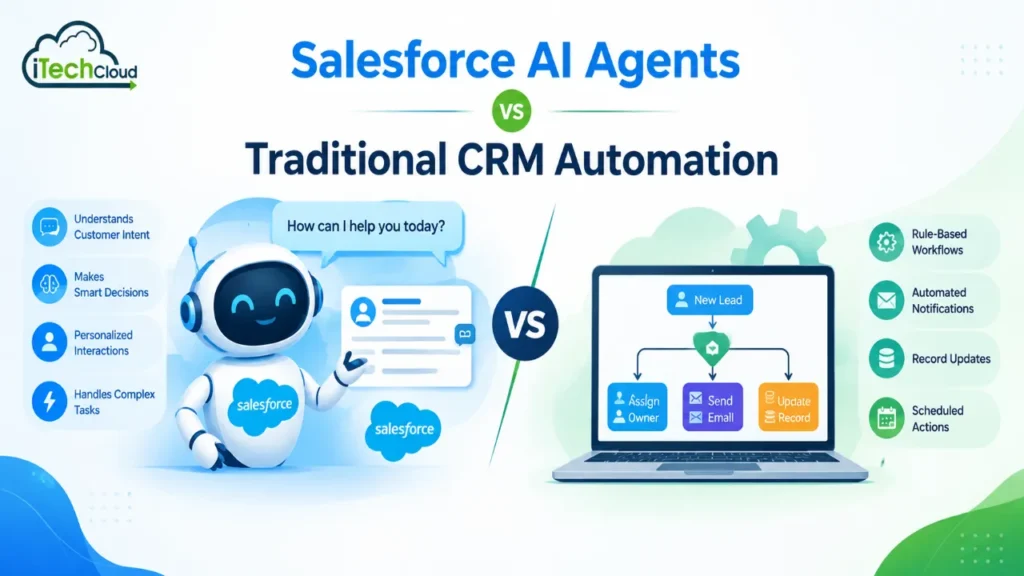
Traditional Salesforce CRM automation uses predefined rules, triggers, and workflows to complete repetitive business tasks. Salesforce Flow, Apex, and scheduled automation can execute actions when specific conditions are met.
For example, when a new lead enters Salesforce, an automated flow can assign it to a sales representative based on location, industry, or lead score. The system follows the configured conditions and performs the appropriate action.
Key features of traditional CRM automation include:
Rule-based workflows and record-triggered actions.
Automated lead assignment and follow-up task creation.
Email notifications and approval processes.
Scheduled record updates and data validation.
Consistent execution of predefined business processes.
Traditional automation works particularly well when business requirements are clear and the expected outcome is predictable.
What Are Salesforce AI Agents?
Salesforce AI agents are AI-powered assistants that can interpret requests, use relevant business data, determine appropriate actions, and complete tasks within configured permissions and guardrails.
Salesforce Agentforce enables organizations to build agents for customer service, sales support, lead engagement, and other business processes. These agents can work with Salesforce data and available actions to respond to customer questions or support employees.
For example, an AI agent can receive a customer inquiry about an order, identify the customer’s intent, retrieve relevant information, and provide an appropriate response. If the issue requires human judgment or falls outside the agent’s permissions, it can escalate the request to a support representative.
Key features of Salesforce AI agents include:
Natural-language understanding and contextual responses.
AI-assisted decision-making and multistep task execution.
Personalized customer interactions using relevant business data.
Support for tasks across sales and customer service.
Human escalation and configured safety controls.
The primary difference is that traditional automation follows predefined paths, while AI agents can use reasoning to determine the next appropriate step for a task.
Salesforce AI Agents vs Traditional CRM Automation: Key Differences
Both approaches are valuable. The right choice depends on process complexity, data quality, reliability requirements, and the level of decision-making required.
Benefits of Salesforce AI Agents
1. More Personalized Customer Experiences
AI agents can use relevant customer information, previous interactions, and business context to provide more useful responses. Instead of relying entirely on generic scripts, they can tailor answers to the customer’s request.
For example, a service agent can help a customer understand a product issue using available knowledge and account information.
2. Reduced Manual Work
Sales teams frequently spend time researching prospects, preparing follow-up messages, and updating CRM records. AI agents can assist with these tasks and, where authorized, execute actions automatically.
This gives sales representatives more time to focus on customer relationships, negotiations, and closing deals.
3. Support Beyond Business Hours
AI agents can be configured to respond to eligible customer inquiries outside normal working hours. They can answer common questions, collect relevant details, and route complex cases to the appropriate team.
This helps businesses maintain service availability without requiring employees to handle every initial interaction.
4. Better Handling of Complex Requests
Traditional automation can struggle when a request does not match its predefined conditions. AI agents can interpret the request, evaluate available information, and select from permitted actions.
However, complex or high-risk decisions should still include appropriate validation and human oversight.
Benefits of Traditional CRM Automation
Traditional automation remains essential for many Salesforce implementations.
Predictable execution: Flows and Apex can follow clearly defined business rules, making them suitable for processes that require consistent outcomes.
Faster processing: Simple record-triggered actions can execute without the additional reasoning required by AI agents.
Easier auditing: Configured logic makes it easier to trace why a particular action occurred and verify whether business rules were followed.
Cost control: For high-volume, repetitive tasks, traditional automation may be more economical than introducing AI reasoning.
For example, automatically updating a lead status when a specific field changes usually does not require an AI agent.
Practical Salesforce Use Cases
Sales and Lead Management
Traditional automation can assign leads based on territory, create follow-up tasks, and send notifications when opportunities change stages.
An AI agent can support prospect research, answer initial prospect questions, help qualify leads using available information, and assist with follow-up conversations.
Customer Service
Traditional automation can route cases according to product category, priority, or customer type.
An AI agent can interpret a customer’s message, retrieve relevant knowledge, suggest troubleshooting steps, and resolve eligible requests or escalate them to a human representative.
Marketing and Customer Engagement
Traditional automation can trigger email campaigns when customers meet predefined criteria.
AI agents can support more contextual engagement by interpreting customer responses, answering questions, and assisting with appropriate next steps within approved communication rules.
Data Management
Traditional automation is suitable for validating fields, enforcing data requirements, and updating related records. AI can help summarize unstructured notes, classify case descriptions, or extract useful information from customer communications.
Can Salesforce AI Agents and Traditional Automation Work Together?
Yes. A hybrid approach is often the most practical solution.
Salesforce Flow and Apex can manage predictable operations, while Agentforce can handle tasks that require contextual understanding or reasoning. For example, an AI agent could interpret a customer request and identify the appropriate resolution. A Flow could then validate required fields, apply business rules, update the case, and trigger the next approved action.
This approach combines the flexibility of AI with the consistency of traditional automation.
Businesses should also establish access permissions, data protection controls, testing procedures, monitoring, and human approval for sensitive actions before deploying agents.
How to Choose the Right Salesforce Automation Approach
Choose traditional CRM automation when the process has clear conditions, predictable outcomes, and strict execution requirements.
Choose Salesforce AI agents when the task involves natural-language requests, variable customer situations, contextual interpretation, or multistep decisions that cannot be fully defined in advance.
Choose a hybrid approach when a process requires both AI reasoning and reliable execution of business rules.
Before implementation, evaluate the business objective, data quality, integration requirements, operating costs, security, and expected return on investment. Start with a clearly defined use case and measure improvements in resolution time, employee productivity, customer satisfaction, and operational accuracy.
Conclusion
Salesforce AI agents and traditional CRM automation serve different but complementary purposes. Traditional automation remains effective for predictable workflows, record updates, approvals, and rule-based processes. Salesforce AI agents introduce greater flexibility by interpreting customer intent, using business context, and handling eligible tasks with less manual intervention.
For most organizations, the best strategy is not to replace every existing workflow with AI. It is to identify where reasoning creates genuine business value and combine it with reliable Salesforce automation.
With the right implementation strategy, businesses can improve CRM efficiency, deliver more personalized customer experiences, and build scalable workflows that support long-term growth.
Founder and CEO of iTechCloud Solution, a Salesforce consulting and product partner since 2017. He sets engagement strategy and stays the commercial owner of every account, working with clients across Salesforce, AI and data from the first call through to go-live.
Connect on LinkedIn