
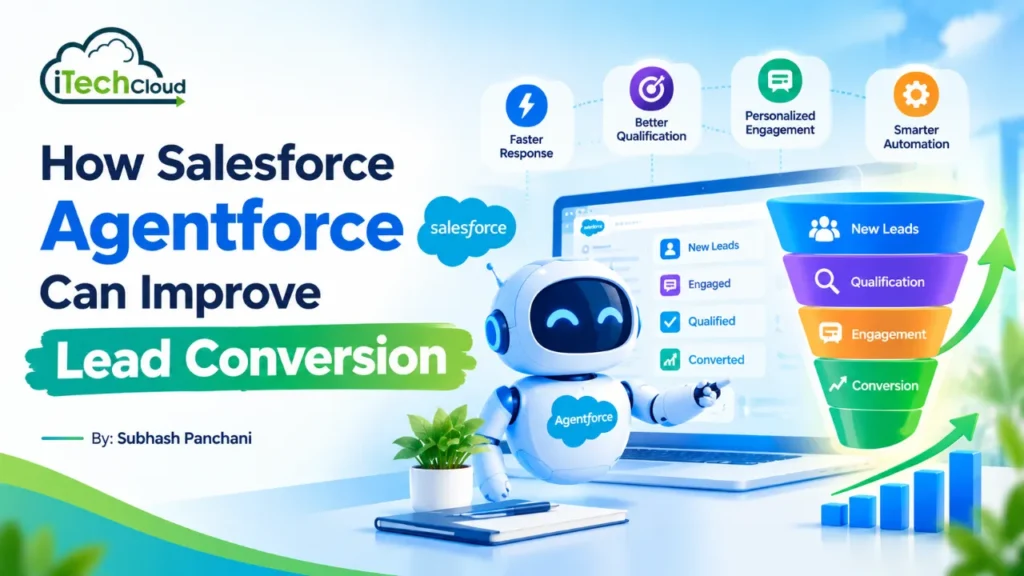
Instead of relying entirely on manual work, companies can use Agentforce to engage prospects, answer questions, identify potential opportunities, and support sales representatives throughout the conversion journey. When implemented with the right sales strategy, it can help businesses respond faster, improve lead qualification, and create a smoother path from initial inquiry to closed deal.
1. Respond to New Leads Without Unnecessary Delays
When a prospect submits a contact form, requests a product demo, or asks about a service, the speed of the first response can influence their buying decision. If a company takes several hours to respond, the prospect may already be speaking with a competitor.
Salesforce Agentforce can support faster lead engagement by using AI agents to interact with prospects, answer common questions, and guide them toward the next step. Depending on the configuration, an agent can use available CRM information and approved business knowledge to provide relevant responses.
For example, a Salesforce consulting company receiving an implementation inquiry can use an AI agent to explain its services, collect initial project requirements, and help the prospect request a consultation.
Business impact: Faster engagement reduces unnecessary waiting and gives sales teams a better opportunity to connect with interested prospects while their intent is still strong.
2. Qualify Leads Based on Actual Buying Intent
Not every lead has the same potential to become a customer. Some prospects are researching solutions, while others have an immediate business requirement and a defined budget.
Agentforce can help collect qualification details through conversations and use configured business rules, CRM records, and available context to support lead assessment. Relevant questions might cover the prospect’s business challenge, company size, required services, expected timeline, and current technology.
Consider a business receiving 100 inquiries for Salesforce development services. Instead of asking a sales representative to manually review every inquiry, an AI agent could collect the required information and identify prospects who meet predefined qualification criteria.
The sales team can then prioritize leads that demonstrate stronger buying intent while routing other prospects into suitable follow-up processes.
Business impact: Better qualification helps sales representatives spend more time on relevant opportunities instead of treating every inquiry equally.
3. Personalize Conversations Using CRM Context
Generic sales messages rarely address the specific concerns that influence a customer’s decision. Prospects expect businesses to understand their requirements rather than send the same response to everyone.
Agentforce can use relevant, authorized Salesforce CRM data and connected business information to support more contextual conversations. Depending on the implementation, this may include previous interactions, existing customer records, product interests, service inquiries, or details collected during earlier conversations.
For instance, a prospect who previously requested information about Salesforce integration may need a different response from someone looking for a complete Salesforce implementation.
An AI agent can use that context to provide more relevant information, answer appropriate questions, and recommend a suitable next action.
Personalization must still follow data-access permissions, privacy requirements, and the company’s communication policies.
Business impact: Relevant conversations can help prospects understand how a service addresses their specific challenges, making it easier for them to move forward.
4. Reduce Lead Drop-Off With Consistent Follow-Ups
Many leads are lost not because prospects lack interest, but because follow-ups are delayed or forgotten. Sales representatives manage multiple opportunities simultaneously, making consistent communication difficult.
Agentforce can support follow-up workflows by helping identify the next appropriate action, preparing contextual messages, or initiating approved actions through configured Salesforce automation. For example, a prospect who requests a proposal but does not respond afterward may be eligible for a reminder based on the company’s follow-up rules.
Businesses can also combine Agentforce with Salesforce Flow and other automation tools to manage tasks, reminders, lead assignments, and follow-up schedules.
However, the exact level of automation depends on the agent’s permissions, integrations, and configured workflows. Follow-ups should respect customer preferences and applicable communication regulations.
Business impact: A more consistent follow-up process reduces the risk of overlooking promising opportunities and helps maintain engagement throughout the sales cycle.
5. Help Prospects Overcome Sales Objections
Potential customers often hesitate before making a purchase. Common concerns include pricing, implementation time, technical compatibility, expected return on investment, and the complexity of changing existing systems.
Agentforce can help address routine questions using approved product documentation, service information, and configured knowledge sources. When a prospect asks whether a Salesforce solution can integrate with an existing business application, an agent can provide relevant information when that information is available.
For complex pricing discussions, custom requirements, or objections requiring commercial judgment, the agent can route the conversation to a sales representative.
This approach allows businesses to resolve straightforward concerns quickly without forcing every prospect to wait for human assistance.
Business impact: Timely answers can reduce friction in the buying journey and help qualified prospects take the next step with greater confidence.
6. Connect Lead Conversations With Salesforce Sales Workflows
Lead conversion becomes difficult when customer conversations, CRM records, and sales activities are disconnected.
Agentforce can work within a configured Salesforce environment to support actions such as updating relevant records, retrieving customer context, creating tasks, or routing inquiries. These capabilities depend on the agent’s instructions, available actions, permissions, and integrations.
For example, after collecting project requirements from a prospect, an agent could help create a structured summary for the assigned sales representative. The representative can review the requirements, confirm the opportunity details, and arrange a discovery call.
Connecting conversations with CRM workflows reduces repetitive data entry and gives sales teams a clearer view of what happened before they contacted the prospect.
Business impact: Better-connected sales processes help teams act on lead information more efficiently and reduce avoidable delays between inquiry and sales engagement.
7. Measure Which Agentforce Activities Improve Conversion
Implementing AI agents does not automatically guarantee higher conversion rates. Businesses need to measure whether the implementation improves their actual sales outcomes.
Salesforce reporting and analytics can help teams compare performance before and after introducing Agentforce. Useful metrics include:
Lead-to-opportunity conversion rate
Opportunity-to-customer conversion rate
Average first-response time
Percentage of qualified leads contacted
Follow-up completion rate
Sales cycle length
Cost per qualified lead and cost per acquisition
For example, a company might discover that response times have improved but qualified leads are not converting into opportunities. This suggests that the team should investigate qualification criteria, messaging quality, service positioning, or the handoff between AI agents and sales representatives.
Tracking these metrics helps businesses identify where Agentforce delivers measurable value and where additional improvements are needed.
Practical Implementation: Turning More Salesforce Leads Into Customers
To achieve meaningful results, businesses should start with one clearly defined conversion problem rather than automate the entire sales process immediately.
A practical implementation approach includes:
Identify the biggest bottleneck: Determine whether leads are being lost because of slow responses, weak qualification, inconsistent follow-ups, or poor sales handoffs.
Configure the agent: Define its role, approved knowledge sources, permitted actions, qualification questions, and escalation rules.
Connect relevant CRM workflows: Use appropriate Salesforce records, Flow automation, and integrations to support the required process.
Test real sales scenarios: Validate responses, record updates, permissions, and human handoffs before expanding access.
Measure conversion performance: Compare the selected KPIs against a reliable baseline and refine the implementation using actual results.
Human oversight remains important, especially when conversations involve complex requirements, sensitive information, pricing commitments, or high-value opportunities.
Final Thoughts: Salesforce Agentforce Can Improve Lead
Salesforce Agentforce can improve lead conversion by helping businesses engage prospects faster, qualify inquiries more effectively, personalize conversations, maintain consistent follow-ups, and connect customer interactions with Salesforce sales workflows.
The biggest opportunity is not simply automating conversations. It is removing the obstacles that prevent qualified leads from becoming customers.
For businesses already using Salesforce, the right Agentforce implementation can make lead management more responsive and organized while allowing sales representatives to focus on relationship building and closing deals. Results will depend on data quality, workflow design, agent configuration, and how effectively AI-driven activities work alongside the sales team.
Looking to improve your Salesforce lead conversion process? iTechCloud Solution can help your business evaluate Salesforce automation opportunities, optimize lead management workflows, and explore Agentforce implementation based on your sales objectives. A focused assessment can identify where AI agents may reduce friction and create a more efficient path from lead generation to revenue.
Founder and CEO of iTechCloud Solution, a Salesforce consulting and product partner since 2017. He sets engagement strategy and stays the commercial owner of every account, working with clients across Salesforce, AI and data from the first call through to go-live.
Connect on LinkedIn