

n8n vs IFTTT: Which is More Powerful in 2026?
Introduction: n8n vs IFTTT
As workflow automation continues to evolve rapidly in 2026, businesses, developers, and tech-savvy users are demanding more flexible, scalable, and customisable automation platforms. Among the leading players in this space, n8n and IFTTT stand out as two of the most widely used tools, but they serve very different needs. While IFTTT remains popular among casual users for its simplicity, n8n has rapidly grown into a powerful open-source automation powerhouse, attracting developers and enterprises needing advanced logic and full control over their workflows.
We break down the core differences in n8n vs IFTTT, evaluate their workflow automation capabilities, explore IFTTT alternatives for advanced automation, and highlight the top n8n automation platform features in 2026. This will help you understand which platform truly stands out in 2026.
Table of Contents
1. Overview: What Makes n8n and IFTTT Different?
IFTTT (If This Then That)
Launched in 2011, IFTTT revolutionised simple automation by allowing end-users to create “applets” connecting apps like Gmail, Instagram, smart home devices, and productivity tools. Its strength lies in simplicity, speed, and broad consumer integrations.
However, its limitations include:
- No advanced branching logic
- Limited customization
- Restricted data manipulation
- Mostly consumer-focused
- Many integrations locked behind subscription plans
In 2026, IFTTT remains ideal for quick personal automation but lacks the depth needed for business-level automation.
n8n (pronounced “n-eight-n”)
n8n later emerged as a developer-friendly, open-source workflow automation platform. It allows users to build sophisticated workflows using:
- conditional logic
- loops
- code nodes
- API integrations
- custom nodes
Unlike IFTTT, n8n can be self-hosted, giving full control over data, customisation, and scalability. By 2026, n8n has become a preferred tool for businesses and automation engineers seeking no-code/low-code workflows with enterprise reliability.
2. n8n vs IFTTT Workflow Automation: How They Compare in 2026
When comparing n8n vs IFTTT workflow automation, the real difference lies in power, flexibility, and the level of control offered.
2.1 Ease of Use
- IFTTT: Extremely beginner-friendly. A single trigger and a single action, simple and fast.
- n8n: Easy for beginners but designed for advanced users. Drag-and-drop editor with more complexity.
Verdict:
IFTTT wins for consumer simplicity; n8n wins for professional use without sacrificing usability.
2.2 Workflow Complexity
- IFTTT:
- Single trigger → single action
- No loops, no custom code
- Ideal for uncomplicated routines
- n8n:
- Multi-step workflows
- Branching, looping, event handling
- Supports complex enterprise-grade automation
Verdict:
n8n dominates in complex workflow orchestration.
2.3 Integrations & API Support
- IFTTT:
- Large library of consumer app integrations
- But many are limited, paid, or restricted
- n8n:
- 500+ prebuilt nodes
- Supports any API with HTTP requests
- Custom integrations possible
- Ideal for cloud apps, databases, CRMs, and ERP systems
Verdict:
n8n wins for API-based automations and advanced integrations.
2.4 Cost & Value
- IFTTT:
- Free version very limited
- Pro plan required for more than a few applets
- n8n:
- Open-source and free
- Self-hosting saves cost
- Cloud version available for scaling
Verdict:
n8n offers far better value, especially for businesses.
2.5 Data Privacy & Control
- IFTTT: Runs on centralized cloud servers → limited data control
- n8n: Self-hosting = full privacy + enterprise control
Verdict:
n8n is the clear winner for companies that prioritise compliance and security.
2.6 Performance & Scalability
- IFTTT: Suitable for small personal tasks
- n8n: Built for large-scale automation, workflow orchestration, databases, and multi-system integration
Winner: n8n
3. IFTTT Alternatives for Advanced Automation
If you’re outgrowing IFTTT, you are not alone. Many users in 2026 are shifting toward more capable automation platforms. Popular IFTTT alternatives for advanced automation include:
3.1 n8n (Top Alternative)
The most recommended IFTTT alternative due to the following:
- rich automation logic
- self-hosting
- open-source capabilities
- enterprise-grade workflows
3.2 Zapier
- More powerful than IFTTT
- Ideal for business automation
- But lacks open-source flexibility
3.3 Make (formerly Integromat)
- Visual automation with scenario-based logic
- Excellent for complex business flows
- Not self-hosted
3.4 Node-RED
- Open-source like n8n
- Requires more technical expertise
- Best for IoT automation
Compared to these, n8n strikes the perfect balance between power, visual simplicity, and open-source flexibility, making it the strongest IFTTT alternative in 2026.
4. n8n Automation Platform Features 2026: What’s New & Powerful?
By 2026, n8n has matured significantly, offering features that outshine traditional automation tools:
4.1 AI-Integrated Automation
n8n now
- Offers built-in AI nodes
- Connects to OpenAI, Anthropic, Amazon Bedrock, and custom LLMs
- Automates text generation, data classification, sentiment analysis
AI-driven automation has become a core capability in 2026.
4.2 Reusable Workflow Templates
n8n provides advanced templates for the following:
- CRM automation
- Marketing automation
- Data syncing
- Lead scoring
- File processing
- Social media workflows
Teams can now share, reuse, and customise workflows effortlessly.
4.3 Visual Data Transformation
The new data mapper (2025–2026 enhancements) allows users to do the following:
- transform data visually
- reduce code-heavy tasks
- process JSON, CSV, Webhooks
4.4 Enterprise-Ready Scaling
In 2026, n8n supports the following:
- multi-node execution
- advanced load balancing
- workflow versioning
- audit logs
- role-based access control (RBAC)
This positions n8n as a direct competitor to enterprise tools like MuleSoft or Workato.
4.5 Built-in Observability
New monitoring dashboards help teams track:
- workflow performance
- error rates
- execution times
- automation uptime
4.6 Unlimited Customization
Because n8n is open-source, developers can:
- build custom nodes
- extend platform capabilities
- integrate proprietary systems
- deploy on any infrastructure
This makes n8n much more adaptable than IFTTT.
5. Practical Use Cases in 2026: n8n vs IFTTT
IFTTT Use Cases
Best for:
- Turning on smart home devices
- Auto-posting simple social media updates
- Syncing basic reminders
- Personal productivity triggers
n8n Use Cases
Best for:
- Multi-step sales workflows
- CRM + ERP integration
- AI-assisted content automation
- ETL-style data processing
- Finance and accounting automation
- IT operations automation
- Customer support workflow orchestration
In other words, IFTTT = personal convenience, while n8n = business automation powerhouse.
6. Which Is More Powerful in 2026? Final Summary
In the battle of n8n vs IFTTT, the winner is clear for 2026:
Overall Winner: n8n
Why?
- Open-source power
- Full scalability
- Advanced workflow logic
- API flexibility
- Strong AI integrations
- Self-hosted security
- Cost-effective for teams
Where IFTTT Still Wins
- Simplicity
- Consumer automation
- Quick setup
- Large smart-home ecosystem
Who Should Use What?
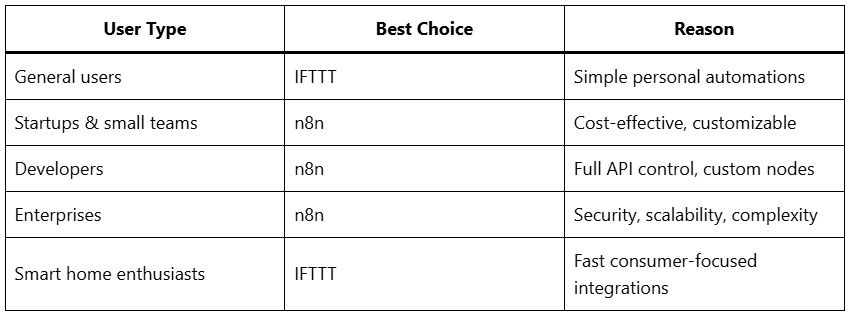
Key Takeaway:
As automation becomes central to digital transformation in 2026, choosing the right platform depends on your needs. If you want quick, no-hassle consumer automation, IFTTT is still an excellent option. But if you’re looking for a powerful, scalable, flexible, and future-proof automation system, n8n is the superior choice by a wide margin. Its open-source foundation, AI capabilities, powerful visual builder, and enterprise scalability make it the most advanced workflow automation platform of 2026.