
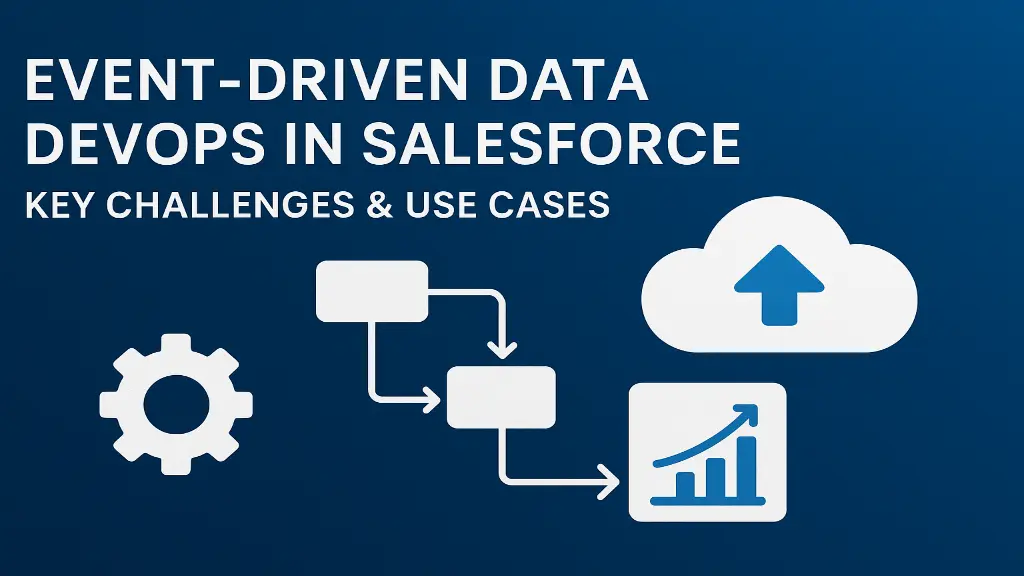
In the Salesforce ecosystem, the practice of good matures around metadata (code, configuration, UI, and declarative definitions). But a difficult area operates data changes (e.g., reference or configuration data, main data, CPQ price determination, and lookup entries) in strong, automatic, and detected ways. Often, teams return to spreadsheets, data loaders, or manual scripts, making deployment brittle, error-prone, and inconsistent in the whole environment.
Event-run information gods are an approach that considers data changes as first-class citizens in your CI/CD/deployment pipelines, closely connecting them with metadata changes. Instead of treating data migration as a different idea, you combine data changes to triggers or events (for example, cumin tickets are “ready to deploy” to synchronise both metadata and data).
In this blog, we find out what this approach means in Salesforce, examine key challenges, and share real use cases where event-powered data DevOps unlock the actual benefits.
Table of Contents
What Is Event-Driven Data DevOps in Salesforce?Why It Matters: Benefits & MotivationsKey Challenges in Event-Driven Data DevOps (especially in Salesforce)Use Cases & Real-World ExamplesBest Practices & Guiding PrinciplesRisks, Tradeoffs & What to Watch Out ForArchitectural Patterns & Reference ToolsHow to Start / Adoption RoadmapKey Takeaway:
What Is Event-Driven Data DevOps in Salesforce?
At its root, event-driven data DevOps is an automation status that includes a change in position or triggers (events) that drive deployment pipelines that include data operations with metadata (insert, update, upsert, and delete). The pipeline is reactive: when an upstream event (e.g., story status, branching merge, or “Ready-for-Release” flag) occurs, the CI/CD pipeline automatically deploys both metadata and data changes.
Key components often include the following:
Eventing Mechanism/Webhook listener (from Cumin, Azure Board, Git, or change management system)
One level to convert an event into efficient tasks (middleware, microservices, or orchestrator) (Call E.G. API, Prepare Data Payload)
Version data samples, or “data scripts”, that are operated with metadata (in git or in data-a-code format)
The CI/CD engine (Copado, Georset, Jenkins SFDX, AutoBit, etc.) supports the implementation of data operations (such as upserts and data loading) via API.
The doors of the rule of approval (human or automatic) are embedded in the flow of phenomena.
Effectively, the system ensures that once the event indicates that “this change is ready”, the pipeline does all components (metadata, configuration data, and master data) one with integrated pressure, logging, rollback, and traceback.
This approach is unlike a traditional model where metadata are deployed by CI/CD, but data changes are carried out manually (spreadsheets, data loaders, or one-off ETL scripts) as a separate step.
An excellent recent article describes how a team uses Cummin, Copdo, and API audiences (using MuleSoft or custom code) to trigger data deployment (e.g., whenever the user enters the “Ready for UAT” phase, Pricebook Entries with Metadata, and CPQ Configures).
Why It Matters: Benefits & Motivations
Before we explore the challenges, it is helpful to first understand the value.
1. Reduction in human error
The manual data migration is error-prone. Missing or incorrect command context information can break the efficiency (e.g., quoting and validation rules); an automated event-powered pipeline reduces that risk.
2. Fast feedback cycle/short lead time
Because the deployment begins at the same time as the event, the downstream atmosphere (UAT, staging, etc.) quickly becomes fully prepared with the required information, allowing the test to start early.
3. Decrease in environmental quality/flow
If each environment (God, QA, UAT, and staging) gets the same data through the same pipeline, it has less deviation, or “it works in the UAT, but the data disappears due to missing” issues.
4. Traceability and Auditability
When a version of data changes, is triggered, and is audited and can be traced back to tickets/committees/user stories, you obtain regime control, compliance, and transparency.
5. Baptism and repetition
Once the patterns and structures are created, new data transformation types can be added with less manual effort. Over time the system becomes more scalable and stronger.
6. Aligned with DevOps principles
Counting data as a code, version, automated, observable-automation, tracebook, and constant integration fits the mindset of the gods of all changes counted as codes.
Because of these benefits, teams often regard deployment days (which are traditionally risky, manual, and stressful) as becoming “boring”, in the best sense of the word.
Key Challenges in Event-Driven Data DevOps (especially in Salesforce)
While the idea is compelling, implementing it in the Salesforce context brings unique challenges and tradeoffs. Below are the major challenges you should plan for:
1. Representing and Versioning Data as Code
Metadata (Apex, custom objects, flow, etc.) is originally version-controlled; no information. Determining data changes (YAML/JSON samples; SQL, such as scripts; CSVs; or custom DSL) is non-trivial to determine how to represent.
Make sure the data scripts are idempotent (safe to operate multiple times); base rollbacks; and conditional logic handle it (e.g., if missed, it is difficult).
Depending on the migration, it may require commands (loading parent records first, then children), and complex relationships (lookups and junction objects) become complicated.
The merge of data ferries from different developers (both adding or replacing seed records) can lead to conflicts or duplicate logic that is difficult to compromise.
2. API & Data Volume Constraints, Governance
Salesforce APIs have limitations (bulk limitations, rate limitations, batch size limitations). Careful batching, returning logic, and backoffs require backoff to load large data by API in the context of CI/CD.
Some atmospheres (e.g., sandbox) may have data volume or storage limits; large data pressure may be slow or fail.
Data loading operations can also struggle with locks, distribution rules, or triggers, which hinder performance or inhibit execution.
You must ensure that data operations respect the security, sharing, and field-level permissions.
3. Decoupling and Event Ordering / Consistency
In event-run systems, sequences and relevance become a matter of concern. If the metadata update is deployed before the required reference data is present, it can cause errors.
Data dependence in items must be controlled, dance direction or orchestration may be required to ensure the right order.
If the parts of the pipeline fail in the middle flow, you need to define the compensation logic (rollback or compensation actions).
Because events are asynchronous, methods for returning the system, deodion, and dead-letter handling may require additional methods.
4. Visibility, Monitoring, and Error Handling
Errors in data operations (e.g., recorded failed validation) must be found in a dashboard or ticket, logged in, and brought to the surface.
You need to observe from the beginning to the end of the pipeline: what event started, what records were applied, and what steps failed.
Recovery strategies (repayment, manual correctional action, rollback, and replay) should be prepared in advance.
Because publishers usually do not know about subscriber failures, you need ways to make sure that no data is quietly lost (e.g., event replay and dead-letter queue). This is a common pattern and challenge in event-powered architecture.
5. Integration with Legacy Systems / Non-event-aware Downstream Systems
Some systems you integrate may not support the event-driven pattern, including the old database. You may need a bridge or adapter that converts events into batch or synchronous actions.
Maintain consistency in systems with different protocols (REST, SOAP, MQ, etc.). Complicates orchestration.
Heritage systems may require voting or scheduled sync, which can collide with an event-driven model.
6. Platform Limitations: Salesforce Eventing Tools & Limits
Salesforce provides event constructs (platform events, change data capture, and pub/sub API), but each has limits and trade-offs. For example, platform events have a retention window and can leave messages if not consumed on time.
High-volume platform events (HVPEs) are required for the scale, but not all use cases are eligible.
Some eventing features are new (e.g., Pub/Sub API), and migration or backward consistency is still evolving. The Salesforce Event-Driven Architecture Guide recommends using the Pub/Sub API for new pub/sub patterns instead of the old API.
Orchestration logic or event listeners (middleware or Apex) can be an issue of obstacles or failure.
Debugging and testing of phenomena-driven trends are more complex than linear deployment, the need to develop the advances and methods.
7. Environment & Sandbox Limitations, Testing Gaps
Salesforce data is noted in the context of the cloud (which is similar to data-centric capabilities in Salesforce). Sandbox is often just metadata and does not mimic data or identification resolution results, which limits the test.
It is difficult to thoroughly test the data pipeline in a non-productive environment if data volume or relationships are different from the product.
Additional efforts or custom tooling may be required to mock or imitate data events, error conditions, and failures in staging.
8. Organizational & Process Challenges
This sample requires a changing mentality: changes of information may not be “thought after” but may be part of release planning.
Teams (administrators, data engineers, and developers) should cooperate more closely on data samples, migration, and regime.
Change management, training, and documentation need to be maintained, the prevalence pipeline initially causes friction.
Rollouts in multiple teams/organisations, especially in large Salesforce ecosystems, may be slow and require pilot phases.
Use Cases & Real-World Examples
Here are several concrete use cases where event-driven data DevOps in Salesforce delivers strong value:
Use Case 1: Automating CPQ / Price Book / Configuration Data Changes
In many institutions, data (not metadata) store CPQ, cost determination, discount level, or product configurations. When a new feature or product is added, both new metadata (new custom fields, rules, or logic) and corresponding data (new product records, discount tiers, or pricebook entries) need to be united. In one case, a team created a pipeline that, when the Jira story transforms into “Ready for UAT”, turns up a set of CPQ configuration records in the target environment with metadata deployment. This ensures that the examiners always have the right data to validate.
Use Case 2: Master / Seed / Reference Data Population
A baseline “seed” dataset (e.g.) is required for many Salesforce implementations. Countries, currencies, basic modes, pick-up values, and auxiliary reference tables are included. Instead of deploying them yourself, teams can go through version-controlled samples and automatically deploy them when the atmosphere is refreshed or new features need new seed data.
Use Case 3: Onboarding / Org Initialization
Event-run pods can automatically provide major data sets while spinning up to new sandboxes or scratch ORGs (for new developers, QA, or projects). For example, after an org is made or refreshed, the event default configuration, user defaults, and sample accounts turn the pipeline to load lookup tables, which enables the ready-made positions.
Use Case 4: Cross-System Real-Time Sync / CDC
In compilation, when Salesforce data changes (say an account is updated), the event (via change data capture) can trigger a downstream data sink into the external system. On the contrary, when external systems change the main data, they can publish events in Salesforce, and the pipeline enters and applies to them. This pattern allows for real-time dual-dysfunctional coordination when it is considered as part of the gods’ plan. Salesforce’s EDA guide emphasises taking advantage of CDCs and platform events for real-time consistency.
Use Case 5: Event Monitoring + Auditing + Data Analytics
Slightly different but relevant patterns: Salesforce event monitoring (user activity logs, API calls, system events) can be exposed as an event stream in the data cloud or external systems for analysis, compliance, or alerts. For example, log events (login, export, API calls) can be published in the data cloud via the Pub/Sub API, and the DevOps pipeline can enable more consumption or conversions.
Use Case 6: Multi-Org or M&A Synchronization
Organizations with multiple Salesforce orgs (e.g., regional or after a merger) may require changes to an organisation’s configuration or reference information in the other. By issuing events, an organization may notify subscribers of another organization to apply data changes, ensuring alignment without manual coordination.
To maximise success and mitigate pitfalls, here are recommended patterns and practices:
1. Define a specified data-code model ahead.
Establish assemblies, samples, folder structures, ordering, and dependency definitions at the beginning of the idempotency semantics.
2. Modularise data changes.
Divide large data loads into modules or growth patches instead of monolithic scripts.
3. Clear sequence and dependence
Define the dependence (e.g., parent-child, lookup resolution) and apply sequencing to the pipeline.
4. Ideal capacity and safe rerun
Your data scripts should be safe to reoperate (no duplicate inserts, no conditional updates) and ideally support rollbacks or returns.
5. Strong Review/Error Management/DLQ
For transient failures (API timeouts, locks), retry the logic. For non-recovering errors, the path of dead-character queues or human intervention flows.
6. Logging, observability, and dashboard
Calculate the affected rows, mistakes, and pipeline delays, and reveal them through dashboards or logs.
7. Testing and staging atmosphere
Emulate the full round-trip event flow, including sandbox or staging failures, edge cases, excessively large payloads, and rollbacks.
8. Attractive version and roll-forward strategies
When developing data models or samples, you need version migration scripts or fallback strategies to support upgrades/reductions.
9. Rule, review, and approval
In the event-running stream, especially for the product-bound pipeline, use gating (manual approvals and peer reviews) as needed.
10. Evolution of the event version and plan
Because your events (payload shapes) can be developed, designed with versioning, backward/forward consistency, or planned migration strategies.
11. Monitor the use of quota, limitations, and resources.
Salesforce Eventing Limitations (Retention Windows, Throughput, Publish Quota), API Limitations, and Sandbox Data Limit.
12. Progressive rollout/pilot approach
Start with non-critical data sets (seed data and reference data) and gradually expand into cases of more complex data use.
While powerful, the event-driven data DevOps model is not free of tradeoffs. Here are risks and pitfalls:
Critical Overhead: System architecture (event listeners, middleware, orchestration, and retries) adds a burden of complexity and maintenance.
Debugging Difficulty: Finding failures by asynchronous chains (occurrence → pipeline → data operation) is more difficult than linear deployment.
Time issues: Because events are inconsistent, race conditions or order problems can come to the surface in edge cases.
Silent Failures/Data Loss: If there are subscribers or pipelines down or network splits, events can be left or applied unless elastic design is present (e.g., durable queues or replay).
Overloading of event buses: Many events or shootings at improper granularity can sink infrastructure. A consolidation or filtration may be required.
Limitations of measurement: As the amount of information or incidence of events increases, pipelines must control back pressure, batching, and horizontal scaling.
Adoption Resistance: Teams used for manual or ad hoc data processes can resist changing their workflow.
Partial deployment/Data drift: If some data fails when the metadata is successful, you can come to an inconsistent state; rollback or return becomes crucial.
When building such a system, these architectural patterns and Salesforce-native tools are often leveraged:
1. Publisher/Subscriber (Pub/Sub) Pattern
Use Salesforce platform events, change data capture (CDCs), or the new Pub/Sub API for eventing. Salesforce event guidance recommends Pub/Sub API for new patterns.
2. Orchestration/Saga/Choreography
Use orchestrator services or saga patterns to manage multi-step-full processes (e.g., “After deploying metadata, load seed information, then validate”). Return logic is part of the Saga design.
3. Middleware/coordination level
Lightweight microservices or middleware (e.g., MuleSoft, ACS Lambda, Azure Functions, etc.) that listen to events on the CI/CD pipeline or organise data operations.
4. Ideal data scripts
Text or samples are prepared in such a way that the upstart logic, merge key, or conditional investigation is prepared in such a way that repeated execution is not harmful.
5. Try the dead-letter methods again.
If data operations fail, place failed tasks in a dead-letter queue, a queue in the log context, and allow manual or automatic retries.
6. Event version and plan registry
Maintain the definitions of the event payload schema, create a version of it, and ensure the customer’s backward consistency.
7. Monitoring and Observability Stack
Centralised logs, dashboards, and warning systems to track event letters, error rates, and pipeline health.
8. CI/CD Tooling Support for Data Operations
Use or expand your existing CI/CD tools (Copado, Gearset, Jenkins, SFDX) to support data loading steps (using, e.g., SFDX information commands, bulk API calls, or custom scripts) and provide Copado data deployment capabilities.
9. Environment Bootstrapping Pipelines
Automatically automate the new org setup (sandbox, scratch, and trial orgs) by launching an org.
Additionally, Salesforce’s Event-Driven Architecture Decision Guide provides good guidance on when to use event-driven patterns vs synchronous ones and tool recommendations.
If your organization wants to adopt this pattern, here’s a pragmatic approach:
1. Evaluation and Pilot Planning
Select a non-critical area (e.g., seed information or reference tables) as a pilot. Evaluate eventing capabilities in your organization and ecosystem.
2. Define the data samples and version plan.
Choose how you represent data changes; select folder structures, idempotency constructions, orders, and dependencies.
3. Make a lightweight program listener/orchestrator.
For example, listen to cumin or Git events and convert them to pipeline triggers.
4. Expand your CI/CD pipeline to handle data.
Add steps to run data operations (e.g., bulk upstart scripts and SFDX commands) to achieve success/failure.
5. Present the operation of the observation and error
Log in at each step; create a dashboard; and try again/return logic and dead-letter handling.
6. Run the pilot.
Verify from the end of the flow to the end (change request → occurrence → metadata and data deploy → verification) and hold lessons and failures.
7. Repeat and expand.
Gradually more data onboard designs, schema evolution, performing tuning on more data domains (CPQ, master data, and cross-ARG sink), schema evolution, and performance tuning.
8. Rule and documentation
Define review doors, approval processes, standard management processes (SOPs), training, and knowledge sharing.
9. Measure ROI/results.
Track matrices such as deployment lead time, error rate, rollback frequency, reduction in manual measures, environment drift, etc.
10. Measurement and maintenance
As volume and complexity increase, revisit the architecture (e.g., horizontal scaling, partitioning event flow, and queue level).
DevOps in Salesforce is an amazing example of the deployment of metadata and is often overlooked, but the long-lasting distance between the critical areas of data changes. By calling data a code, by building deployment at events, and by automating end-to-end flow, teams can reduce errors, increase release velocity, maintain environmental relevance, and strengthen the regime.
However, this route is not without challenges: representing data versioning, handling API obstacles, ranking dependence, handling strong errors, handling eventing limitations in Salesforce, and institutional inertia must be handled. Strategy requires architectural discipline, supervision, and maturity.
In view of the ongoing investment of Salesforce in eventing (e.g., Sub API and improved event structure) and Salesforce ecosystems (multi-ARG, data cloud, CPQ, and AI use cases), it will only push towards event-run data centricity.
Part of the team turning Salesforce and AI strategy into shipped, measurable outcomes for enterprises across five regions.