
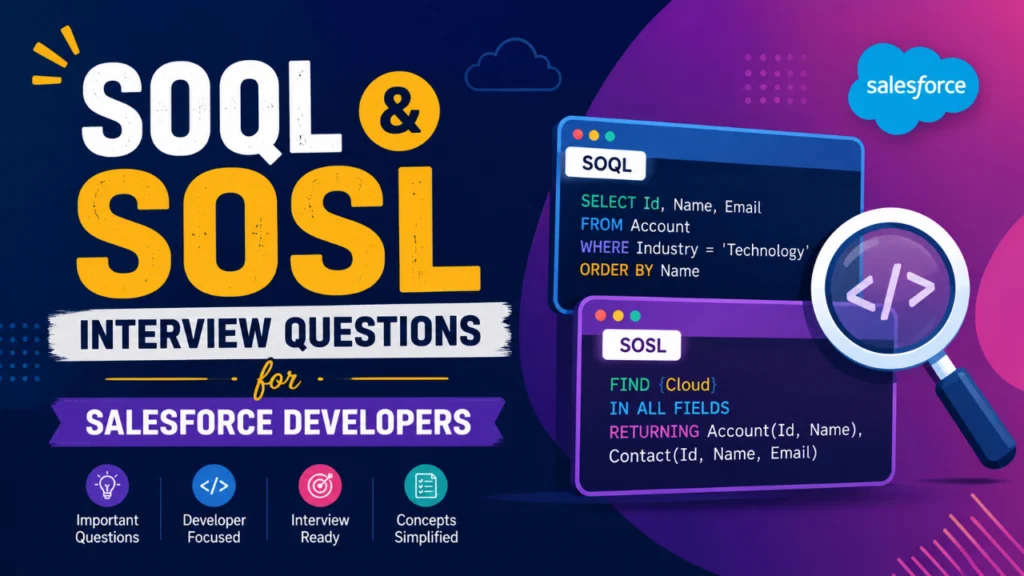
Below is a comprehensive collection of Salesforce SOQL and SOSL interview questions categorized into Easy, Medium, and Pro levels. These questions can be used for interview preparation, team training, certification study, or technical assessments.
Table of Contents
Easy Level SOQL and SOSL Interview QuestionsBasic SOQL Questions
Relationship Query Questions
Basic SOSL Questions
Medium Level SOQL and SOSL Interview QuestionsIntermediate SOQL Questions
Query Optimization Questions
Relationship Query Questions
Dynamic SOQL Questions
SOSL Scenario Questions
Pro Level SOQL and SOSL Interview QuestionsAdvanced Query Performance Questions
Advanced Relationship Query Questions
Dynamic SOQL Security Questions
Batch Apex and SOQL Questions
Pro Scenario-Based SOQL Interview QuestionsScenario 1: Large Data Volume
Scenario 2: Governor Limit Issue
Scenario 3: Dynamic Search Application
Scenario 4: Security Review
Scenario 5: Reporting Optimization
Scenario 6: Parent-Child Data Retrieval
Scenario 7: Real-Time Search
Scenario 8: Batch Processing
Scenario 9: Data Migration
Scenario 10: Enterprise Salesforce Architecture
Expert-Level Rapid Fire Questions
Conclusion
Easy Level SOQL and SOSL Interview Questions
Basic SOQL Questions
What is SOQL in Salesforce?
How is SOQL different from SQL?
What are the main components of a SOQL query?
How do you retrieve all fields from an object in SOQL?
How do you query records from the Account object?
What is the purpose of the WHERE clause in SOQL?
How do you sort records using ORDER BY?
What is the difference between ASC and DESC?
How can you limit the number of records returned?
What is the use of the LIMIT keyword?
What does OFFSET do in SOQL?
How can you retrieve records created today?
How do you query records based on CreatedDate?
What are date literals in SOQL?
What is the difference between TODAY and YESTERDAY date literals?
How do you filter records using multiple conditions?
What is the difference between AND and OR operators?
How do you use the IN operator in SOQL?
What is the NOT IN operator used for?
How do you query records with NULL values?
How do you retrieve records that are not NULL?
What is a selective query?
What is a governor limit?
Why should developers avoid SOQL inside loops?
What is the maximum number of SOQL queries allowed per transaction?
Relationship Query Questions
What are parent-to-child relationships in Salesforce?
What are child-to-parent relationships?
How do you retrieve parent records from a child object?
How do you retrieve child records from a parent object?
What is the role of relationship names in SOQL?
How do you query Contact records along with Account details?
What is the difference between standard and custom relationship names?
How do custom object relationship names end?
Can you traverse multiple relationships in SOQL?
What are the limitations of relationship queries?
Basic SOSL Questions
What is SOSL in Salesforce?
How is SOSL different from SOQL?
When should you use SOSL instead of SOQL?
What is the FIND keyword in SOSL?
What is the RETURNING clause?
Can SOSL search multiple objects simultaneously?
Which fields are searched by default in SOSL?
How do you search for a specific keyword?
What is wildcard searching in SOSL?
What are the limitations of SOSL searches?
Medium Level SOQL and SOSL Interview Questions
Intermediate SOQL Questions
What are aggregate functions in SOQL?
What is COUNT() in SOQL?
What is COUNT(Id)?
What is SUM() used for?
How does AVG() work?
What is MIN() and MAX()?
What is the GROUP BY clause?
How do you use HAVING in SOQL?
What is the difference between GROUP BY and ORDER BY?
What is a roll-up summary field and how does it compare to aggregate queries?
Query Optimization Questions
What is a selective query in Salesforce?
How can query selectivity impact performance?
What is the Query Plan Tool?
How do indexes improve SOQL performance?
Which standard fields are indexed by default?
What custom fields can be indexed?
What happens when a query becomes non-selective?
How do you optimize large data volume queries?
What is skinny table optimization?
How do you avoid full table scans?
Relationship Query Questions
Explain child-to-parent relationship queries.
Explain parent-to-child relationship queries.
How many levels up can you traverse in child-to-parent relationships?
How many levels down can you traverse in parent-to-child relationships?
What is a semi-join query?
What is an anti-join query?
How do you use nested queries?
Can aggregate functions be used with relationship queries?
What are the limitations of nested SOQL queries?
How do you retrieve Accounts without Contacts?
Dynamic SOQL Questions
What is Dynamic SOQL?
How is Dynamic SOQL different from Static SOQL?
When should Dynamic SOQL be used?
How do you execute Dynamic SOQL in Apex?
What are the risks of Dynamic SOQL?
How can SOQL injection occur?
How do you prevent SOQL injection?
What is String.escapeSingleQuotes()?
What are bind variables?
Why are bind variables preferred?
SOSL Scenario Questions
How does SOSL search across multiple objects?
What is the difference between ALL FIELDS and NAME FIELDS?
How does fuzzy search work in SOSL?
Can SOSL search attachments?
What is the maximum number of objects searchable in SOSL?
What is the maximum number of records returned by SOSL?
How do you improve SOSL performance?
What are search groups in SOSL?
How do you search emails using SOSL?
What are practical use cases for SOSL in Salesforce applications?
Pro Level SOQL and SOSL Interview Questions
Advanced Query Performance Questions
Explain Salesforce query optimization.
How does the Salesforce Query Optimizer work?
What is a cost threshold in query planning?
How do you analyze query performance issues?
What causes a non-selective query exception?
How do large data volumes impact SOQL performance?
What are best practices for querying millions of records?
How can custom indexes improve query performance?
What are external IDs and how do they help querying?
What strategies improve SOQL scalability?
Advanced Relationship Query Questions
Explain polymorphic relationships in Salesforce.
What are WhoId and WhatId?
How do you query Tasks related to Leads and Contacts?
What is TYPEOF in SOQL?
When should TYPEOF be used?
What are the advantages of TYPEOF queries?
How do polymorphic relationships affect reporting?
Can aggregate functions be combined with polymorphic queries?
What are the limitations of TYPEOF?
Explain advanced relationship traversal strategies.
Dynamic SOQL Security Questions
What is SOQL injection?
Give a real-world SOQL injection example.
How can hackers exploit dynamic queries?
What are secure coding practices for SOQL?
How do bind variables improve security?
How can whitelist validation prevent attacks?
What is field-level security consideration in Dynamic SOQL?
What is WITH SECURITY_ENFORCED?
When should SECURITY_ENFORCED be used?
What security risks exist in dynamic search pages?
Batch Apex and SOQL Questions
How does SOQL behave inside Batch Apex?
What is QueryLocator?
What are the advantages of Database.QueryLocator?
How many records can QueryLocator process?
What is Iterable in Batch Apex?
When should Iterable be used instead of QueryLocator?
How do governor limits differ in Batch Apex?
What are best practices for large-scale data processing?
How can query performance affect batch jobs?
What happens if a batch query becomes non-selective?
Pro Scenario-Based SOQL Interview Questions
Scenario 1: Large Data Volume
Your organization has 50 million Account records. A query is timing out. How would you optimize it?
Which fields would you consider indexing?
How would you use the Query Plan Tool to troubleshoot?
Scenario 2: Governor Limit Issue
Users are receiving “Too Many SOQL Queries: 101” errors. How would you identify the root cause?
What coding patterns would you implement to fix the issue?
Scenario 3: Dynamic Search Application
A customer wants a global search component across Accounts, Contacts, and Opportunities. Would you use SOQL or SOSL and why?
How would you design the search for maximum performance?
Scenario 4: Security Review
A dynamic query is built from user input. How would you secure it against SOQL injection attacks?
Which Salesforce security mechanisms would you implement?
Scenario 5: Reporting Optimization
Business users need total Opportunity revenue by region and industry. Would you use aggregate SOQL or reports? Why?
How would you optimize the query for performance?
Scenario 6: Parent-Child Data Retrieval
Retrieve all Accounts with their Contacts and Opportunities in a single operation. How would you structure the query?
What limitations would you consider?
Scenario 7: Real-Time Search
Users need Google-like instant search functionality. Would you use SOSL or SOQL?
How would you optimize the user experience and response times?
Scenario 8: Batch Processing
A nightly batch processes 10 million records. What query strategy would you use?
How would you avoid non-selective query failures?
Scenario 9: Data Migration
During a migration project, duplicate records must be identified quickly. Would SOQL or SOSL be more suitable?
Which fields would you query to improve matching accuracy?
Scenario 10: Enterprise Salesforce Architecture
How would you design SOQL queries for an enterprise org with hundreds of millions of records?
What performance monitoring techniques would you implement?
How would you future-proof query architecture for continued growth?
Expert-Level Rapid Fire Questions
What is the difference between COUNT() and COUNT(Id)?
What is the maximum number of child records returned in a subquery?
What is the purpose of FOR UPDATE?
What is the difference between QueryLocator and Iterable?
What are skinny tables?
What are indexed fields?
What is a selective query threshold?
What is a semi-join?
What is an anti-join?
What is TYPEOF?
What is WITH SECURITY_ENFORCED?
What is SOQL injection?
What is the difference between FIND and RETURNING in SOSL?
How does SOSL rank search results?
When should SOSL be avoided?
What is the maximum number of records returned by a SOQL query?
What is the maximum number of SOQL queries per transaction?
What are best practices for large data volume querying?
How do governor limits affect query design?
What are the most common SOQL mistakes made by Salesforce developers?
What are the most common SOSL mistakes made by Salesforce developers?
What query optimization techniques are recommended by Salesforce?
How do you prepare SOQL and SOSL answers for a Salesforce Architect interview?
Conclusion
SOQL and SOSL remain among the most important topics in Salesforce Developer, Senior Developer, Technical Lead, and Architect interviews. Mastering query optimization, relationship queries, aggregate functions, Dynamic SOQL, security practices, SOSL search strategies, and large data volume scenarios can significantly improve your chances of succeeding in Salesforce interviews in 2026 and beyond. This collection of 180 interview questions provides a structured roadmap from beginner to expert-level preparation.
Founder and CEO of iTechCloud Solution, a Salesforce consulting and product partner since 2017. He sets engagement strategy and stays the commercial owner of every account, working with clients across Salesforce, AI and data from the first call through to go-live.
Connect on LinkedIn