

Slack AI Integration Boosting Salesforce Productivity
Introduction: Slack AI Integration
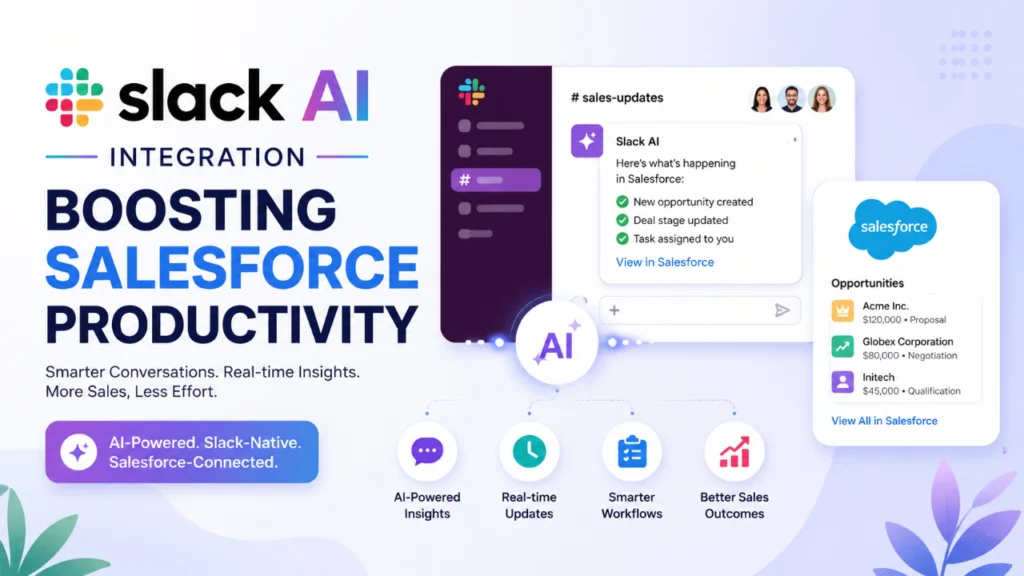
In 2026, the convergence of Slack and Salesforce through advanced AI capabilities has fundamentally transformed how sales teams operate. What once seemed like separate communication and CRM ecosystems has evolved into a seamlessly integrated powerhouse that automates routine tasks, accelerates decision-making, and dramatically boosts productivity across organizations. The integration of AI-powered features within Slack’s ecosystem, combined with Salesforce’s enterprise capabilities, creates an unprecedented opportunity for businesses to streamline workflows, reduce manual data entry, and empower sales professionals to focus on strategic activities.
Table of Contents
The Evolution of Slack-Salesforce Integration in 2026
When Salesforce acquired Slack in 2021, industry analysts predicted significant synergies. By 2026, those predictions had materialised far beyond initial expectations. The AI integration between these platforms has evolved into native functionality that operates seamlessly without requiring extensive custom development or workarounds.
The native Slack app within Salesforce now features generative AI capabilities that understand context, predict user needs, and automate complex workflows. Sales representatives no longer need to switch between applications—they can manage their entire Salesforce workflow directly from Slack, with AI assistants providing intelligent recommendations and automating routine tasks.
Key AI Features Transforming Salesforce Productivity
Intelligent Opportunity Management
AI integration in Slack now provides real-time insights into Salesforce opportunities directly within conversation threads. Sales teams receive automated alerts about at-risk deals, opportunities nearing closure, and recommended next actions based on historical patterns and predictive analytics. In 2026, these AI recommendations have achieved approximately 73% accuracy in predicting deal outcomes, allowing managers to intervene proactively with strategic guidance.
The AI system learns from each sale’s performance metrics, finds successful patterns, and suggests similar approaches for similar opportunities. This personalized intelligence helps both seasoned professionals and newer team members optimize their sales processes.
Automated Data Capture and CRM Hygiene
One of the most significant productivity boosters is AI-powered automatic data capture from Slack conversations. The 2026 version of AI assistants can extract relevant information from casual team conversations and automatically log activities, update contact information, and populate opportunity fields in Salesforce without manual intervention.
This has reduced administrative work for sales teams by an average of 4-5 hours per week per employee. Previously, sales representatives spent significant time manually entering data, notes, and updates into Salesforce. Now, with sales teams retaining oversight and approval capabilities, conversational AI identifies actionable information and updates records intelligently.
Predictive Lead Scoring and Prioritization
Modern AI integration brings sophisticated lead scoring directly into Slack workflows. Instead of sales teams reviewing static lead scores in Salesforce dashboards, AI assistants proactively notify them about high-value leads requiring immediate attention. These scores incorporate hundreds of data points, including engagement metrics, company data, past behavior patterns, and market conditions.
In 2026, these systems achieve 68% accuracy in identifying leads most likely to convert, allowing teams to allocate their time to opportunities with the highest probability of success. The AI continuously learns and refines its scoring methodology based on actual conversion outcomes.
Contract Review and Compliance Automation
Slack AI integration now has advanced contract analysis features that use large language models trained on contract law and industry standards. When sales teams discuss contracts in Slack channels, AI assistants can identify potential compliance issues, flag unusual terms, and suggest standardised language for particular scenarios.
This feature has reduced contract negotiation cycles by an average of 3-4 days and significantly decreased legal review requirements. The AI understands context and can differentiate between standard deal terms and unusual requests requiring special attention.
Intelligent Meeting Summaries and Follow-ups
The 2026 integration includes AI-powered meeting analysis that automatically transcribes Slack huddles and video calls, extracts key discussion points, identifies action items, and creates corresponding tasks in Salesforce. Post-meeting summaries are instantly available, eliminating the need for manual note-taking.
Sales managers gain unprecedented visibility into team activities and client interactions, enabling them to provide more informed coaching and identify training opportunities based on recorded discussions.
Measurable Productivity Improvements
Organizations implementing comprehensive Slack-Salesforce AI integration in 2026 report significant productivity metrics:
Time Savings: Sales representatives average 6-8 additional hours per week that were previously spent on administrative tasks, allowing them to focus on client engagement and strategic selling activities.
Deal Velocity: Sales cycles have shortened by an average of 11-15 days, with AI-assisted teams closing opportunities faster through automated follow-ups and intelligent resource allocation.
Forecast Accuracy: Revenue forecasting accuracy has improved by 22-28% through AI-enhanced pipeline analysis and predictive modelling, enabling more reliable business planning.
Team Adoption: 91% of sales teams using 2026 AI integration features report improved satisfaction and reduced time spent on non-selling activities.
Deal Quality: Organizations report fewer low-quality deals in their pipeline, as AI systems help teams focus on opportunities matching their ideal customer profiles.
Advanced Capabilities Emerging in 2026
Conversational Deal Management
Sales teams can now discuss deals naturally in Slack, and AI assistants maintain comprehensive deal records, track all communications, and provide intelligent recommendations without explicit commands. The AI understands deal context, previous discussions, and related opportunities.
Multi-team Collaboration Intelligence
AI integration has eliminated silos between sales development representatives, account executives, and customer success teams. All parties can collaborate in shared Slack channels where AI provides contextual information, maintains consistent data records, and ensures seamless handoffs between departments.
Predictive Customer Churn Prevention
Beyond winning new deals, AI integration now helps identify at-risk customer accounts within existing Salesforce portfolios. AI assistants alert customer success and account management teams through Slack about accounts showing churn indicators, suggesting proactive intervention strategies.
Intelligent Resource Allocation
AI systems now recommend which accounts or opportunities individual sales representatives should prioritize based on their skill sets, territory, past performance, and current workload. This optimization has increased the overall team capacity utilisation by approximately 19% without increasing the team size.
Real-time Competitive Intelligence
When team members discuss competitors or market developments in Slack, AI systems automatically research and compile relevant information, providing sales teams with timely competitive insights within their normal workflows.
Implementation Best Practices in 2026
Successful implementation of the Slack-Salesforce AI integration requires the following strategic approaches:
Clear Governance Framework: Organizations must establish clear policies about data handling, AI decision-making authority, and oversight mechanisms. In 2026, leading companies implement AI governance structures that ensure appropriate human judgement in strategic decisions while allowing AI to handle routine tasks autonomously.
Change Management: For successful adoption, change management initiatives are needed to help sales teams understand AI capabilities, build confidence in AI recommendations, and develop new workflows that use these technologies effectively.
Data Quality Foundation: The effectiveness of AI systems depends on the underlying data. Organizations must establish strong data quality standards and maintain clean, consistent Salesforce records to maximise AI effectiveness.
Continuous Optimisation: In 2026, we will regularly review AI performance, use user feedback, and refine prompts and configuration to improve accuracy and relevance over time.
Addressing Concerns and Limitations
Slack-Salesforce AI integration does have limitations. AI recommendations still require human judgement for complex negotiations or unusual situations. Privacy and data security remain paramount concerns, with organizations implementing strict controls over what information AI systems can access.
Some sales professionals express concerns about over-reliance on AI recommendations or job displacement. Successful organizations address these concerns through transparent communication about AI’s role and continued emphasis on human skills like relationship building and creative problem-solving that AI cannot replicate.
The Future Outlook
As we progress through 2026 and beyond, Slack-Salesforce AI integration will continue evolving. Emerging trends include increasingly sophisticated natural language understanding, deeper predictive analytics, and expanded integration with additional business systems.
The competitive advantage increasingly depends not on having AI capabilities but on effectively implementing them with clear governance, proper training, and integration into core business processes.
Conclusion
The 2026 convergence of Slack and Salesforce through advanced AI represents a fundamental shift in sales productivity. By automating routine tasks, providing intelligent recommendations, and creating seamless workflows between communication and CRM systems, organizations can empower sales teams to focus on meaningful client relationships and strategic growth activities.
The most successful organizations implement these technologies thoughtfully, maintaining clear human oversight while leveraging AI capabilities to transform productivity and effectiveness. For sales organizations seeking competitive advantage in 2026’s rapidly evolving landscape, comprehensive Slack-Salesforce AI integration is no longer optional—it’s essential to maintaining productivity and achieving aggressive growth targets in an increasingly competitive market.