
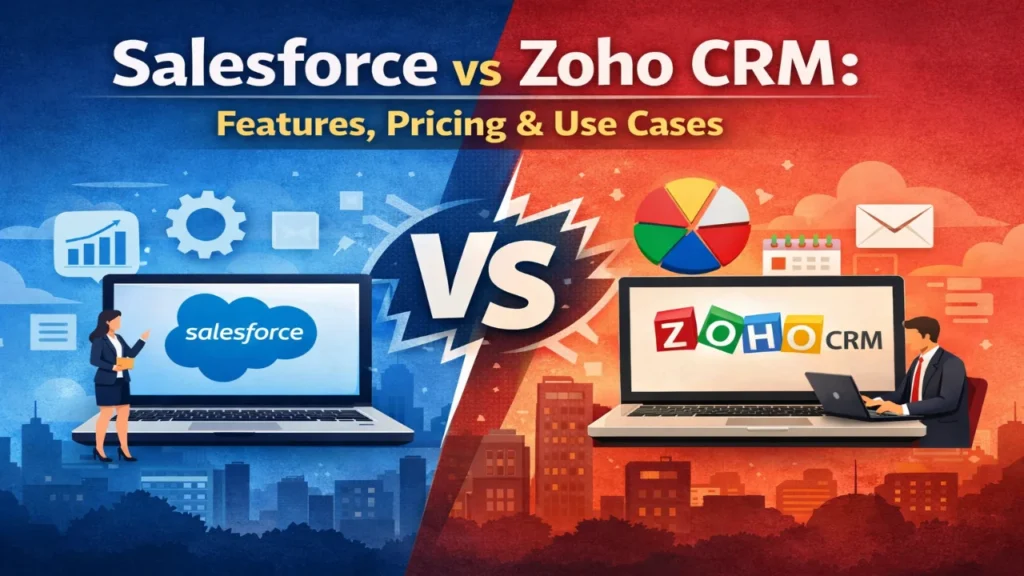
Choosing the right Customer Relationship Management (CRM) platform is one of the most critical decisions for modern businesses. Among the top contenders, Salesforce vs Zoho CRM is one of the most frequently searched and debated comparisons online, including across communities like Salesforce vs Zoho CRM Reddit. Both platforms offer powerful tools for managing sales, marketing, customer service, and automation, but they target different business needs, budgets, and growth strategies.
This in-depth comparison explores features, pricing, market share, revenue, and real-world use cases, while also positioning Zoho against Salesforce and HubSpot to help businesses make a confident, future-proof decision.
Table of Contents
Overview: Salesforce vs Zoho CRMCore CRM Features ComparisonZoho vs Salesforce Pricing BreakdownZoho vs Salesforce Market ShareZoho vs Salesforce Revenue ComparisonCRM:Salesforce vs Zoho CRM: Reddit InsightsZoho vs Salesforce vs HubSpot: How Do They Compare?Zoho vs HubSpot: A Quick ComparisonUse Cases: Which CRM Is Right for You?Key Takeaway: Salesforce vs Zoho CRM
Overview: Salesforce vs Zoho CRM
Salesforce is the world’s leading enterprise CRM platform, widely adopted by large organizations, fast-scaling companies, and global enterprises. It is known for its deep customisation, AI-powered insights, and a vast ecosystem.
Zoho CRM, on the other hand, is a cost-effective, all-in-one CRM solution designed primarily for small to mid-sized businesses. It integrates seamlessly with the broader Zoho ecosystem, offering simplicity, affordability, and ease of use.
The debate of Zoho vs Salesforce ultimately comes down to scalability versus simplicity.
Core CRM Features Comparison
Salesforce CRM Features
Salesforce offers an advanced and highly customisable CRM platform designed for complex business operations. Key strengths include the following:
Advanced lead and opportunity management
Highly customizable dashboards and reports
Workflow automation with Salesforce Flow
AI-powered insights through Einstein AI
Multi-cloud ecosystem (Sales, Service, Marketing, Experience)
Enterprise-grade security and compliance
Extensive AppExchange marketplace
Salesforce is ideal for organizations that require profound customisation, complex automation, and advanced analytics.
Zoho CRM Features
Zoho CRM focuses on usability and affordability while still delivering essential CRM functionality. Key features include the following:
Lead, contact, and deal management
Sales automation and workflow rules
Built-in email marketing and telephony
AI assistant (Zia) for predictions and insights
Native integration with Zoho Books, Zoho Campaigns, and Zoho Desk
Omnichannel communication (email, phone, social)
Zoho CRM is best for teams that want quick setup, minimal learning curve, and lower operational costs.
Zoho CRM Pricing
Zoho CRM pricing is one of its biggest advantages. It offers multiple plans designed for small and growing businesses, typically including the following:
Free plan for very small teams
Entry-level paid plans with core CRM features
Advanced plans with AI, automation, and analytics
Zoho’s pricing structure is predictable and budget-friendly, making it attractive for startups and SMBs.
Salesforce Pricing
When discussing Zoho vs Salesforce pricing, Salesforce is generally considered more expensive but far more scalable.
Salesforce pricing varies by cloud and feature set and often includes the following:
Entry-level CRM plans
Advanced enterprise plans with automation and AI
Add-on costs for advanced analytics, integrations, and storage
While Salesforce requires a higher investment, it delivers long-term scalability and enterprise-grade capabilities.
In terms of global adoption, Zoho vs Salesforce market share shows a clear distinction:
Salesforce dominates the global CRM market and holds the largest market share worldwide
Zoho CRM continues to grow rapidly, especially among small- and mid-sized businesses
Salesforce dominates because of its enterprise focus, innovation, and ecosystem, while Zoho grows thanks to affordability and bundled software offerings.
When comparing Zoho vs Salesforce revenue, the gap reflects their target audiences:
Salesforce revenue is significantly higher, driven by enterprise subscriptions, cloud solutions, and AI innovation
Zoho’s revenue is smaller but growing steadily due to its diversified SaaS portfolio and SMB-focused pricing
This difference highlights Salesforce’s enterprise dominance versus Zoho’s efficiency-driven growth strategy.
Discussions on Reddit comparing Salesforce and Zoho CRM often highlight real user experiences.
Common Salesforce feedback:
Extremely powerful but complex
Steep learning curve
Higher total cost of ownership
Ideal for long-term scaling
Common Zoho CRM feedback:
Easy to use and quick to deploy
Excellent value for money
Limited customization for complex needs
Best for small teams
These discussions reinforce that there is no universal “best CRM”, only the best fit for a specific business model.
When evaluating Zoho vs Salesforce vs HubSpot, each platform serves a distinct purpose:
Salesforce
Best for large organizations and enterprises
Advanced automation and customization
Ideal for complex sales and service processes
Zoho CRM
Best for startups and SMBs
Cost-effective all-in-one solution
Strong ecosystem of business tools
HubSpot
Best for inbound marketing-focused teams
Excellent user experience
Free entry-level tools with paid scaling options
If your business prioritises marketing automation, HubSpot may be attractive. If budget and simplicity matter most, Zoho is ideal. If scalability and customisation are critical, Salesforce is the leader.
The Zoho vs HubSpot comparison often comes down to marketing versus operations:
Zoho offers broader business tools beyond CRM
HubSpot excels in content marketing and inbound lead generation
Zoho is generally more affordable
HubSpot becomes expensive as contacts scale
Businesses with strong content and inbound strategies may lean toward HubSpot, while operationally focused teams prefer Zoho.
Choose Salesforce If:
You are a mid-sized or large enterprise
You need advanced customization and integrations
You manage complex sales cycles
You plan long-term global scaling
Choose Zoho CRM If:
You are a startup or small business
Budget is a key consideration
You want fast deployment and ease of use
You prefer an all-in-one business suite
Consider HubSpot If:
Marketing automation is your primary focus
You rely heavily on inbound leads
You want a simple CRM with strong marketing tools
The Salesforce vs Zoho CRM debate does not have a single answer. Salesforce stands out as a powerhouse CRM built for enterprises that need profound customisation, AI-driven insights, and scalability. Zoho CRM shines as a cost-effective, user-friendly solution for small and mid-sized businesses that want strong CRM capabilities without high costs. When factoring in pricing, market share, revenue, and real-world use cases, the right CRM depends entirely on your business size, budget, and growth vision.
Founder and CEO of iTechCloud Solution, a Salesforce consulting and product partner since 2017. He sets engagement strategy and stays the commercial owner of every account, working with clients across Salesforce, AI and data from the first call through to go-live.
Connect on LinkedIn