

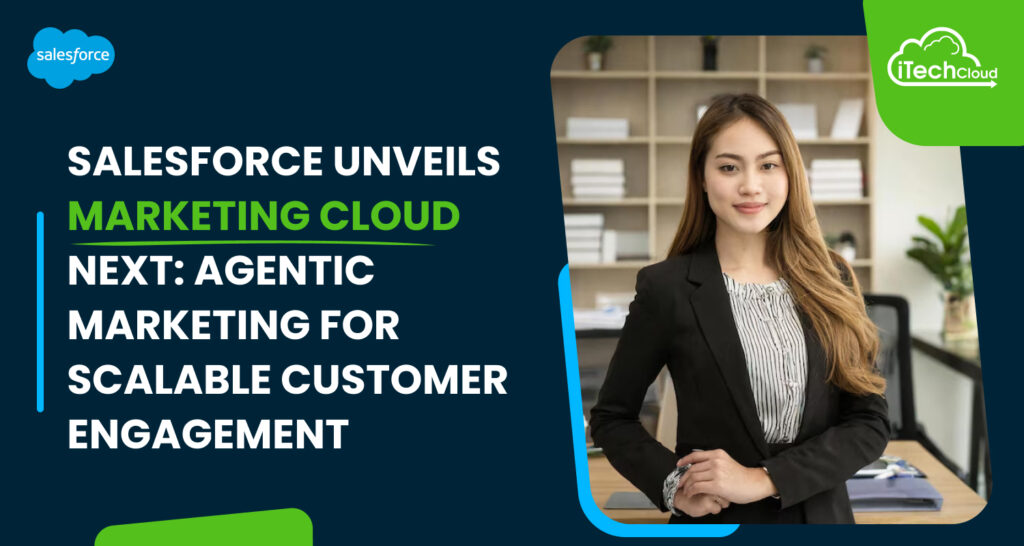
Introduction: Salesforce Unveils Marketing Cloud Next
Salesforce, the global leader in customer relationship management (CRM) and cloud-based enterprise solutions, has once again redefined the future of digital marketing with the launch of Marketing Cloud Next. This next-generation platform introduces Agentic Marketing, a revolutionary AI-driven approach that enables businesses to automate, personalize, and optimize customer engagement at an unprecedented scale.
In today’s hyper-competitive digital landscape, brands face increasing pressure to deliver seamless, personalized, and real-time customer experiences. Traditional marketing automation tools, while effective, often rely on static rules and manual oversight, limiting their ability to adapt dynamically. Marketing Cloud Next addresses these challenges by embedding autonomous AI agents into the marketing workflow, allowing for self-learning, self-optimising, and predictive customer interactions.
This in-depth analysis explores every facet of Marketing Cloud Next, including its core components, technological innovations, business benefits, real-world applications, and potential challenges.
Table of Contents
Introduction: Salesforce Unveils Marketing Cloud Next1. Understanding Marketing Cloud Next2. The Concept of Agentic Marketing3. Business Benefits of Marketing Cloud Next4. Challenges & Considerations5. The Future of Marketing with Salesforce6. My Takeaway:
1. Understanding Marketing Cloud Next
1.1 What is Marketing Cloud Next?
Marketing Cloud Next is Salesforce’s latest evolution of its Marketing Cloud platform, designed to leverage artificial intelligence (AI), machine learning (ML), and predictive analytics to transform how businesses engage with customers. The platform’s defining feature is Agentic Marketing, which shifts marketing automation from a rules-based system to an AI-driven, autonomous decision-making framework.
Unlike conventional marketing automation tools that execute pre-programmed workflows, Agentic Marketing enables AI agents to:
Learn continuously from customer interactions.
Adapt in real-time based on behavioural signals.
Predict future actions using advanced analytics.
Optimize campaigns autonomously without human intervention.
1.2 Core Components of Marketing Cloud Next
A. AI-Powered Autonomous Agents
Self-Learning Algorithms: These AI agents analyze historical and real-time data to refine targeting and messaging strategies.
Dynamic Decision-Making: Instead of following fixed rules, AI agents adjust campaigns based on live engagement metrics.
Automated A/B Testing: Continuously tests variations of creatives, CTAs, and send times to determine the best-performing combinations.
B. Hyper-Personalization Engine
Dynamic Content Generation: AI tailors messages based on individual customer profiles, past behavior, and predictive intent.
Real-Time Segmentation: Automatically categorises customers into micro-segments for ultra-precise targeting.
Contextual Engagement: Adjusts messaging based on external factors (e.g., weather, location, recent purchases).
C. Predictive & Prescriptive Analytics
Customer Behavior Forecasting: Uses AI to predict churn risk, purchase likelihood, and engagement patterns.
Next-Best-Action Recommendations: Suggests optimal engagement strategies for each customer.
Automated Insights Generation: Delivers actionable reports without manual analysis.
D. Omnichannel Orchestration
Unified Customer Journeys: Coordinates messaging across email, SMS, social media, chatbots, and emerging channels (e.g., WhatsApp and RCS).
Channel Optimisation: AI selects the best-performing channel for each customer interaction.
Cross-Channel Attribution: Measures impact across touchpoints for accurate ROI tracking.
E. Customer Data Platform (CDP)
360-Degree Customer Profiles: Consolidates data from CRM, transactional systems, and third-party sources.
AI-Driven Identity Resolution: Matches customer identities across devices and platforms for accurate targeting.
Privacy-Compliant Data Management: Ensures compliance with GDPR, CCPA, and other regulations.
F. Low-Code/No-Code Campaign Builder
Drag-and-Drop Interface: Allows marketers to design complex campaigns without coding.
Pre-Built AI Templates: Accelerates campaign deployment with industry-specific best practices.
Collaboration Tools: Enables cross-team workflows for seamless execution.
2.1 What Makes Agentic Marketing Unique?
Traditional marketing automation follows “if-this-then-that” (IFTTT) logic, where predefined triggers dictate actions. While useful, this approach lacks adaptability.
Agentic Marketing introduces the following:
Autonomous AI Agents: Independent decision-makers that refine strategies in real-time.
Continuous Optimisation: Campaigns evolve based on performance data without manual tweaks.
Predictive Intelligence: Anticipates customer needs before they arise.
2.2 How Agentic Marketing Works
Data Ingestion: AI agents ingest structured and unstructured data from CRM, web analytics, social media, and IoT devices.
Behavioural Analysis: Machine learning models detect patterns (e.g., browsing habits, purchase cycles).
Real-Time Decision Making: AI adjusts messaging, timing, and channel selection dynamically.
Closed-Loop Learning: Outcomes are fed back into the system to improve future interactions.
2.3 Real-World Applications
A. E-Commerce & Retail
Personalized Product Recommendations: AI suggests items based on browsing history and inventory trends.
Dynamic Pricing Alerts: Sends real-time discounts if a customer hesitates at checkout.
B. Financial Services
AI-Driven Lead Scoring: Prioritises high-intent prospects for sales teams.
Fraud Detection Alerts: Notifies customers of suspicious transactions via preferred channels.
C. Healthcare & Life Sciences
Automated Appointment Reminders: AI reschedules based on patient no-show likelihood.
Personalized Wellness Campaigns: Tailors health tips based on wearable device data.
D. Travel & Hospitality
Dynamic Loyalty Rewards: Adjusts offers based on booking frequency and preferences.
Real-Time Itinerary Updates: Sends proactive alerts for flight delays or hotel upgrades.
3.1 Increased Operational Efficiency
Reduces manual workload by automating repetitive tasks.
Eliminates guesswork with AI-driven optimisations.
3.2 Higher Conversion Rates & Revenue Growth
Delivers hyper-relevant content, increasing engagement by 30-50% (based on Salesforce benchmarks).
Reduces cart abandonment with real-time interventions.
3.3 Customer Lifetime Value (CLV)
Strengthens loyalty through personalized experiences.
Predicts churn risks and triggers retention campaigns.
3.4 Seamless Omnichannel Experiences
Ensures consistent messaging across all touchpoints.
Increases engagement by meeting customers on preferred channels.
3.5 Scalability for Enterprise Growth
Handles millions of interactions without performance degradation.
Supports global campaigns with localised AI adaptations.
4.1 Data Privacy & Compliance
Must adhere to GDPR, CCPA, and industry-specific regulations.
Requires transparent AI decision-making for customer trust.
4.2 Balancing Automation & Human Creativity
AI handles execution, but marketers must oversee strategy.
Risk of over-automation leading to impersonal interactions.
4.3 Implementation Complexity
Requires integration with existing Salesforce ecosystems.
Needs training for teams to leverage AI effectively.
5.1 AI Expanding Role in Marketing
Generative AI: Automated content creation for blogs, ads, and emails.
Voice & Visual Search Optimisation: Adapting strategies for AI assistants like Siri and Alexa.
5.2 Salesforce Vision for Autonomous Marketing
Self-Healing Campaigns: AI detects and fixes underperforming ads in real-time.
Blockchain for Data Security: Ensuring tamper-proof customer records.
Salesforce Marketing Cloud Next represents a quantum leap in marketing technology. By embracing agentic marketing, businesses can transition from static automation to dynamic, AI-driven engagement. The platform’s ability to learn, predict, and optimize in real-time ensures that brands stay ahead in an era where personalization, speed, and scalability define success.
Founder and CEO of iTechCloud Solution, a Salesforce consulting and product partner since 2017. He sets engagement strategy and stays the commercial owner of every account, working with clients across Salesforce, AI and data from the first call through to go-live.
Connect on LinkedIn