
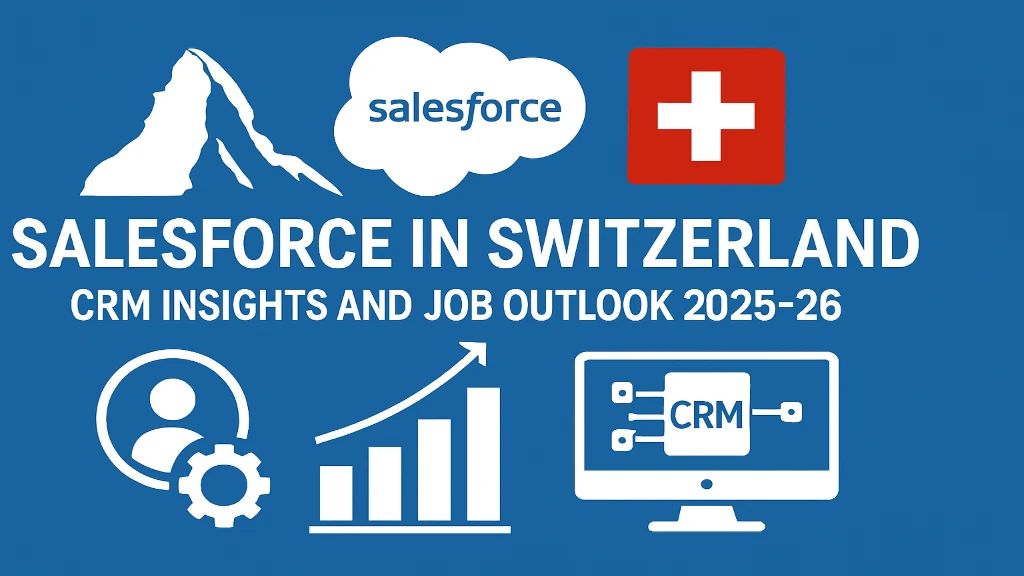
Introduction: Salesforce in Switzerland
Salesforce, the global leader in customer relationship management (CRM) solutions, continues to expand its influence in Switzerland. As businesses increasingly prioritize digital transformation, Salesforce’s cloud-based CRM platform has become indispensable for enterprises across industries, including finance, healthcare, pharmaceuticals, and retail.
This blog explores the current state of Salesforce adoption in Switzerland, key CRM trends shaping 2025-26, and the evolving job market for Salesforce professionals.
Table of Contents
Introduction: Salesforce in Switzerland1. Salesforce Adoption in Switzerland2. CRM Trends in Switzerland (2025-26)3. Salesforce Job Market Outlook (2025-26)4. Challenges & Opportunities5. How to Start a Salesforce Career in Switzerland (2025-26)Conclusion
1. Salesforce Adoption in Switzerland
Switzerland, known for its strong economy and innovation-driven enterprises, has embraced Salesforce as a key enabler of customer engagement, sales automation, and data-driven decision-making.
Key Industries Leveraging Salesforce
1. Banking & Finance
Swiss banks and financial institutions use Salesforce for client relationship management, compliance tracking, and personalized financial services.
Companies like UBS and Credit Suisse leverage Salesforce Financial Services Cloud for secure, scalable CRM solutions.
2. Pharmaceuticals & Life Sciences
Switzerland’s thriving pharmaceutical sector (Novartis and Roche) relies on Salesforce Health Cloud for patient engagement, clinical trial management, and regulatory compliance.
3. Retail & Luxury Goods
High-end brands like Rolex and Swatch use Salesforce Commerce Cloud and Marketing Cloud to enhance customer experiences through AI-driven personalization.
4. Manufacturing & Industrial Sector
Companies such as ABB and Nestlé utilise Salesforce for supply chain optimization, B2B sales, and IoT-integrated CRM solutions.
Factors Driving Salesforce Growth in Switzerland
Digital Transformation: Swiss businesses are accelerating cloud adoption to stay competitive.
AI & Automation: Salesforce Einstein AI is being widely adopted for predictive analytics and chatbots.
Data Privacy & Compliance: Salesforce’s strong security measures align with Switzerland’s strict data protection laws (FADP, GDPR).
As businesses evolve, CRM strategies are becoming more sophisticated. Here are the top Salesforce CRM trends shaping Switzerland in 2025-26:
A. Hyper-Personalization with AI
Salesforce Einstein AI enables Swiss companies to deliver hyper-personalised customer experiences by analyzing behavior, purchase history, and engagement patterns.
Example: Swiss luxury brands use AI-powered recommendations to enhance customer loyalty.
B. Integration of IoT & CRM
Manufacturing and logistics firms integrate Salesforce with IoT devices for real-time tracking, predictive maintenance, and automated customer service.
C. Rise of Salesforce CDP (Customer Data Platform)
Companies are consolidating customer data from multiple sources into Salesforce CDP for a unified customer view, improving marketing and sales alignment.
D. Sustainability & ESG Tracking in CRM
Swiss firms are leveraging Salesforce Sustainability Cloud to track ESG (Environmental, Social, and Governance) metrics, aligning with Switzerland’s sustainability goals.
E. Increased Use of Low-Code/No-Code Tools
Salesforce Lightning and MuleSoft enable Swiss businesses to build custom CRM solutions without extensive coding, accelerating digital transformation.
Switzerland’s demand for Salesforce professionals is surging, driven by digital transformation and cloud adoption.
A. Most In-Demand Salesforce Roles
1. Salesforce Administrators
Responsible for CRM customisation, user management, and reporting.
Average Salary: CHF 95,000 – 120,000 per year.
2. Salesforce Developers
Specialize in Apex, Lightning Web Components, and integrations.
Average Salary: CHF 110,000 – 140,000 per year.
3. Salesforce Consultants
Help businesses implement and optimize Salesforce solutions.
Average Salary: CHF 100,000 – 130,000 per year.
4. Salesforce Architects
Design scalable Salesforce solutions for enterprises.
Average Salary: CHF 130,000 – 160,000 per year.
5. Marketing Cloud Specialists
Focus on email automation, customer journeys, and analytics.
Average Salary: CHF 105,000 – 135,000 per year.
B. Key Skills Employers Seek
Technical Skills: Apex, LWC, Salesforce Flow, MuleSoft, CPQ.
Soft Skills: Problem-solving, stakeholder management, and business analysis.
Certifications: Salesforce Administrator, Platform Developer, Sales/Service Cloud Consultant.
C. Hiring Trends
Remote & Hybrid Work: Many Swiss companies offer flexible work arrangements for Salesforce roles.
Freelancing & Contracting: High demand for independent Salesforce consultants.
Upskilling Initiatives: Companies invest in training programmes to bridge the skills gap.
A. Challenges
Talent Shortage: High demand but limited certified professionals.
Cost of Implementation: SMEs may find Salesforce licensing expensive.
Data Security Concerns: Strict Swiss regulations require careful CRM governance.
B. Opportunities
Growing Startup Ecosystem: Swiss startups are adopting Salesforce for scalability.
Government & Public Sector Adoption: Increased use of Salesforce for citizen services.
AI & Automation Expansion: More businesses will leverage AI-driven CRM features.
A. Get Certified
Start with Salesforce Administrator or Platform App Builder certifications.
Advanced roles may require Developer, Architect, or Consultant certifications.
B. Gain Practical Experience
Work on Trailhead projects, volunteer for non-profits, or take internships.
C. Network in the Swiss Salesforce Community
Join Zurich or Geneva Salesforce User Groups and attend events like Dreamforce or TrailblazerDX.
D. Apply for Jobs Strategically
Target industries like finance, pharma, and retail where Salesforce adoption is high.
Salesforce continues to be a game-changer for Swiss businesses, driving innovation in CRM, AI, and automation. The job market for Salesforce professionals is booming, with lucrative opportunities across administration, development, consulting, and architecture. For businesses, investing in Salesforce means staying ahead in customer engagement and operational efficiency. For job seekers, acquiring Salesforce skills opens doors to high-paying roles in Switzerland’s tech-driven economy.
Part of the team turning Salesforce and AI strategy into shipped, measurable outcomes for enterprises across five regions.