
Introduction: Salesforce in Norway
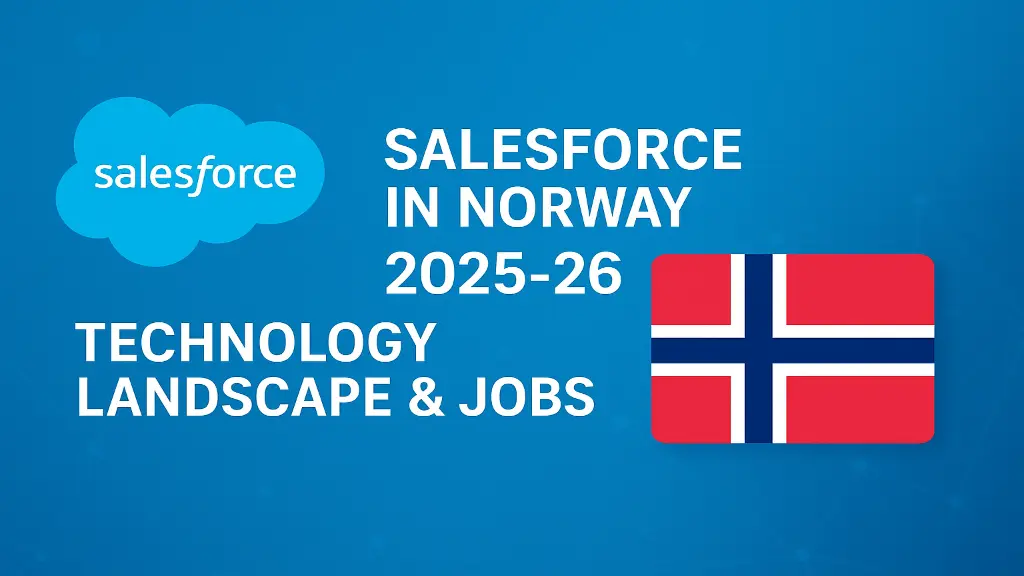
Salesforce, the global leader in customer relationship management (CRM) solutions, continues to expand its influence in Norway. As businesses increasingly adopt cloud-based technologies, digital transformation, and AI-driven automation, Salesforce remains at the forefront of this evolution. The Norwegian market, known for its strong economy, tech-savvy workforce, and innovation-driven enterprises, presents a thriving ecosystem for Salesforce technologies.
Table of Contents
Introduction: Salesforce in Norway1. Current State of Salesforce Adoption in Norway2. Key Salesforce Trends Shaping 2025-263. Salesforce Ecosystem & Partner Network in Norway4. In-Demand Salesforce Skills & Job Market Trends5. Future Outlook: AI, Automation, and Industry-Specific Growth6. How to Prepare for a Salesforce Career in NorwayConclusion
1. Current State of Salesforce Adoption in Norway
Norway’s business environment has highly digitised industries, with oil & gas, shipping, finance, retail, and the public sector leading in CRM adoption. Salesforce has gained significant traction due to the following:
Cloud-First Strategies: Norwegian companies prioritize cloud solutions for scalability and remote collaboration.
Customer-Centric Business Models: Businesses focus on enhancing customer experiences, making Salesforce a preferred CRM.
Government & EU Compliance: GDPR and local data regulations push firms toward secure, compliant platforms like Salesforce.
Industries Driving Salesforce Growth
Financial Services: Banks (DNB, Nordea) and fintech firms use Salesforce for customer onboarding and analytics.
Energy & Maritime: Equinor and other energy giants leverage Salesforce for B2B sales and field service management.
Retail & E-commerce: Companies like Komplett use Salesforce Commerce Cloud for omnichannel sales.
Public Sector & Healthcare: Digital transformation initiatives in government agencies integrate Salesforce for citizen services.
Market Challenges
High Implementation Costs: SMEs sometimes struggle with Salesforce licensing and customisation expenses.
Talent Shortage: Certified Salesforce professionals are in high demand but limited in supply.
Data Localisation Concerns: Some firms prefer on-premise solutions due to strict data sovereignty laws.
Despite these challenges, Salesforce’s market share in Norway is projected to grow by 15-20% annually through 2026.
A. AI & Einstein GPT Integration
Salesforce’s Einstein AI is transforming CRM with predictive analytics, automated workflows, and AI-driven insights. In Norway, businesses are adopting:
AI-Powered Customer Service: Chatbots and automated case routing.
Predictive Sales Analytics: Forecasting deals and optimizing sales pipelines.
Generative AI (Einstein GPT): Automated content creation for marketing and sales teams.
B. Hyper-Personalization with Customer Data Platforms (CDP)
Norwegian firms use Salesforce CDP to unify customer data across touchpoints, enabling the following:
Real-time personalization in marketing campaigns.
360-degree customer views for sales teams.
C. Sustainability & ESG Tracking
Norway’s focus on sustainability drives demand for Salesforce Net Zero Cloud, helping companies track carbon footprints and ESG compliance.
D. Industry-Specific Clouds
Salesforce offers tailored solutions, like:
Energy & Utilities Cloud for oil/gas companies.
Financial Services Cloud for banking and insurance.
Health Cloud for healthcare providers.
E. Low-Code & No-Code Development (MuleSoft & Salesforce Flow)
Norwegian businesses increasingly use Salesforce Flow and MuleSoft for rapid app development without heavy coding.
Norway has a strong Salesforce partner network, including the following:
Consulting Partners: Capgemini, Accenture, and Deloitte help with implementations.
ISVs (Independent Software Vendors): Local firms build niche apps on Salesforce AppExchange.
Salesforce User Groups: Oslo and Bergen have active communities for networking and knowledge-sharing.
Key Salesforce Events in Norway
Salesforce World Tour Oslo (annual conference for users and developers).
Nordic Dreamin’ (a community-led event for Salesforce professionals).
Top Salesforce Roles in Norway (2025-26)
Most Valued Certifications
Administrator (Entry-level)
Platform Developer I/II (For coders)
Sales Cloud/Service Cloud Consultant (Industry-specific)
Marketing Cloud Email Specialist (for digital marketers)
Job Market Outlook
Remote Work Flexibility: Many Norwegian firms offer hybrid roles.
Freelance & Contract Demand: Short-term Salesforce projects are rising.
Upskilling Programmes: Companies invest in training their employees on Salesforce.
By 2026, Salesforce in Norway will see:
More AI-driven automation in sales and service.
Expansion of vertical clouds (e.g., manufacturing cloud).
Increased public sector adoption for digital governance.
Steps to Break into the Salesforce Job Market
Get Certified: Start with admin or platform developer certifications.
Gain Experience: Work on Trailhead projects or freelance gigs.
Network: Join Salesforce Norway LinkedIn groups and attend events.
Learn Norwegian: While English is widely used, knowing Norwegian helps in local firms.
Follow Industry Trends: Stay updated on AI, CDP, and automation.
Salesforce’s growth in Norway is unstoppable, driven by AI, cloud adoption, and industry-specific solutions. The job market is ripe for skilled professionals, with high salaries and remote opportunities. Whether you’re a business looking to implement Salesforce or a professional aiming to upskill, now is the time to act.
Founder and CEO of iTechCloud Solution, a Salesforce consulting and product partner since 2017. He sets engagement strategy and stays the commercial owner of every account, working with clients across Salesforce, AI and data from the first call through to go-live.
Connect on LinkedIn