

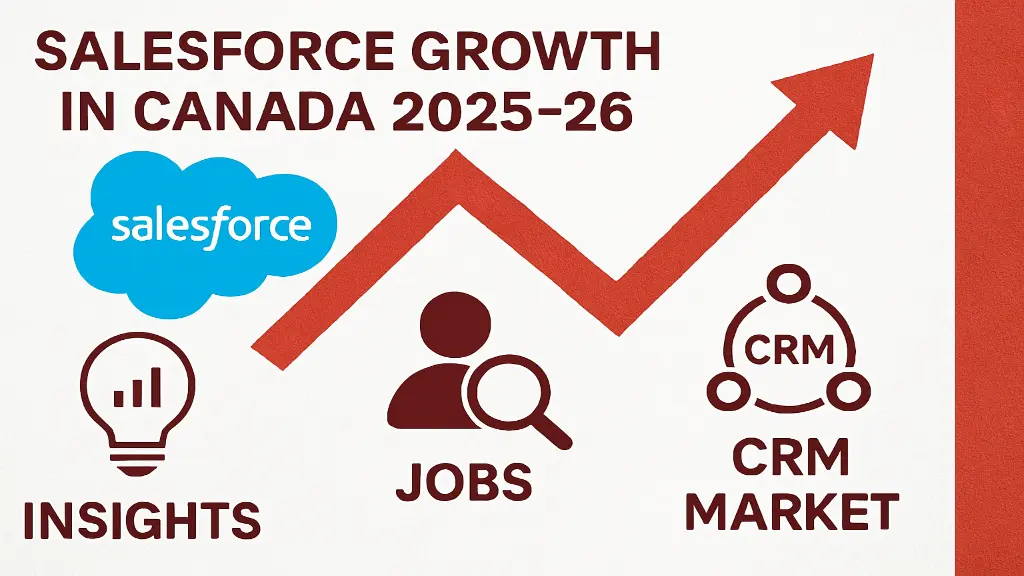
Introduction: Salesforce in Canada
Salesforce, the global leader in customer relationship management (CRM) software, continues to expand its footprint in Canada. As businesses increasingly adopt digital transformation strategies, Salesforce’s cloud-based solutions are becoming essential for companies looking to enhance customer engagement, streamline operations, and drive revenue growth.
The Canadian market presents unique opportunities for Salesforce due to its thriving tech ecosystem, government support for innovation, and a growing demand for CRM expertise. This blog explores the latest insights into Salesforce growth in Canada, emerging job opportunities, industry trends, and how businesses are leveraging Salesforce to stay competitive in 2025-26.
Table of Contents
Introduction: Salesforce in Canada1. Salesforce Market Growth in Canada (2025-26)2. Salesforce Jobs & Career Opportunities in Canada3. Emerging Salesforce Trends in Canada (2025-26)4. Challenges & Opportunities for Salesforce in Canada5. How Can Canadian Businesses Leverage Salesforce?Conclusion
1. Salesforce Market Growth in Canada (2025-26)
A. Expanding Cloud Adoption
Canada’s cloud computing market is booming, with businesses across industries – finance, healthcare, retail, and manufacturing – migrating to cloud-based CRM solutions. Salesforce dominates this space, offering the following:
Sales Cloud for sales automation
Service Cloud for customer support
Marketing Cloud for personalized campaigns
Commerce Cloud for e-commerce optimization
Tableau & Slack for data analytics and collaboration
According to recent forecasts, the Canadian CRM market is expected to grow at a CAGR of 14% from 2025 to 2026, with Salesforce holding over 30% market share.
B. Industry-Specific CRM Adoption
Financial Services: Banks and insurers use Salesforce for client onboarding and fraud detection.
Healthcare: Hospitals leverage Health Cloud for patient management.
Retail & E-commerce: Brands deploy Commerce Cloud for omnichannel experiences.
Public Sector: Government agencies use Salesforce for citizen engagement.
C. Salesforce’s Investment in Canada
Salesforce is still putting money into data centres in Canada, specifically in Toronto and Montreal, to meet the regulations regarding data residency. The company also partners with Canadian universities and boot camps to upskill talent in CRM technologies.
A. High Demand for Salesforce Professionals
With over 25,000 Salesforce-related job postings in 2025, Canada faces a talent shortage in CRM expertise. Key roles include:
Salesforce Administrators – Manage CRM configurations and user access.
Salesforce Developers – Customise solutions using Apex, Lightning, and integrations.
Salesforce Consultants – Advise businesses on CRM implementation.
Marketing Cloud Specialists – Design automated campaigns.
Data Analysts (Tableau CRM) – Generate insights from customer data.
B. Salary Trends (2025-26)
Salesforce Administrator: $80,000 – $110,000
Salesforce Developer: $100,000 – $140,000
Solution Architect: $130,000 – $180,000
Marketing Cloud Specialist: $90,000 – $130,000
C. How to Build a Salesforce Career in Canada?
Certifications: Pursue Salesforce certifications (Admin, Developer, Consultant).
Hands-on Experience: Work on real-world projects via Trailhead.
Networking: Join Canadian Salesforce User Groups (Toronto, Vancouver, and Montreal).
Freelancing: Explore contract roles on Upwork, Toptal, and Salesforce partner firms.
A. AI & Einstein GPT Integration
Salesforce Einstein AI is transforming CRM with the following:
Predictive lead scoring
Automated customer service (chatbots)
AI-driven marketing personalization
B. Hyper-Personalization with CDP (Customer Data Platform)
Businesses use Salesforce CDP to unify customer data and deliver hyper-targeted experiences.
C. Sustainability Cloud for ESG Reporting
Canadian companies are adopting Sustainability Cloud to track carbon footprints and comply with ESG regulations.
D. Hybrid Work & Digital Collaboration (Slack + Salesforce)
With remote work still prevalent, Salesforce integrates Slack for seamless team collaboration.
E. Increased Focus on Data Privacy & Compliance
As Canada enforces stricter data laws (PIPEDA, GDPR alignment), Salesforce ensures compliance with secure cloud infrastructure.
A. Challenges
Talent Gap: Need for more certified professionals.
Cost of Implementation: SMEs may consider Salesforce expensive without proper ROI planning.
Competition from Microsoft Dynamics & HubSpot.
B. Opportunities
Government & Non-Profit Sector Growth: More public sector adoption.
AI & Automation Expansion: Increased demand for AI-powered CRM.
Partner Ecosystem Growth: More Canadian Salesforce consulting firms emerging.
A. Start with a Clear CRM Strategy
Define business goals (sales growth, customer retention).
Choose the right Salesforce products (Sales Cloud, Service Cloud).
B. Invest in Training & Adoption
Train employees on Salesforce best practices.
Use Trailhead for continuous learning.
C. Leverage Salesforce Partners
Work with Canadian Salesforce consulting firms for seamless implementation.
D. Monitor ROI & Optimize
Track KPIs like customer acquisition cost (CAC), retention rates, and sales cycle length.
Salesforce’s growth in Canada shows no signs of slowing down in 2025-26. With increasing cloud adoption, AI integration, and a booming job market for Salesforce professionals, Canadian businesses have a tremendous opportunity to enhance customer relationships and drive digital transformation.
For job seekers, now is the perfect time to upskill in Salesforce and tap into high-paying roles. For businesses, implementing Salesforce can lead to improved efficiency, customer satisfaction, and revenue growth.
Founder and CEO of iTechCloud Solution, a Salesforce consulting and product partner since 2017. He sets engagement strategy and stays the commercial owner of every account, working with clients across Salesforce, AI and data from the first call through to go-live.
Connect on LinkedIn