
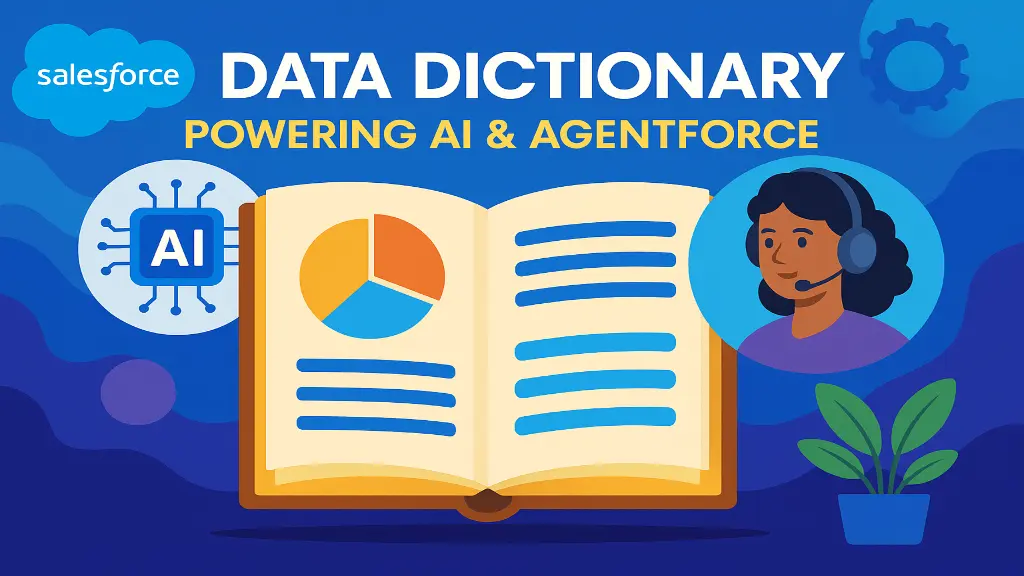
Introduction: Salesforce Data Dictionary
In the era of data-driven decision-making, Salesforce has emerged as a leading customer relationship management (CRM) platform, empowering businesses to manage customer interactions, sales pipelines, and service operations efficiently. One of the most powerful yet often underutilised features of Salesforce is the Data Dictionary, a structured repository of metadata that defines the organisation’s data model.
This 2000-word blog explores the Salesforce Data Dictionary in depth, its significance in AI-driven CRM, and how it enhances Agentforce capabilities.
Table of Contents
Introduction: Salesforce Data Dictionary1. What is a Salesforce Data Dictionary?2. How Salesforce Data Dictionary Powers AI3. Data Dictionary & Agentforce: Enhancing Customer Service4. Best Practices for Managing Salesforce Data Dictionary5. The Future of Salesforce Data Dictionary with AI & AgentforceConclusion
1. What is a Salesforce Data Dictionary?
A data dictionary in Salesforce is a comprehensive catalogue that documents all the objects, fields, relationships, and metadata within an organisation’s Salesforce instance. It serves as a single source of truth for data definitions, ensuring consistency across reports, dashboards, and AI models.
Key Components of Salesforce Data Dictionary:
Objects – Tables that store data (e.g., Account, Contact, Opportunity).
Fields – Columns within objects (e.g., account name, contact email).
Data Types – Defines the format of data (text, number, date, and picklist).
Relationships – How objects are linked (Lookup, Master-Detail).
Validation Rules – Ensures data quality and consistency.
Workflow & Automation Rules – Business logic tied to data.
Why Is It Important?
Improves Data Governance – Ensures compliance with regulations such as GDPR.
Enhances Reporting Accuracy – Eliminates ambiguity in data interpretation.
Facilitates AI & Machine Learning – Clean, well-defined data improves AI predictions.
AI in Salesforce (Einstein AI) relies heavily on structured data to deliver insights, predictions, and automation. Here’s how the Data Dictionary fuels AI:
A. Data Quality & Standardization
AI models require high-quality, consistent data to function accurately. The data dictionary enforces the following:
Field-Level Definitions – Ensures AI understands what each field represents.
Data Validation Rules – Prevents incorrect data from corrupting AI predictions.
Standardised Naming Conventions – Avoids confusion in machine learning models.
B. Training AI Models (Einstein AI)
Salesforce Einstein uses historical data to predict outcomes like the following:
Lead Scoring – Which leads are most likely to convert?
Opportunity Insights – Which deals are at risk?
Case Classification – Automatically categorises support tickets.
The data dictionary ensures that the AI model interprets fields correctly, avoiding errors like treating a “Phone Number” field as a numerical value instead of a text identifier.
C. Natural Language Processing (NLP) for Agent Force
Agentforce (Salesforce’s AI-powered service agents) uses NLP to understand customer queries. A well-maintained data dictionary helps by:
Mapping Synonyms – Recognising that “client” and “customer” refer to the same entity.
Defining Entity Relationships – Understanding that an “Order” is linked to an “Account”.
Without a data dictionary, AI chatbots might misinterpret user requests, leading to poor customer experiences.
Agentforce leverages AI to automate and enhance customer service. The data dictionary plays a pivotal role in the following areas:
A. Automated Case Resolution
Field Definitions Help AI Classify Cases – If a customer says, “My order is late”, the AI checks the data dictionary to link “order” with the “case” object.
Dynamic Response Generation – AI uses field descriptions to generate accurate responses (e.g., pulling the “Estimated Delivery Date” from the Order object).
B. Knowledge Article Recommendations
When a customer asks a question, Agent Force searches Salesforce Knowledge. The data dictionary ensures:
Relevant Tagging – Articles are linked to the correct objects (e.g., “Refund Policy” is tied to the “Case” object).
Contextual Understanding – AI knows that “billing issue” relates to the “Invoice” object.
C. Proactive Customer Engagement
With AI-driven insights, Agentforce can:
Predict Customer Needs – Using historical data (e.g., if a customer frequently asks about upgrades, AI suggests relevant products.
Personalize Interactions – By understanding data relationships (e.g., “This customer has a high lifetime value based on past purchases”).
To maximise the benefits of the Data Dictionary for AI and Agentforce, follow these best practices:
A. Regular Audits & Documentation
Review Fields & Objects – Remove unused fields to avoid AI confusion.
Document Business Definitions – Clearly define what each field represents (e.g., “Last Modified Date” vs. “Created Date”).
B. Enforce Naming Conventions
Consistent Field Labels – Use “Customer_Email” instead of variations like “Client_Email” or “User_Email”.
Avoid Reserved Keywords – Prevents conflicts with Salesforce AI models.
C. Leverage Salesforce Tools
Salesforce Object Manager – Central hub for managing objects and fields.
Metadata API – Automates data dictionary updates.
Einstein Data Insights – Monitors data quality for AI readiness.
D. Train Teams on Data Governance
Educate Admins & Developers – Ensure they understand the impact of schema changes on AI.
Collaborate with Data Scientists – Align AI training datasets with the data dictionary.
As AI becomes more embedded in CRM, the data dictionary will evolve to the following:
Auto-Generate Metadata – AI could suggest new fields based on usage patterns.
Self-Healing Data Models – Detect and correct inconsistencies automatically.
NLP for Agentforce: deeper integration with industry-specific lexicons.
A Salesforce Data Dictionary is essential for understanding your org’s metadata structure. It provides a comprehensive reference of objects, fields, relationships, and data types, streamlining development, integration, and compliance efforts. By maintaining an up-to-date data dictionary, teams can improve collaboration, reduce errors, and accelerate onboarding. Whether you’re customising Salesforce or integrating with external systems, a clear data dictionary ensures data consistency and governance.
Part of the team turning Salesforce and AI strategy into shipped, measurable outcomes for enterprises across five regions.