
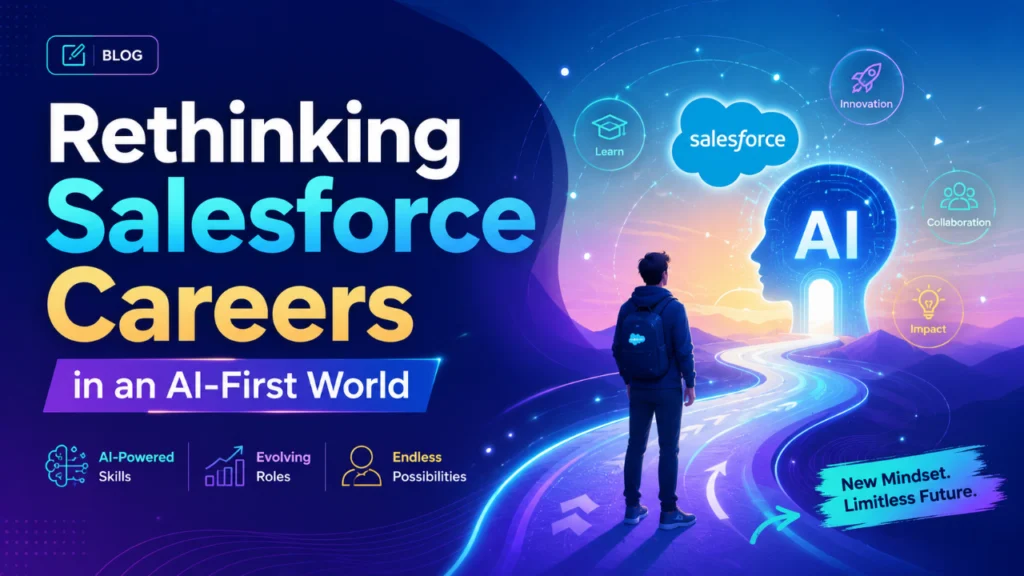
Introduction: Rethinking Salesforce Careers
The Salesforce ecosystem has long been recognized as one of the most promising career paths in the technology industry. From administrators and developers to consultants, architects, and business analysts, Salesforce professionals have played a crucial role in helping organizations manage customer relationships, automate processes, and drive business growth.
However, the rapid advancement of artificial intelligence (AI) is transforming the technology landscape. AI-powered tools can now generate code, automate repetitive tasks, analyze data, create reports, and even assist with decision-making. As a result, many professionals are asking an important question: Will AI replace Salesforce jobs, or will it create new opportunities?
The reality is that Salesforce careers are not disappearing. Instead, they are evolving. Professionals who understand how to work alongside AI will be better positioned to succeed in the next generation of Salesforce roles.
Table of Contents
Introduction: Rethinking Salesforce Careers
The Rise of AI in the Salesforce Ecosystem
Why Salesforce Careers Are Changing
The Future of Salesforce Administrators
The Evolution of Salesforce Developers
Consultants Will Become More Valuable
The Growing Importance of Salesforce Architects
New Opportunities Emerging with AIAI Solution Specialist
AI Governance Manager
Prompt Engineer
AI Business Analyst
Data Quality Specialist
Skills That Will Define Future SuccessBusiness Understanding
Data Literacy
Communication Skills
Problem-Solving Ability
AI Knowledge
Continuous Learning
What Salesforce Professionals Should Do Today
The Human Advantage AI Cannot Replace
Conclusion
The Rise of AI in the Salesforce Ecosystem
AI is no longer a futuristic concept. It has become a practical tool integrated into everyday business operations. Salesforce has embraced this transformation by embedding AI capabilities across its platform, enabling organizations to improve productivity, customer engagement, and operational efficiency.
AI assistance now enables faster completion of tasks that once required significant manual effort. Examples include:
Generating Apex code suggestions
Creating reports and dashboards
Automating customer service responses
Predicting sales opportunities
Building workflow recommendations
Enhancing marketing personalization
These capabilities allow teams to focus less on repetitive work and more on strategic initiatives that deliver business value.
Why Salesforce Careers Are Changing
The Salesforce industry is experiencing a shift from execution-focused roles to strategy-focused roles. Traditionally, professionals spent a large portion of their time performing manual configuration, coding, documentation, and data management tasks.
Today, AI can assist with many of these activities. This means organizations increasingly value professionals who can:
Solve business problems
Design scalable solutions
Interpret data insights
Manage stakeholder expectations
Govern AI implementation
Drive digital transformation
The ability to think critically and align technology with business objectives is becoming more important than technical execution alone.
The Future of Salesforce Administrators
Salesforce administrators remain essential to organizational success. However, their responsibilities are evolving.
In the past, administrators primarily focused on:
User management
Security settings
Report creation
Workflow configuration
Data maintenance
In an AI-first environment, administrators will also need to:
Manage AI-powered automation
Monitor AI-generated outputs
Ensure data quality
Configure intelligent workflows
Support AI adoption across teams
The future Salesforce administrator will act as both a platform expert and a business process advisor.
The Evolution of Salesforce Developers
Many developers worry that AI-generated code will reduce demand for development roles. While AI can accelerate coding tasks, it cannot fully replace skilled Salesforce developers.
AI can help generate:
Apex classes
Lightning Web Components
Test methods
Documentation
Debugging suggestions
However, developers are still needed to:
Design complex architectures
Validate AI-generated code
Maintain security standards
Optimize performance
Integrate enterprise systems
Solve unique business challenges
The role of the developer is shifting from writing every line of code manually to overseeing, validating, and improving AI-assisted development.
Consultants Will Become More Valuable
Salesforce consultants help organizations maximize their Salesforce investment by aligning technology with business goals.
As AI handles more technical tasks, consulting skills become even more important. Businesses still require experts who can:
Understand business requirements
Recommend suitable solutions
Lead digital transformation projects
Improve customer experiences
Guide change management initiatives
Organizations do not simply purchase technology; they invest in outcomes. Consultants who can connect Salesforce capabilities with measurable business value will continue to be in high demand.
The Growing Importance of Salesforce Architects
AI is least likely to replace architects because their role requires strategic thinking, experience, and decision-making.
Architects are responsible for:
Designing enterprise-wide solutions
Managing system scalability
Ensuring compliance and security
Creating integration strategies
Governing data architecture
AI can provide recommendations, but architects must evaluate trade-offs, business requirements, and long-term organizational goals.
As companies adopt AI technologies, they will significantly increase the demand for skilled architects.
New Opportunities Emerging with AI
Rather than eliminating careers, AI is creating entirely new opportunities within the Salesforce ecosystem.
Some emerging roles include:
AI Solution Specialist
Professionals who help organizations implement and optimize AI-powered Salesforce solutions.
AI Governance Manager
Experts responsible for ensuring ethical, secure, and compliant AI usage.
Prompt Engineer
Specialists who design effective prompts and workflows for AI-powered business applications.
AI Business Analyst
Professionals who bridge the gap between business requirements and AI capabilities.
Data Quality Specialist
Experts focused on maintaining clean, reliable data for AI-driven decision-making.
These roles combine Salesforce expertise with AI knowledge, creating exciting new career paths.
Skills That Will Define Future Success
As the Salesforce ecosystem evolves, professionals must continuously update their skills.
Business Understanding
Technology alone is not enough. Understanding business processes and customer needs is increasingly valuable.
Data Literacy
AI depends on data. Professionals who can analyze, interpret, and manage data effectively will have a competitive advantage.
Communication Skills
The ability to explain technical concepts to non-technical stakeholders remains essential.
Problem-Solving Ability
Organizations value professionals who can identify challenges and design effective solutions.
AI Knowledge
Understanding AI fundamentals, automation strategies, and intelligent workflows will become a critical skill across all Salesforce roles.
Continuous Learning
The technology landscape changes rapidly. Successful professionals invest in ongoing learning and certification development.
What Salesforce Professionals Should Do Today
To remain competitive in an AI-first world, Salesforce professionals should focus on preparation rather than fear.
Recommended actions include:
Learn about the AI capabilities available within Salesforce.
Develop stronger business consulting skills.
Improve data management expertise.
Explore automation and intelligent workflows.
Gain hands-on experience with AI-assisted development tools.
Stay updated with Salesforce product innovations.
Build problem-solving and strategic thinking abilities.
Expand knowledge of integrations and enterprise architecture.
Those who embrace change will find more opportunities than ever.
The Human Advantage AI Cannot Replace
Despite remarkable advancements, AI still has limitations.
AI cannot fully replicate the following:
Human creativity
Leadership
Strategic thinking
Relationship building
Emotional intelligence
Organizational understanding
Complex decision-making
Successful Salesforce projects require collaboration among stakeholders, users, executives, and technical teams. Human judgement remains essential for balancing competing priorities and delivering meaningful outcomes.
The professionals who combine technical expertise with strong business and interpersonal skills will remain highly valuable regardless of technological advances.
Conclusion
The Salesforce career landscape is entering a new era driven by artificial intelligence. While some routine tasks will become automated, the demand for skilled Salesforce professionals is not disappearing. Instead, the nature of the work is evolving toward higher-value activities that require strategic thinking, business expertise, and human insight.
Administrators will become automation specialists, developers will become AI-assisted solution builders, consultants will focus on business transformation, and architects will guide organizations through increasingly complex technology ecosystems.
The future belongs to professionals who adapt, learn continuously, and embrace AI as a powerful partner rather than viewing it as a threat. Salesforce careers are not ending. They are being redefined for an AI-first world. Those who prepare today will be best positioned to lead tomorrow’s digital transformation journey.
Founder and CEO of iTechCloud Solution, a Salesforce consulting and product partner since 2017. He sets engagement strategy and stays the commercial owner of every account, working with clients across Salesforce, AI and data from the first call through to go-live.
Connect on LinkedIn