

Build AI-Powered Workflows Using n8n and OpenAI

Automation is no longer just about moving data from one tool to another. With artificial intelligence in the mix, workflows can now think, analyze, generate, and decide. This is where n8n OpenAI automation becomes a game-changer. By combining n8n, a powerful workflow automation platform, with OpenAI, businesses and creators can build intelligent systems that automate content creation, customer support, data analysis, marketing, and internal operations.
This article explores how to build AI-powered workflows with n8n, why this approach matters, and how you can design scalable, smart automations using OpenAI models.
Table of Contents
What Is n8n and Why It’s Perfect for AI Automation
n8n is an open-source workflow automation tool that allows users to connect apps, APIs, and services visually. Unlike traditional automation platforms, n8n offers the following:
- Full control over workflow logic
- Self-hosting capabilities
- Advanced conditional logic
- Native support for APIs and custom code
When you introduce OpenAI integration with n8n, workflows evolve from simple task automation into intelligent decision-making systems.
Understanding OpenAI’s Role in Workflow Automation
OpenAI provides advanced language models capable of:
- Generating human-like text
- Summarizing large datasets
- Classifying and tagging information
- Analyzing sentiment and intent
- Producing code, emails, reports, and ideas
When combined with n8n, OpenAI becomes the “brain” of your automation system, while n8n acts as the orchestrator that connects data sources, triggers actions, and routes outcomes. This is the foundation of n8n AI workflow automation.
Why Build AI-Powered Workflows with n8n and OpenAI
Traditional automation follows rigid rules. AI-powered automation adapts, interprets, and improves outcomes.
Key Benefits
- Smarter Decisions
Workflows can analyze text, user behavior, or data patterns before acting. - Time Savings
Tasks that took hours, writing content, analysing feedback, and replying to queries, can be automated. - Scalability
AI workflows can handle thousands of inputs without additional effort. - Consistency with Flexibility
AI maintains quality while adapting tone, style, and intent. - Reduced Manual Errors
Automated intelligence minimises repetitive human mistakes.
Core Components of an n8n OpenAI Automation Workflow
Every AI-powered workflow with n8n follows a structured pattern:
1. Trigger
The workflow starts when an event occurs, such as the following:
- New form submission
- Incoming email
- API request
- Database update
- Scheduled time trigger
2. Data Preparation
Before sending data to OpenAI, n8n cleans, formats, or enriches the input. This may include:
- Extracting text
- Merging fields
- Removing unnecessary data
3. OpenAI Processing
The OpenAI node processes the data using prompts, instructions, or system messages. This is where intelligence happens:
- Content generation
- Classification
- Analysis
- Summarization
4. Logic & Conditions
n8n evaluates the AI output and applies conditions:
- If sentiment is negative → escalate
- If lead quality is high → notify sales
- If content passes validation → publish
5. Action & Output
Finally, n8n sends results to tools such as the following:
- Databases
- CRMs
- Email platforms
- Messaging apps
- CMS systems
Popular Use Cases for AI-Powered Workflows with n8n
1. AI Content Creation Automation
One of the most common use cases of n8n OpenAI automation is content generation.
Automated workflow examples:
- Blog outline generation
- Social media post creation
- Product description writing
- Email campaign drafts
The workflow can:
- Receive a topic or keyword
- Send it to OpenAI for content generation
- Review length, tone, or keywords
- Save or publish the content automatically
2. Customer Support Automation
AI-powered workflows with n8n can analyze incoming support requests and respond intelligently.
Capabilities include:
- Classifying tickets by priority
- Detecting customer sentiment
- Generating draft replies
- Escalating complex issues
This reduces response time while maintaining personalized communication.
3. Lead Qualification and Scoring
With OpenAI integration with n8n, lead data can be evaluated intelligently.
The workflow can:
- Analyze form responses
- Score leads based on intent
- Identify high-value prospects
- Route leads to appropriate teams
This creates smarter sales pipelines without manual review.
4. Data Analysis and Summarization
AI excels at understanding large volumes of text and data.
n8n workflows can
- Summarize meeting notes
- Analyze survey responses
- Extract insights from feedback
- Generate reports automatically
This is especially powerful for operations, HR, and research teams.
5. Social Media and Marketing Automation
AI-powered workflows with n8n help marketers scale content and engagement.
Examples include:
- Caption generation
- Hashtag recommendations
- Comment moderation
- Campaign performance analysis
The result is consistent brand messaging with minimal effort.
Designing Effective Prompts for n8n AI Workflow Automation
Prompt design is critical for reliable AI output.
Best Practices for Prompts
- Be specific and structured
- Define tone and format clearly
- Set word or character limits
- Provide examples when possible
- Avoid vague instructions
A well-designed prompt ensures predictable results across automated workflows.
Handling Errors and Quality Control
AI outputs are powerful but not perfect. n8n allows you to implement safeguards.
Quality Control Techniques
- Validation checks on AI responses
- Conditional logic for low-confidence outputs
- Human review steps for critical workflows
- Logging and error handling nodes
These practices make AI-powered workflows with n8n production-ready.
Security and Ethical Considerations
When using OpenAI within automation workflows, responsible usage is essential.
Key Considerations
- Avoid sending sensitive personal data unnecessarily
- Mask or anonymize inputs
- Store AI outputs securely
- Ensure compliance with internal policies
n8n’s self-hosting option provides added control for businesses handling sensitive data.
Scaling AI Workflows with n8n
As usage grows, workflows must scale efficiently.
Tips for Scaling
- Modularize workflows
- Reuse common AI prompt templates
- Optimize API calls
- Use queues and batch processing
- Monitor execution performance
Proper design ensures that n8n AI workflow automation remains fast and cost-effective at scale.
Comparing Traditional Automation vs AI-Powered Automation
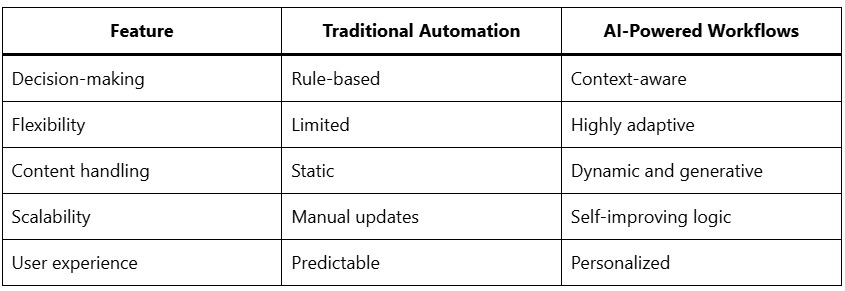
AI-powered workflows with n8n clearly represent the next evolution of automation.
The Future of OpenAI Integration with n8n
The future of automation is intelligent, adaptive, and autonomous.
Expected advancements include:
- Multi-step reasoning workflows
- AI agents coordinating multiple tasks
- Real-time decision systems
- Deeper personalization
- Autonomous workflow optimization
As OpenAI models improve, n8n OpenAI automation will become even more powerful and accessible.
Final Thoughts
Building AI-powered workflows using n8n and OpenAI unlocks a new level of efficiency, intelligence, and scalability. From content creation and marketing to customer support and analytics, AI-driven automation transforms how work gets done. With thoughtful prompt design, proper workflow structure, and ethical considerations, n8n AI workflow automation empowers businesses and creators to move faster, smarter, and more creatively than ever before.