
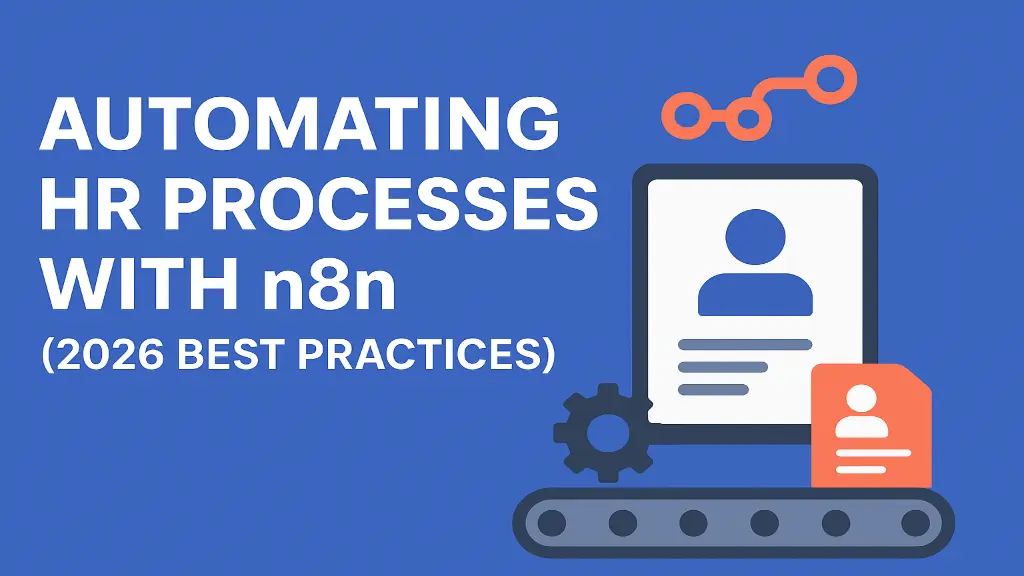
Introduction: Automating HR Processes with n8n
The landscape of human resources in 2026 has fundamentally shifted from reactive administration to proactive, strategic operations. This extensive guide explores how n8n has emerged as the pivotal orchestration layer for this transformation. Unlike the rigid, linear automation tools of the early 2020s, n8n’s node-based architecture now powers “agentic HR” systems where AI agents not only execute tasks but also make low-level decisions, routing complex issues to human professionals. The core thesis is that by 2026, the value of HR automation is no longer just about saving time; it is about delivering a hyper-personalised employee experience (EX) at scale while maintaining strict data sovereignty.
Table of Contents
Introduction: Automating HR Processes with n8nWhy n8n is the Standard for HR in 2026Technical Best Practices: Modular Design and Error HandlingConclusion: The Human-Centric Future
Why n8n is the Standard for HR in 2026
The blog highlights why n8n has surpassed closed-source competitors for HR workflows. The primary driver is data sovereignty and privacy. With the maturation of AI regulations (GDPR 2.0 and global AI acts), HR teams can no longer risk sending sensitive employee PII (Personally Identifiable Information) to “black box” third-party clouds. n8n’s self-hostable nature allows organizations to run powerful automation workflows on their own infrastructure, ensuring that candidate data, payroll details, and internal feedback never leave the corporate firewall. Furthermore, the article drive,emphasises cost-effective scalability. As HR workflows become more complex, involving thousands of execution steps per recruitment drive, n8n’s fair-code model prevents the “pricing cliff” often seen with volume-based SaaS automation tools.
Use Case 1: Recruitment 3.0 and The Intelligent Screen
A major section of the guide details the evolution of recruitment automation. The 2026 best practice involves “Intelligent Screening” pipelines. Instead of simple keyword matching, n8n workflows now utilise Large Language Model (LLM) nodes to semantically analyze resumes. The workflow triggers when a candidate applies via an ATS (like Greenhouse or Lever). n8n extracts the resume, anonymizes the personal data to prevent bias, and passes the text to an AI agent. This agent scores the candidate not just on skills but also on implied soft skills and project context. The summary notes that top-tier workflows now include “Vision Nodes” that can parse creative portfolios or non-standard PDF layouts, ensuring no talent is overlooked due to formatting issues.
Use Case 2: “Zero-Day” Onboarding Orchestration
The article describes the “Zero-Day” onboarding standard a process where the administrative burden of a new hire is resolved before their first day. n8n acts as the central nervous system connecting disparate departments. Once a contract is signed, an n8n master workflow triggers parallel sub-workflows: IT is signaled to provision hardware and create Single Sign-On (SSO) accounts; Facilities is notified to assign a desk and security badge; and Payroll is updated with tax information. Uniquely, 2026 best practices emphasize the “Culture Injection” workflow, where n8n schedules automated “coffee chats” with relevant team members and assigns a peer mentor, populating the new hire’s calendar immediately upon account creation.
Use Case 3: The Internal Knowledge Bot (RAG)
One of the most transformative applications discussed is the deployment of Retrieval-Augmented Generation (RAG) for internal HR support. Rather than answering repetitive questions about leave policies or benefits manually, HR teams use n8n to build “knowledge agents”. These workflows ingest company handbooks and policy documents into a vector store (like Pinecone or Qdrant). When an employee asks a question via Slack or Teams, an n8n webhook captures the query, retrieves the relevant policy section, and uses an LLM to draft a precise, empathetic answer. The guide stresses that 2026 best practices require a “human-in-the-loop” step for sensitive queries, where n8n routes the draft answer to an HR manager for one-click approval before sending.
Use Case 4: Pulse Analytics and Retention
The summary touches upon the proactive use of data to prevent burnout. Advanced n8n workflows are now used to aggregate “exhaust data” (metadata from work platforms, not content) to gauge team sentiment. For instance, a workflow might detect a spike in after-hours communication or a drop in meeting attendance across a specific department. This data doesn’t trigger a disciplinary action but rather alerts HR business partners to potential burnout risks. The article advises on the ethical configuration of these workflows, ensuring they are used for aggregate well-being analysis rather than individual surveillance, aligning with the “Employee Trust” framework essential in the 2026 workplace.
The technical section of the blog warns against “spaghetti automations”, massive, linear workflows that are impossible to debug. The 2026 standard is Modular Architecture. HR Engineers should build small, reusable sub-workflows (e.g., a standalone “Send Email via Gmail” workflow or a “Update BambooHR” workflow) that can be called by various parent processes. This ensures that if an API changes, it only needs to be fixed in one place. Additionally, robust error handling is non-negotiable. Every HR workflow must have error triggers that not only log the failure but also send an immediate notification to the HR Ops team via Slack/Teams, ensuring that no candidate is ghosted and no payroll update is missed due to a technical glitch.
The blog concludes by reiterating that automation via n8n is not about removing humans from HR but about removing the robot from the human. By offloading the 60-70% of HR tasks that are transactional, n8n allows HR professionals to focus on high-touch interactions, coaching, conflict resolution, and culture-building. The “2026 Best Practices” ultimately define success not by the number of workflows running but by the measurable improvement in employee satisfaction and the agility of the HR function to adapt to rapid organisational change.
Part of the team turning Salesforce and AI strategy into shipped, measurable outcomes for enterprises across five regions.