
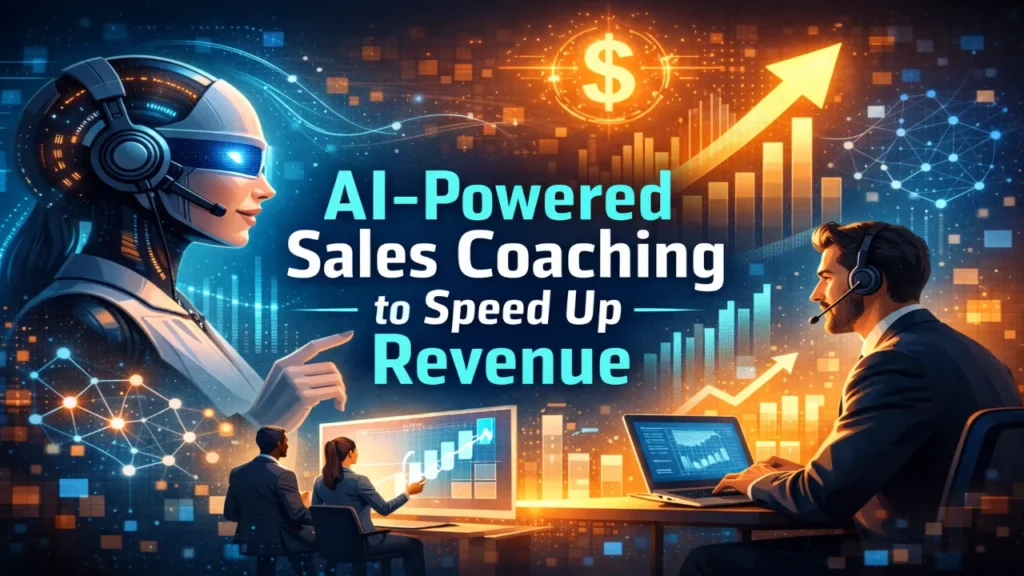
Artificial intelligence is no longer just a support tool; it has evolved into a strategic driver of sales results. AI enables sales teams to work smarter, close faster, and create more value throughout the customer lifecycle by leveraging automation, predictive insights, and personalised coaching. As organisations adopt AI-first strategies, AI-powered coaching is emerging as one of the most effective ways to accelerate revenue growth.
Table of Contents
Why Traditional Sales Coaching Falls Short1. Inconsistent Coaching Quality
2. Lack of Real-Time Visibility
3. Limited Time for Managers
4. Generic Training Content
5. No Clear Measurement
What Is AI-Powered Sales Coaching?
Key Capabilities of AI-Driven Sales Coaching1. Real-Time Call Intelligence
2. Automated Performance Analysis
3. Personalized Coaching Paths
4. Predictive Deal Insights
5. Content and Script Optimization
6. Real-Time Nudges
7. Automated Reporting
How AI-Powered Coaching Accelerates Revenue Growth1. Faster Onboarding
2. Better Pipeline Hygiene
3. Higher Win Rates
4. Shorter Sales Cycles
5. Increased Sales Productivity
6. Enhanced Coaching Quality
7. Consistent Best Practices
The Manager’s Role in an AI-Driven Coaching Model1. Strategic Coaching
2. Human Motivation
3. High-Impact Interventions
4. Team Alignment
Real-World Use Cases of AI-Powered Coaching1. Reducing Lost Deals from Poor Discovery
2. Improving Follow-Up Discipline
3. Enhancing Objection Handling
4. Increasing Cross-Sell and Upsell Opportunities
5. Supporting Remote Sales Teams
How Organizations Can Adopt AI-Powered Sales Coaching1. Start with Data Quality
2. Integrate Coaching Tools into Daily Workflows
3. Focus on Change Management
4. Set Performance Benchmarks
5. Maintain Human Oversight
The Future of AI-Driven Sales Coaching
Conclusion
Why Traditional Sales Coaching Falls Short
For decades, sales coaching has relied on in-person interactions, manual performance reviews, and generalised training content. While valuable, these methods often face several limitations:
1. Inconsistent Coaching Quality
Different managers coach differently. The absence of standardised frameworks results in unpredictable outcomes and uneven team performance.
2. Lack of Real-Time Visibility
Managers usually analyse performance after conversations happen. Without live insights, opportunities to correct behaviour or guide reps in the moment are missed.
3. Limited Time for Managers
Sales managers are overloaded with forecasts, team operations, hiring, reviews, and deal approvals. This leaves little room for consistent coaching.
4. Generic Training Content
Traditional training often focuses on broad skills that may not reflect current deals, customer sentiment, or rep-specific gaps.
5. No Clear Measurement
It’s difficult to measure the true ROI of human coaching without structured data or trend analysis.
AI solves these limitations at scale by offering continuous, unbiased, and data-driven coaching to every rep.
What Is AI-Powered Sales Coaching?
AI-powered sales coaching uses artificial intelligence, machine learning, and automation to analyse sales activities and provide real-time feedback, personalised recommendations, and performance insights.
Instead of a manager manually observing calls or reviewing CRM data, AI automatically:
Monitors sales calls and emails
Detects tone, keywords, and sentiment
Evaluates rep performance
Highlights risks and opportunities
Recommends next-best actions
Suggests personalized training modules
Reinforces best practices
This creates a smart coaching layer that boosts skill development and deal execution simultaneously.
Key Capabilities of AI-Driven Sales Coaching
1. Real-Time Call Intelligence
AI tools can listen to sales calls in real time, analyse customer sentiment, measure talk-to-listen ratios, and identify effective sales behaviours. Reps receive instant cues during conversations, such as reminders to ask discovery questions or reduce monologues.
2. Automated Performance Analysis
AI compares each rep’s activities against top performers to pinpoint gaps. It identifies patterns such as low follow-up frequency, delayed responses, or neglected high-value leads.
3. Personalized Coaching Paths
Each rep gets individualised guidance based on their strengths and weaknesses. AI creates personalised micro-learning content and habit-building recommendations.
4. Predictive Deal Insights
AI models forecast deal success likelihood by analysing historical data, buyer engagement, objection trends, and pipeline movements. This helps managers coach reps toward the most impactful actions.
5. Content and Script Optimization
AI analyses which sales scripts, templates, and talk tracks perform the best and recommends improvements. Reps also get tailored email copy or call scripts optimised for conversion.
6. Real-Time Nudges
During live calls or CRM updates, AI prompts reps with nudges such as:
“Ask a budget-related question.”
“Mention the value proposition related to customer pain.”
“Follow up with a proposal now for better closing probability.”
These nudges help reps stay intentional and effective.
7. Automated Reporting
AI removes the burden of manual reporting. It generates coaching dashboards, weekly summaries, and performance trackers that keep everyone aligned.
How AI-Powered Coaching Accelerates Revenue Growth
The primary goal of sales organisations is revenue acceleration. AI coaching delivers measurable impact across the revenue funnel.
1. Faster Onboarding
New reps ramp up significantly faster because AI offers consistent, data-driven guidance. They learn from top performer behaviours without waiting for scheduled coaching sessions.
2. Better Pipeline Hygiene
AI continuously monitors data quality and reminds reps to update fields, add notes, and complete follow-ups. A cleaner pipeline means better forecasting and fewer lost opportunities.
3. Higher Win Rates
When reps receive insights on customer sentiment, objection trends, and next-best actions, they execute deals more effectively. This directly boosts close rates.
4. Shorter Sales Cycles
Real-time call intelligence helps reps navigate conversations more efficiently, reducing the number of back-and-forth interactions. AI also flags delays quickly, speeding up progression through pipeline stages.
5. Increased Sales Productivity
AI eliminates repetitive tasks like summarising calls, writing emails, updating CRM fields, or scheduling follow-ups. This allows reps to spend more time selling.
6. Enhanced Coaching Quality
Managers can finally coach with precision. They get access to unbiased insights about rep performance, deal health, and skill gaps, leading to more meaningful coaching conversations.
7. Consistent Best Practices
Through automated nudges and recommendations, AI makes sure every rep follows proven playbooks and messaging frameworks.
The Manager’s Role in an AI-Driven Coaching Model
Even with AI, managers continue to play a critical role. But their responsibilities shift from transactional work to high-value leadership:
1. Strategic Coaching
Managers use AI insights to guide reps on mindset, strategy, and advanced selling skills.
2. Human Motivation
AI can highlight gaps, but managers provide encouragement, empathy, and support.
3. High-Impact Interventions
Managers can focus on complex deals, conflict resolution, and scenario-based coaching instead of administrative tasks.
4. Team Alignment
AI ensures data consistency, while managers ensure cultural alignment, morale, and collaboration.
Together, AI and sales managers create a coaching environment that blends data precision with human connection.
Real-World Use Cases of AI-Powered Coaching
1. Reducing Lost Deals from Poor Discovery
AI tracks whether reps ask the right questions. If discovery quality drops, it alerts managers and suggests training modules.
2. Improving Follow-Up Discipline
AI monitors engagement timelines and nudges reps to follow up after specific time gaps.
3. Enhancing Objection Handling
AI identifies objections that commonly lead to stalled deals and recommends best-practice scripts.
4. Increasing Cross-Sell and Upsell Opportunities
AI analyses buying signals, product usage, and customer health to recommend value-added offerings.
5. Supporting Remote Sales Teams
With virtual selling growing, AI ensures remote reps receive continuous coaching anytime, anywhere.
How Organizations Can Adopt AI-Powered Sales Coaching
1. Start with Data Quality
High-quality CRM and call-recording data ensures better AI recommendations.
2. Integrate Coaching Tools into Daily Workflows
AI coaching works best when embedded into CRM systems, call platforms, and collaboration apps.
3. Focus on Change Management
Reps and managers need training, clarity on expectations, and guidelines for using AI effectively.
4. Set Performance Benchmarks
Define KPIs such as win rates, deal velocity, or ramp-up time to measure the impact.
5. Maintain Human Oversight
AI supports coaching, but managers validate insights and ensure fairness.
The Future of AI-Driven Sales Coaching
Sales coaching is evolving rapidly. With advancements in generative AI, conversational intelligence, and predictive analytics, the future will bring:
Hyper-personalized coaching plans
Deep buyer-behavior predictions
Role-playing simulations powered by AI
Automated deal strategy recommendations
Multi-channel coaching across calls, email, chat, and video
Full integration with marketing and customer success
Continuous learning through real-time data streams
As AI becomes more sophisticated, sales teams will operate with unprecedented efficiency, precision, and agility.
Conclusion
AI-powered sales coaching is no longer optional. It is essential for organisations that want to accelerate revenue and stay competitive. By delivering personalised insights, real-time guidance, and intelligent automation, AI transforms every rep into a high-performing, data-driven seller. It speeds up onboarding, improves win rates, shortens sales cycles, and enhances coaching quality across the board.
Organisations that embrace AI-powered coaching will build stronger teams, deliver exceptional buying experiences, and unlock sustainable revenue growth.
Founder and CEO of iTechCloud Solution, a Salesforce consulting and product partner since 2017. He sets engagement strategy and stays the commercial owner of every account, working with clients across Salesforce, AI and data from the first call through to go-live.
Connect on LinkedIn