
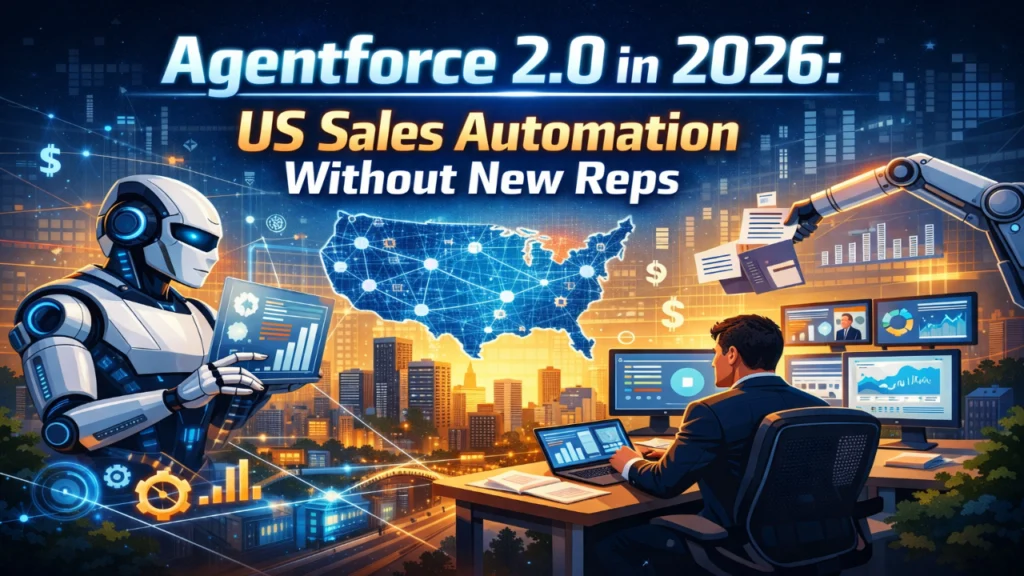
Agentforce 2.0 represents the next generation of intelligent sales automation. It combines artificial intelligence, workflow automation, predictive analytics, and conversational interfaces to handle tasks traditionally managed by human sales representatives. From lead generation to closing deals, organizations are leveraging this technology to streamline processes, improve accuracy, and accelerate growth, all without hiring additional reps.
Table of Contents
The Evolution of Sales Automation
Why US Companies Are Adopting Agentforce 2.01. Rising Cost of Sales Teams
2. Demand for Faster Sales Cycles
3. Data-Driven Decision Making
4. Scalability Without Complexity
Key Features of Agentforce 2.0Intelligent Lead Qualification
Autonomous Outreach
Conversational AI
Workflow Automation
Predictive Forecasting
How Businesses Are Using Agentforce 2.0B2B SaaS Companies
E-commerce and Retail
Financial Services
Real Estate
Benefits of Sales Automation Without New RepsIncreased Efficiency
Improved Consistency
Higher Conversion Rates
Reduced Operational Costs
Better Resource Allocation
Challenges and ConsiderationsImplementation Complexity
Data Quality
Human Touch
Change Management
The Future of Sales with Agentforce 2.0
Conclusion: Agentforce 2.0 in 2026
The Evolution of Sales Automation
Sales automation is not a new concept. Over the past decade, companies have adopted CRM systems, email automation tools, and basic AI-driven insights. However, these tools often required human intervention at multiple stages. Sales reps still needed to qualify leads, follow up manually, and manage pipelines.
Agentforce 2.0 changes this dynamic by introducing autonomous agents that can operate independently across the entire sales cycle. These agents are capable of:
Identifying high-quality leads using real-time data
Engaging prospects through personalized communication
Scheduling meetings and demos automatically
Nurturing leads with targeted content
Assisting in deal closure with predictive recommendations
This level of automation allows businesses to handle a larger volume of prospects without increasing headcount.
Why US Companies Are Adopting Agentforce 2.0
Several factors are driving the rapid adoption of Agentforce 2.0 across US organizations.
1. Rising Cost of Sales Teams
Hiring, training, and retaining sales representatives has become increasingly expensive. Salaries, commissions, benefits, and onboarding costs add up quickly. For growing companies, scaling a sales team can significantly impact profitability.
Agentforce 2.0 offers a cost-effective alternative. Once implemented, it can handle repetitive and time-consuming tasks at scale, reducing the need for large teams while maintaining or even improving performance.
2. Demand for Faster Sales Cycles
Modern buyers expect quick responses and personalized experiences. Delayed follow-ups or generic messaging can result in lost opportunities.
With Agentforce 2.0, responses are instant and tailored. AI agents analyze customer behaviour, preferences, and interactions to deliver relevant communications at the right time. This accelerates the sales cycle and improves conversion rates.
3. Data-Driven Decision Making
Sales success increasingly depends on data. Companies need insights into customer behaviour, market trends, and pipeline performance.
Agentforce 2.0 leverages advanced analytics to provide actionable insights. It predicts which leads are most likely to convert, identifies bottlenecks in the sales process, and suggests optimal strategies for closing deals.
4. Scalability Without Complexity
Traditional scaling often introduces complexity: more people, more management layers, and more coordination challenges.
Agentforce 2.0 enables seamless scaling. Businesses can handle increased demand without adding operational complexity, making it ideal for fast-growing companies and startups.
Key Features of Agentforce 2.0
Agentforce 2.0 stands out due to its advanced capabilities that go beyond traditional automation tools.
Intelligent Lead Qualification
Instead of relying on manual scoring, Agentforce 2.0 uses machine learning models to evaluate leads in real time. It considers multiple factors, such as behaviour, demographics, and engagement history, to determine lead quality.
Autonomous Outreach
AI-powered agents can initiate and manage outreach campaigns. They send emails, messages, and follow-ups based on predefined strategies and real-time triggers.
Conversational AI
Agentforce 2.0 includes sophisticated conversational AI that can interact with prospects in a natural and human-like manner. These interactions can happen via chat, email, or voice, ensuring consistent engagement across channels.
Workflow Automation
Complex sales workflows are automated end-to-end. From assigning leads to updating CRM records, every step is handled seamlessly, reducing manual effort and errors.
Predictive Forecasting
Sales forecasting becomes more accurate with AI-driven predictions. Agentforce 2.0 analyses historical data and current trends to provide reliable forecasts, helping businesses plan effectively.
How Businesses Are Using Agentforce 2.0
Companies across industries are implementing Agentforce 2.0 in innovative ways to drive results.
B2B SaaS Companies
Software companies are using Agentforce 2.0 to manage inbound leads, qualify prospects, and schedule product demos automatically. This ensures that no opportunity is missed and that human reps can focus on high-value deals.
E-commerce and Retail
Retail businesses are leveraging AI agents to engage customers, recommend products, and handle enquiries. This enhances the customer experience while increasing sales conversions.
Financial Services
Financial institutions are using automation to manage client onboarding, provide personalized investment recommendations, and follow up with potential clients efficiently.
Real Estate
Real estate firms are using Agentforce 2.0 to capture leads from multiple channels, nurture prospects, and schedule property viewings without manual intervention.
Benefits of Sales Automation Without New Reps
The ability to scale sales without hiring additional representatives offers several advantages.
Increased Efficiency
Automation eliminates repetitive tasks, allowing businesses to operate more efficiently. Processes that once took hours can now be completed in seconds.
Improved Consistency
Human performance can vary, but AI-driven systems deliver consistent results. Every lead receives the same level of attention and follow-up.
Higher Conversion Rates
Personalized communication and timely engagement lead to better customer experiences and higher conversion rates.
Reduced Operational Costs
By minimising the need for additional staff, companies can significantly reduce operational expenses while still maintaining growth.
Better Resource Allocation
Existing sales teams can focus on strategic activities such as relationship building and closing high-value deals, rather than routine tasks.
Challenges and Considerations
While Agentforce 2.0 offers numerous benefits, businesses must also address certain challenges to maximise its potential.
Implementation Complexity
Deploying advanced automation requires careful planning and integration with existing systems. Companies need to ensure that their infrastructure can support these technologies.
Data Quality
The effectiveness of AI depends on data quality. Inaccurate or incomplete data can lead to poor decisions and reduced performance.
Human Touch
Despite advancements in AI, human interaction remains important in sales. Businesses must strike the right balance between automation and personal engagement.
Change Management
Adopting new technology often requires a cultural shift. Employees need to be trained and aligned with the new approach to ensure successful implementation.
The Future of Sales with Agentforce 2.0
As technology continues to evolve, the role of AI in sales will only expand. Agentforce 2.0 is just the beginning of a broader transformation.
In the future, we can expect:
Even more advanced AI capabilities with deeper personalization
Seamless integration across multiple platforms and channels
Enhanced predictive analytics for better decision-making
Greater collaboration between human reps and AI agents
Sales teams will not disappear, but their roles will change. Instead of focusing on routine tasks, they will act as strategists, relationship builders, and problem solvers.
Conclusion: Agentforce 2.0 in 2026
Agentforce 2.0 is redefining how sales operates in 2026. By enabling businesses to automate key processes and operate without expanding their sales teams, it offers a powerful solution to modern challenges.
US companies are embracing this shift to stay competitive, reduce costs, and improve efficiency. While there are challenges to overcome, the benefits far outweigh the drawbacks when implemented correctly.
The future of sales lies in intelligent automation, where AI and humans work together to achieve better outcomes. Agentforce 2.0 is leading this transformation, proving that growth is no longer dependent on increasing headcount but on leveraging technology effectively.
Founder and CEO of iTechCloud Solution, a Salesforce consulting and product partner since 2017. He sets engagement strategy and stays the commercial owner of every account, working with clients across Salesforce, AI and data from the first call through to go-live.
Connect on LinkedIn