

5 Enterprise AI Trends Salesforce Says Will Define 2026
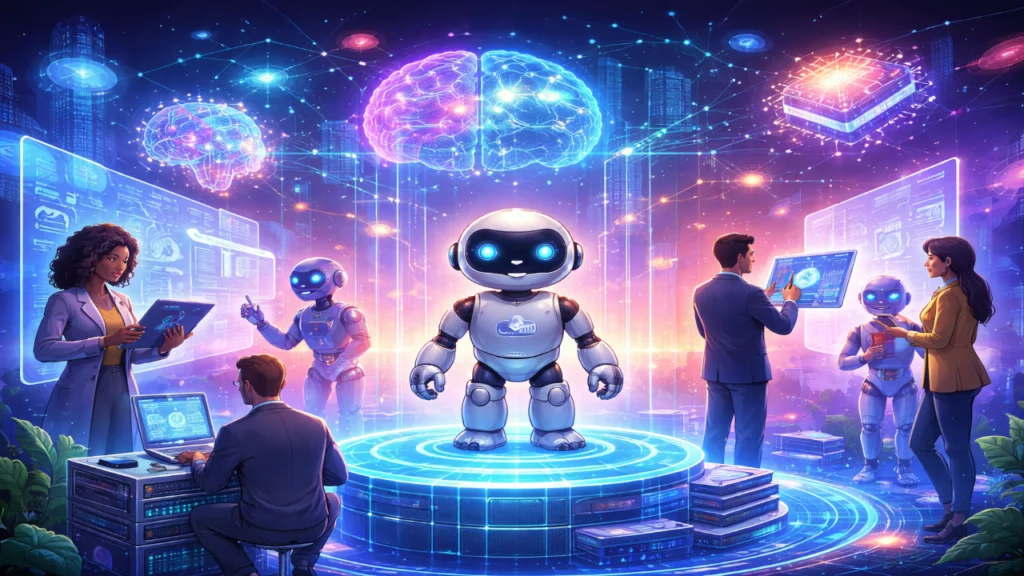
Artificial intelligence is no longer a futuristic concept—it has become the backbone of enterprise innovation. As businesses continue to evolve in a hyper-digital world, AI is shaping how organizations operate, compete, and deliver value. According to insights from Salesforce, 2026 will mark a turning point where AI transitions from a supporting tool to a core business driver.
From autonomous agents to deeply embedded intelligence across workflows, enterprise AI is entering a new era. In this blog, we explore five major AI trends that will define 2026 and reshape the future of work.
Table of Contents
1. AI Agents Become Core Digital Workforce
One of the most transformative trends is the rise of AI agents as an integral part of the workforce. These are not just simple chatbots—they are intelligent systems capable of reasoning, decision-making, and executing tasks autonomously.
In 2026, enterprises will increasingly rely on AI agents to handle complex workflows such as customer support, lead qualification, service case resolution, and even internal operations. Unlike traditional automation, these agents can adapt in real time, learn from data, and collaborate with humans.
For example, AI agents will:
- Handle multi-step customer queries without human intervention
- Automatically prioritize and resolve support tickets
- Assist sales teams by identifying high-value prospects
This shift will redefine productivity. Employees will focus more on strategic work, while AI agents take over repetitive and data-heavy tasks.
However, the use of AI also brings new challenges—organisations will need clear governance models to manage AI behaviour, accountability, and performance.
2. Hyper-Personalization at Scale
Personalization has been a buzzword for years, but AI is finally making it scalable. In 2026, enterprises will deliver deeply personalized experiences across every customer touchpoint—emails, websites, apps, and even customer service interactions.
AI systems will analyze vast amounts of customer data in real time, including:
- Behavioral patterns
- Purchase history
- Engagement signals
- Preferences and intent
Using this data, businesses can tailor messaging, product recommendations, and offers for each individual customer.
This level of personalization will go beyond marketing. Sales teams will receive AI-driven insights on how to approach each prospect, while service teams will provide context-aware support instantly.
The key shift here is from segmentation to true one-to-one engagement. Customers will expect brands to understand them deeply—and companies that fail to meet this expectation may fall behind.
3. Unified Data + AI Platforms Become Essential
AI is only as powerful as the data behind it. One of the biggest barriers enterprises face today is fragmented data across multiple systems. In 2026, the focus will shift toward unified data platforms that integrate all business data into a single, accessible source.
Companies will invest heavily in:
- Data unification across CRM, ERP, and external systems
- Real-time data pipelines
- Clean, structured, and governed datasets
With unified data, AI models can generate more accurate predictions and insights. This will enable better decision-making across departments—from marketing and sales to finance and operations.
The concept of a “single source of truth” will become critical. Without it, even the most advanced AI systems will struggle to deliver value.
Organizations that successfully unify their data will gain a significant competitive advantage, as they can act faster and more intelligently than their competitors.
4. Trust, Security, and Ethical AI Take Center Stage
As AI adoption grows, so do concerns around trust, security, and ethics. In 2026, enterprises will prioritise responsible AI practices to ensure transparency, fairness, and compliance.
Key focus areas will include:
- Data privacy and protection
- Bias detection and mitigation
- Explainability of AI decisions
- Regulatory compliance
Customers and regulators are becoming more aware of how AI systems operate. Businesses will need to clearly explain how their AI models make decisions, especially in sensitive areas like finance, healthcare, and hiring.
Trust will become a competitive differentiator. Companies that build transparent and ethical AI systems will earn customer confidence, while those that neglect these aspects risk reputational damage.
This trend will also lead to the rise of AI governance frameworks, where organizations establish clear policies and oversight mechanisms for AI usage.
5. AI-Driven Automation Expands Across Every Department
Automation is not new, but AI is taking it to the next level. In 2026, AI-driven automation will extend beyond IT and operations into every business function.
Here’s how different departments will benefit:
Sales
AI will automate lead scoring, pipeline management, and forecasting. Sales reps will receive real-time recommendations on the next best action.
Marketing
Campaigns will be automatically optimised based on performance data. AI will generate content, segment audiences, and predict outcomes.
Customer Service
AI will resolve a majority of customer queries instantly, reducing wait times and improving satisfaction.
HR and Finance
From recruitment to payroll processing, AI will streamline administrative tasks and provide predictive insights.
This widespread adoption of AI automation will lead to faster processes, reduced costs, and improved efficiency. However, it also requires organizations to rethink their workflows and upskill employees to work alongside AI systems.
The Bigger Picture: Human + AI Collaboration
While these trends highlight the growing power of AI, the future is not about replacing humans—it’s about collaboration.
In 2026, the most successful organizations will be those that combine human creativity, empathy, and strategic thinking with AI’s speed, accuracy, and scalability.
Employees will increasingly act as the following:
- Decision-makers supported by AI insights
- Supervisors of AI agents
- Creators of AI-driven strategies
This shift will require a cultural transformation within organizations. Businesses must invest in training programmes to help employees understand and leverage AI effectively.
Challenges Enterprises Must Overcome
Despite the opportunities, adopting AI at scale comes with challenges:
- Data Quality Issues: Poor data can lead to inaccurate AI outputs
- Integration Complexity: Connecting multiple systems is not easy
- Skill Gaps: Employees need training to work with AI tools
- Cost and ROI Concerns: Implementing AI requires significant investment
Addressing these challenges will be crucial for organizations to fully realise the benefits of AI.
Preparing for 2026: What Businesses Should Do Now
To stay ahead of these trends, enterprises should start preparing today:
- Invest in Data Infrastructure
Build a strong foundation with clean and unified data - Adopt AI Gradually
Start with high-impact use cases and scale over time - Focus on Governance
Establish clear policies for ethical and responsible AI use - Upskill the Workforce
Train employees to collaborate effectively with AI systems - Measure Impact
Continuously track ROI and optimize AI initiatives
Conclusion: AI Trends Salesforce
The year 2026 will be a watershed moment in the evolution of enterprise AI. As highlighted by Salesforce, organizations are moving toward a future where AI is deeply embedded in every aspect of business operations.
From autonomous AI agents and hyper-personalisation to unified data platforms and ethical AI practices, these trends will redefine how enterprises function. The shift is not just technological—it’s strategic and cultural. Businesses that embrace these changes early will unlock new levels of efficiency, innovation, and customer satisfaction. Those that hesitate may struggle to keep up in an increasingly AI-driven world.