

3 Essential Skills Salesforce Architects Need in the AI Era
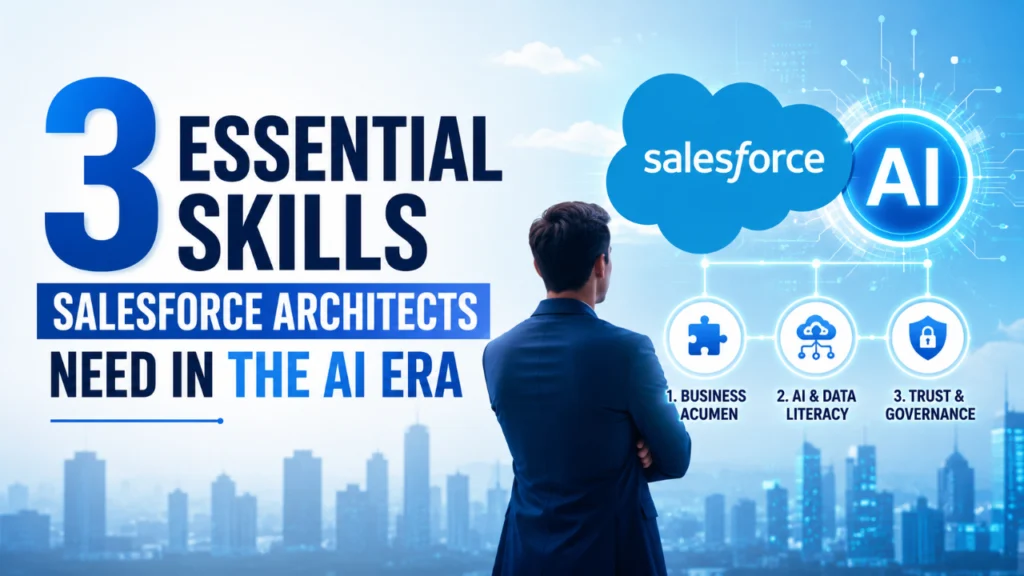
Artificial intelligence is transforming the Salesforce ecosystem faster than ever. From intelligent automation and predictive analytics to AI-powered customer interactions, organizations are rapidly adopting AI-driven solutions to improve efficiency, customer experience, and business outcomes. As a result, the role of the Salesforce architect is evolving beyond traditional system design and platform governance.
Today’s Salesforce architects are expected not only to understand the technical aspects of the platform but also to guide organizations through AI adoption, data strategy, and intelligent automation initiatives. While AI tools can automate many routine tasks, the need for skilled architects who can align technology with business goals has never been greater.
To remain valuable and future-ready, Salesforce architects must develop a new set of capabilities. Here are the three essential skills that will protect and strengthen Salesforce Architect careers in the AI era.
Table of Contents
1. AI Strategy and Solution Architecture
AI is no longer a futuristic concept within Salesforce. It has become an integral part of customer relationship management, service operations, sales enablement, marketing automation, and business intelligence. Salesforce architects must understand how AI technologies fit into the broader enterprise landscape and how they can create measurable business value.
Why This Skill Matters
Many organizations are investing heavily in AI initiatives but struggle to identify the right use cases. Architects play a critical role in determining where AI can improve efficiency, automate processes, and enhance decision-making.
Instead of simply implementing technology, architects must evaluate business requirements and identify opportunities where AI can deliver meaningful outcomes. This includes recommending intelligent workflows, predictive analytics, conversational AI solutions, and automation strategies.
Key Areas to Master
- AI-powered CRM solutions
- Salesforce Agentforce capabilities
- Predictive analytics and forecasting
- Generative AI applications
- Intelligent automation frameworks
- AI governance and compliance
- AI integration with existing business systems
Real-World Example
Consider a customer service organization handling thousands of support tickets daily. An architect can design a solution where AI automatically categorises cases, recommends resolutions, prioritises urgent issues, and assists service agents with real-time suggestions. This improves productivity and enhances customer satisfaction.
How to Build This Skill
Salesforce architects should actively explore AI-powered Salesforce products, experiment with intelligent automation use cases, and understand the business impact of AI implementations. Learning how AI models operate and how they integrate into Salesforce workflows will become increasingly important.
Architects who can connect business strategy and AI implementation will remain highly valuable in the years ahead.
2. Data Architecture and Data Governance
AI systems are only as effective as the data that powers them. Poor-quality, incomplete, or disconnected data can significantly reduce AI performance and lead to inaccurate insights. This makes data architecture one of the most important skills for modern Salesforce architects.
Organizations today generate data from multiple sources, including CRM platforms, marketing tools, customer service applications, websites, mobile apps, and third-party systems. Managing and organising this information is essential for successful AI initiatives.
Why This Skill Matters
AI relies on trusted, accurate, and well-structured data. Architects must ensure that they properly collect, store, govern, and make information accessible across the organization.
Without a strong data foundation, AI solutions may produce unreliable recommendations and poor business outcomes. As AI adoption grows, businesses will increasingly depend on architects to establish scalable data strategies.
Key Areas to Master
- Enterprise data modeling
- Salesforce Data Cloud architecture
- Data integration strategies
- Data quality management
- Master data management
- Security and compliance frameworks
- Data governance best practices
- Real-time data synchronization
Real-World Example
Imagine a global company storing customer information across multiple systems. Duplicate records, inconsistent formats, and outdated information create significant challenges.
A Salesforce architect can design a centralised data strategy that consolidates customer information into a single, unified profile. AI systems can then use this trusted data to generate accurate insights, personalized recommendations, and predictive forecasts.
The Growing Importance of Data Cloud
As organizations focus on creating unified customer experiences, platforms like Data Cloud are becoming increasingly important. Architects who can connect and activate customer data across multiple touchpoints will gain a significant competitive advantage.
Data architecture is no longer just about database design. It is about enabling intelligent business decisions through trusted and accessible information.
How to Build This Skill
Architects should deepen their understanding of enterprise data management principles and modern data platforms. Learning advanced integration patterns, governance frameworks, and customer data strategies will help future-proof their careers.
Organizations will continue to seek architects who can transform fragmented information into strategic business assets.
3. Business Consulting and Leadership Skills
While AI can automate technical tasks, it cannot replace the human ability to understand business challenges, manage stakeholders, and drive organisational change. This is why consulting and leadership skills are becoming increasingly valuable for Salesforce architects.
Technical expertise alone is no longer enough. Architects must be able to communicate complex concepts in simple language, influence decision-makers, and guide teams through digital transformation initiatives.
Why This Skill Matters
AI projects often impact multiple departments, business processes, and customer interactions. Success depends on effective collaboration between executives, business users, developers, administrators, and external partners.
Architects frequently serve as the bridge between technology and business strategy. Their ability to align stakeholders around a common vision is critical to project success.
Key Areas to Master
- Strategic planning
- Stakeholder management
- Executive communication
- Change management
- Business process optimization
- Solution consulting
- Team leadership
- Digital transformation planning
Real-World Example
A company may want to introduce AI-driven sales forecasting across its global sales organization. The technical implementation may be straightforward, but achieving user adoption requires careful planning.
The architect must communicate benefits to leadership, address concerns from sales teams, establish governance policies, and ensure alignment across departments. Strong leadership skills make this process significantly more successful.
The Human Advantage
AI can analyze data, generate recommendations, and automate workflows. However, it cannot fully understand organisational culture, business priorities, or stakeholder dynamics.
Architects who excel at relationship building and strategic thinking will remain indispensable regardless of technological advancements.
How to Build This Skill
Participate in business discussions, present solutions to leadership teams, and take ownership of strategic initiatives. Improving communication, negotiation, and leadership abilities will significantly increase long-term career value.
The architects who thrive in the AI era will be those who combine technical expertise with strong business acumen.
Preparing for the Future
The Salesforce ecosystem is entering a new era where AI is becoming deeply embedded in every aspect of customer engagement and business operations. While automation will continue to evolve, it is unlikely to eliminate the need for experienced Salesforce architects. Instead, it will redefine the skills required for success.
Architects who focus exclusively on platform configuration and technical implementation may face increasing competition from AI-powered tools. However, those who develop expertise in AI strategy, data architecture, and business leadership will continue to play a critical role in enterprise transformation.
The future belongs to architects who can:
- Design AI-enabled business solutions
- Build trusted and scalable data foundations
- Lead digital transformation initiatives
- Connect technology investments with business outcomes
- Guide organizations through innovation and change
Conclusion
The AI era is not a threat to Salesforce architects—it is an opportunity. As businesses accelerate their adoption of intelligent technologies, the demand for skilled professionals who can design, govern, and lead AI-driven transformations will continue to grow.
By mastering these areas, Salesforce Architects can position themselves as strategic advisors rather than technical implementers. The organizations of the future will need professionals who understand both technology and business, and Salesforce architects who embrace these skills will remain among the most valuable experts in the industry.