Executive summary
Fracturing operations, from plan to signed ticket.
STEP Energy Services Ltd., trading as STEP, is a North American energy services company headquartered in Calgary, Alberta, providing hydraulic fracturing, coiled tubing, nitrogen and fluid pumping services to oil and gas producers across Western Canada and the major US basins. Its customers are Exploration and Production operators who demand precise chemical disclosures for every stage pumped, real-time visibility into stage execution, and verifiable reductions in ESG emissions.
iTechCloud Solution built the real-time Salesforce platform that STEP runs its fracturing operations on. It carries an engineered well stimulation program from plan to execution, covering stage splitting, daily field ticketing in FieldFX, and post-frac client reporting. One system is shared by frac van engineers, rig managers, billing clerks, and the client company representatives who verify the work on site.
The platform was designed and built against four specific operational targets: shift tickets generated in under two minutes rather than two hours, stage logging in fifteen seconds rather than five minutes, zero stage records lost during wellbore screen-outs, and same-day delivery of customer Post-Frac reports on well completion.
- Client
- STEP Energy Services Ltd. (STEP), Calgary, Alberta, Canada
- Industry
- Oil and gas field services: horizontal hydraulic fracturing and well stimulation
- Users
- Frac van field engineers, rig managers and field supervisors, field ticket writers and billing clerks, client company representatives
- Platform
- Salesforce internal org, FieldFX mobile and desktop operations, Visualforce PDF engine, Databricks telemetry integration
- Scope
- Treatment schedule hierarchy, engineering plan import, stage operations logging, interval splitting, blend propagation, FieldFX field ticketing, Post-Frac reporting, ESG dual-fuel tracking
- Engagement
- Full-lifecycle platform build with ongoing managed services
The client
A North American energy services leader with ESG at the core.
STEP Energy Services Ltd. is headquartered in Calgary, Alberta, with operations across Western Canada and the major US basins. The business provides hydraulic fracturing, coiled tubing, nitrogen and fluid pumping services to major oil and gas producers: Exploration and Production operators who contract STEP for its fleets, pumps, sand, chemicals and dual-fuel equipment.
STEP works for some of the most sophisticated producers in North America. These are operators who do not accept hand-written stage counts or billing reconciled in a spreadsheet. They expect precise chemical disclosures for every stage pumped, real-time visibility into stage execution as it happens, and verifiable reductions in ESG emissions, particularly the diesel-displacement savings that STEP's Tier 4 Dynamic Gas Blending dual-fuel fleets are built to deliver.
A business of this profile places particular demands on its operational platform. Horizontal fracturing runs 24/7 on remote well pads, treating 50 to more than 100 sequential stages per well under extreme downhole pressures. Every stage pumped is a commercial event, a safety-critical operation and an ESG data point at the same time. The platform that runs that work has to be as fast as the frac van floor and as rigorous as the client representative's expectations.
The situation
Operations fragmented across spreadsheets, paper and phone calls.
Before the platform, STEP's fracturing operations ran on a patchwork of disconnected tools. Engineering programs lived in one place, active job execution in another, billing in a third, and client reporting was a manual assembly job after the equipment had left the well site. The underlying business worked, but every stage of the lifecycle leaked time, data and quality. Four specific problems shaped the engagement.
Disconnected engineering programs
Well stimulation designs created in STEP's engineering software existed only as static plans. Re-typing 60 to 100 stages per well into active field jobs was manual, slow, and pushed transcription errors straight into the operational record.
Data entry bottlenecks in the frac van
Field engineers in the control van had only 15 to 20 minutes between stages to log proppant tonnages, chemical concentrations and treating pressures. Standard web forms were too slow, so engineers reverted to offline spreadsheets and stage data lived outside the platform until someone had time to key it in.
Stage complications and screen-outs
When sand prematurely blocked the wellbore or sleeves failed, stages had to be aborted, flushed and re-pumped. The previous setup supported only one record per stage, so records were overwritten during the re-attempt, the team lost track of what was actually pumped on each attempt, and engineering baselines were damaged.
Delayed customer reporting
Compiling the final Post-Frac Report took days of manual copying, screenshot pasting and PDF assembly after the fleet had left the pad. Customers waited for the report that mattered most to them: verification of what had actually happened on their well.
Any one of these would have been a legitimate improvement target in isolation. Together they were a structural drag on operations whose customers were already pushing STEP to run tighter, faster and more verifiable.
Our approach
Built for the frac van, not the office.
The design principle running through this engagement was simple to state: the platform must be fast enough to live inside the 15-to-20-minute window between fracturing stages, and rigorous enough to satisfy a client representative verifying every quantity against a signed contract. Real-time field speed and auditable commercial precision shaped every decision that followed.
In practice that meant four things. Serving four user roles, the frac van engineer, the field supervisor, the billing clerk and the client representative, each through an interface built for how that role actually works, with all four sharing one operational data model. Modelling the lifecycle around how a frac job actually unfolds: a well pad with multiple wellheads, each with 50 to more than 100 engineered stages, each stage splittable when downhole complications occur. Treating data entry in the frac van as a first-order engineering problem rather than a UI afterthought, which is why the workspace uses spreadsheet-speed keyboard navigation instead of conventional web forms. And integrating cleanly with the tools STEP already runs, FieldFX for commercial ticketing and Databricks for telemetry, rather than trying to replicate them inside Salesforce.
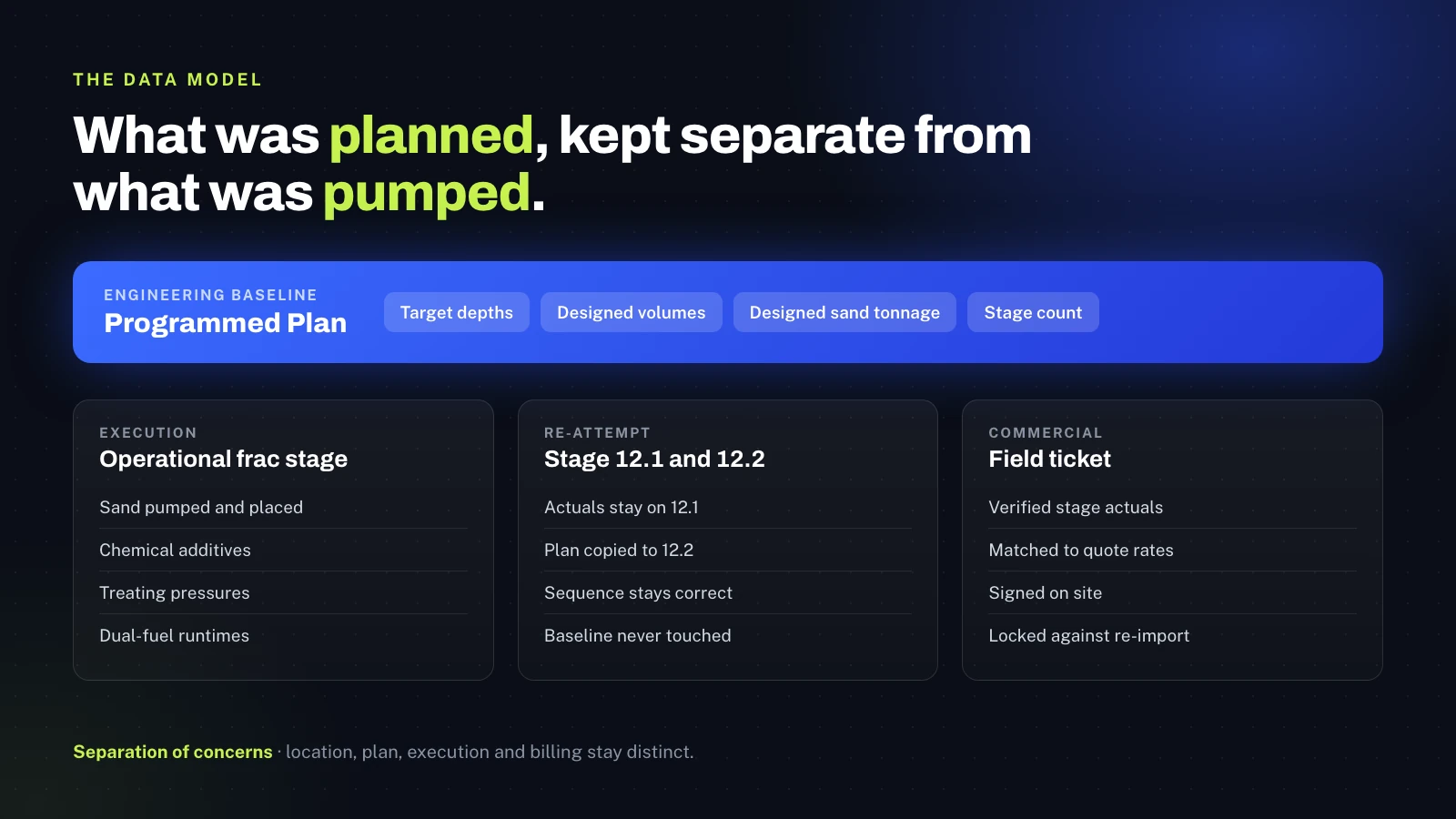
A fifth principle shaped the data model specifically: separating what the engineering team planned from what the field actually pumped. The engineering plan, with its target depths, designed fluid volumes and designed sand tonnages, is a reference baseline that must survive every operational decision taken in the field. The operational frac stage records what was actually pumped under the active contract, including every re-attempt after a screen-out. Keeping those two concepts cleanly separate is what makes the whole platform auditable.
When the frac van engineer has 15 minutes between stages, the platform either keeps up or it gets abandoned for spreadsheets. We built this one to keep up, and to make the next three systems downstream faster because the data arrives verified, structured and ready.
Subhash Panchani, CEO & Co-Founder, iTechCloud Solution
What we built
The fracturing platform, end to end.
The platform is organised around seven integrated capability areas. Each covers a stage of the fracturing lifecycle and connects cleanly to the next, so data captured once on the frac van floor flows through billing to the executive Post-Frac PDF without anyone re-keying it.
The pad-to-stage data model
Underneath every screen is a data model that mirrors how a frac job actually runs. Well Pad and Wellhead store geographic and asset locations: the surface pad manifold and each child wellhead borehole identified by its Unique Well Identifier. The Programmed Engineering Plan stores the approved design, with target depths, fluid volumes and designed sand tonnages for each stage. The Operational Frac Stage stores what was actually pumped in the field under the active contract: sand pumped versus placed, chemical additives, treating pressures and dual-fuel runtimes. A parent-child relationship lets any stage be split into sub-stages when downhole complications require re-pumping, without breaking the engineering baseline. The Commercial Field Ticket pulls verified stage actuals, matches them to contracted quote rates and packages them for customer signature on site. That separation of location, plan, execution and billing is why the platform scales from a five-stage completion to a 100-stage multi-well pad.
Pad console and background plan import
The field supervisor's workspace is a single-screen console showing the full well pad hierarchy, pad, child wells, programmed stages and sub-splits, in one place. Live completion indicators show green when downhole sensor telemetry has synced and red when stage count mismatches or integration errors need attention. Each stage displays its assigned Field Ticket number, so it is obvious which stages are billed and which are pending. Plan import runs through a background Queueable Apex engine: the supervisor clicks Import for a well and parallel background jobs process the engineering plan in configurable chunks of ten stages, pulling in target depths, designed sand tonnages and flush volumes, matching the active job's contract quote and creating operational line items for every contracted product. A progress monitor polls every five seconds and reports completion without locking the screen.
Spreadsheet-speed frac van workspace
This is where the platform earns its keep, because this is where every stage is logged in real time. Engineers move between cells with arrow keys and Enter without touching the mouse. Clicking or tabbing into a cell clears placeholder zeros. Strict numeric controls prevent accidental text entry and decimal errors. Entering pumped sand automatically fills placed sand totals. Because around 90% of stages along a horizontal wellbore use the same chemical and sand recipes, Copy Previous replicates sand types, chemical concentrations and client-supplied blends from the preceding stage in about a second, and Copy Blend to Later Stages applies a friction-reducer blend to every subsequent stage in one click. A pumping schedule timeline tracks each discrete step, acid, pad, proppant ramps and flush, with inline editing of fluid systems and event descriptions. The target is stage logging in fifteen seconds rather than five minutes, which is the specific reason engineers use the platform in the van rather than reverting to offline spreadsheets.
Instant stage splitting for downhole complications
When a screen-out, sleeve failure or pressure spike occurs partway through a stage, the engineer clicks Split Interval. Within seconds the system creates two sub-stages, preserving the pumped sand and actuals from the first attempt on the first, and copying all planned chemicals, proppants and pumping steps to the second with its actuals reset to zero. Metadata-driven field retention rules clean up the parent stage automatically, preserving the baseline engineering data without manual recalculation. The resulting record is clean, auditable and sequence-correct for everything downstream: the billing engine, the Post-Frac PDF and the client representative's verification. This is the capability that addresses lost stage records during screen-outs, previously a recurring source of data loss and billing disputes.
Live telemetry integration
The platform does not only capture what engineers type. A polling layer monitors downhole sensor feeds every 6.5 seconds until pressure logs confirm stage synchronisation, so the console's green sync indicator reflects verified field reality rather than a manual "I am done" button. The integration removes the need for manual IT follow-up when telemetry lags, and it feeds the surface pressure and chemical concentration data that later appears in the Post-Frac PDF charts.
FieldFX shift ticketing automation
At shift change the billing clerk opens the Field Ticket, launches the importer and sees every completed stage for the well with start and end times. The clerk selects the stages completed during the shift, clicks Submit, and the platform totals all sand and chemical actuals across them, groups products by catalog item and blend name, cross-references the job's approved quote items, and replaces outdated draft lines with verified billing items carrying exact totals and external blend notes. For pump horsepower billing the engine scans pump counts across the selected stages and updates the ticket header with the highest count used during the shift. A trigger-bypass safety activates a user-level setting during bulk ticket item creation and resets it asynchronously, preventing timeouts caused by heavy field automation. Audit traceability stamps the generated Field Ticket number on each operational stage record, locking billed stages against re-import so nothing is billed twice. The target is a shift ticket in under two minutes rather than two hours, with no calculation discrepancies.
Executive Post-Frac PDF with ESG tracking
The one-click Post-Frac Report is the artefact STEP's clients care about most: the publication-grade PDF that verifies, for each stage, what was pumped, at what pressures, and with what measurable ESG benefit from the dual-fuel fleets. It is built on Visualforce with CSS paged media and a cover page carrying official branding, well coordinates, formation name, true vertical depth, total measured depth and client contact details. A tabular summary of all stages renders with clean page breaks every ten stages. Because fracture programs range from five simple additives to more than thirty complex chemical and proppant combinations, an adaptive density scaling formula scales typography, cell padding and row heights so dense chemical tables never break awkwardly across pages. For ESG the report calculates total diesel displaced in litres, dual-fuel pumps running on Dynamic Gas Blending against total pumps rigged in, and average and maximum natural gas substitution percentages. High-resolution surface pressure and chemical concentration charts are retrieved from the well record and embedded alongside downhole engineering notes for every stage.
The outcome
Five steps of the job, re-engineered.
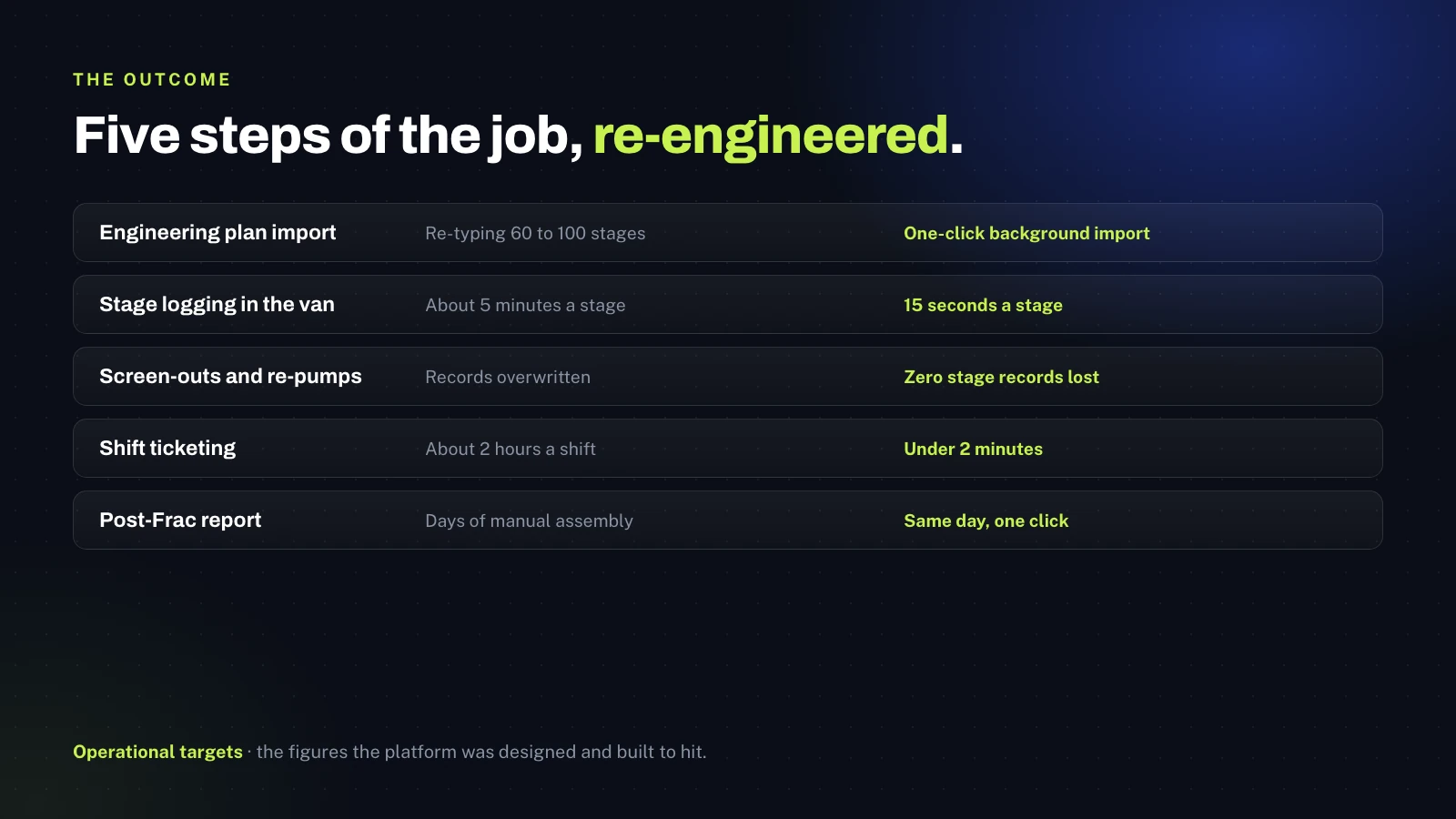
STEP now runs horizontal fracturing on a unified, real-time digital workflow rather than disconnected spreadsheets and manual billing calculations. The shifts fall into five areas, each with an operational target the platform was built to hit.
Engineering plan import
What was manual re-typing of 60 to 100 stages per well from engineering sheets is now a one-click background import that loads full plans in seconds, with contracted quote pricing already mapped. The transcription errors that used to propagate from engineering through to billing are eliminated structurally.
Frac van data entry
The slow web forms that pushed engineers back to offline spreadsheets are replaced with spreadsheet-speed keyboard navigation, auto-filled totals and one-click stage copying, targeting fifteen seconds a stage rather than five minutes. The practical consequence is that stage data lives inside the platform from the moment the stage completes.
Well complications and screen-outs
Overwritten records, damaged engineering baselines and lost actuals during screen-outs, previously a recurring source of billing disputes and audit gaps, are addressed structurally. One-click stage splitting creates sub-intervals with engineering baselines preserved and sequence numbers clean.
Shift ticketing
Shift ticketing that consumed around two hours of a billing clerk's time per shift is targeted at under two minutes, with billing calculation discrepancies eliminated. Verified aggregation against contracted quote pricing is what makes a number that small safe to rely on commercially.
Customer Post-Frac reporting
Days of manual copying, screenshot pasting and PDF formatting are replaced with one-click executive PDF generation, including stage telemetry charts and dual-fuel diesel savings. For STEP's clients, who increasingly report their own ESG metrics upstream, that verification matters as much as the operational detail.
Operational targets
The platform was built against four specific operational targets: shift tickets generated in under two minutes, stage logging in fifteen seconds, 100% billing accuracy against contracted quote rates, and zero stage records lost during wellbore screen-outs, with Post-Frac reports delivered same-day on well completion. The architectural choices described above, the plan and actuals split, the splitter, the spreadsheet-speed workspace and the verified shift aggregation, are the specific mechanisms through which each target is delivered.
Platform & tooling
What's under the hood.
Salesforce platform
Salesforce internal org as the system of record for pads, wells, engineering plans, operational stages and commercial tickets.
User interfaces
Lightning Web Components across every operational screen: the pad console, the high-speed frac van stage workspace and the shift billing ticket generator.
Business logic
Apex for the stage split engine, sequence renumbering, metadata-driven field retention, shift aggregation, quote matching and pump horsepower reconciliation.
Asynchronous engine
Queueable Apex for the chunked background plan importer, ten stages per chunk and configurable, with five-second client-side polling.
Document engine
Visualforce PDF generator with CSS paged media, adaptive density scaling for dense chemical tables, and embedded high-resolution sensor chart renditions.
Field operations
FieldFX for mobile and desktop field ticketing, with Salesforce to FieldFX ticket aggregation and audit traceability back to operational stages.
Telemetry integration
Databricks telemetry streams polled every 6.5 seconds for downhole pressure confirmation and stage synchronisation.
Event architecture
Lightning Message Channel for refresh-free coordination between the pad console and the stage detail panel.
Design & delivery
iTechCloud delivery methodology: discovery, design, Agile build, QA and automated release management across Dev, UAT and Production.
Working with iTechCloud
How the engagement actually ran.
A real-time operational platform for an industry whose working environment is a control van on a remote well pad rewards specific disciplines: deep upfront modelling of the real-world lifecycle, close iteration with the people who will use the platform at speed, and relentless attention to the integration seams with the tools the business already depends on. The engagement was structured around those disciplines.
Engagement model
Full-lifecycle platform build delivered end to end, followed by ongoing managed services to evolve the platform as STEP's operational scope grows. The build ran in clearly scoped phases, discovery, data model and architecture design, workspace build, FieldFX integration, Post-Frac PDF engine, QA, release and hypercare, each with explicit entry and exit criteria so STEP always had clarity on where the engagement was and what came next.
Team shape
The engagement was led by a solution architect with Salesforce platform experience, deep Lightning Web Components and Visualforce background, and an appetite for the specifics of industrial operations. The architect was supported by developers across LWC, Apex, Visualforce, FieldFX integration and the telemetry layer, with a dedicated business analyst and QA throughout. CEO and Co-Founder Subhash Panchani sponsored the engagement and remained personally involved in the architectural and strategic decisions, the founder-engaged model we apply to every major client engagement.
Governance and collaboration
Regular steering reviews with STEP's leadership, daily stand-ups within the delivery team, and architecture reviews at the key design decisions. The data model and the frac van workspace were co-designed with STEP's engineering and operations teams through workshops in discovery, so the platform's behaviour on day one reflected the operational realities of horizontal hydraulic fracturing rather than a generic field service template.