Executive summary
Every signal a buyer leaves, in one profile.
A premium residential developer in the Mumbai Metropolitan Region runs several project launches at once, each with its own campaigns, pre-sales team and site-visit pipeline. A home at this price is a long, considered purchase: buyers research for weeks, compare configurations and amenities, visit, revisit with family, and only then book. Every one of those steps leaves a signal somewhere.
The developer had already invested in Salesforce Data Cloud and Marketing Cloud Engagement, but the two were not working as one system. iTechCloud Solution built the layer between them: Data Cloud works out what each buyer cares about, a funnel engine works out where they stand, and Marketing Cloud uses both to send the right message on the channel that buyer actually reads.
Buyer communication for every project now runs from one unified profile. Browsing behaviour, CRM history, ad platforms and messaging resolve to a single person; one funnel status per lead drives journey entry and exit; and a shared set of WhatsApp and email templates personalises itself per buyer rather than being rebuilt per journey.
- Client
- Premium residential developer, Mumbai Metropolitan Region (anonymised)
- Industry
- Real estate: residential, multiple concurrent projects
- Users
- Marketing and campaign teams, pre-sales callers, project sales teams, and the buyers themselves on WhatsApp and email
- Platform
- Salesforce Data Cloud, Marketing Cloud Engagement, Sales Cloud, CloudPages
- Scope
- Data Cloud data model, identity resolution, Calculated Insights and batch transforms, funnel-status engine, Journey Builder architecture, AMPscript dynamic content, site-visit booking flow, KPI framework
- Channels
- WhatsApp, email and web
The situation
Rich data, generic conversation.
The raw material was all there. Data Cloud held 63 data streams covering website behaviour, Google and Meta advertising, WhatsApp messaging and consent, and around 20 Salesforce CRM objects. What was missing was anything that turned those streams into per-buyer interest a marketer could act on. Six specific problems shaped the engagement.
Rich data, no single view
Sixty-three streams were landing, and none of them became an answer to the only question that matters for the next message: what does this particular buyer care about?
Marketing Cloud ran blind to Data Cloud
Segments could not drive Journey Builder entry, and email and WhatsApp engagement did not flow back into the unified profile, so the two halves never informed each other.
One WhatsApp flow per journey
Every new journey meant building a new WhatsApp flow. A single project needed 25 WhatsApp messages across revival, pre-sales, site-visit, revisit and booking journeys, each to be approved and maintained.
No shared definition of progress
Call outcomes sat on Tasks, visits on a custom Site Visit object, bookings on Quotes. Nobody could say in one field how far a lead had progressed, so journeys could not enter or exit people at the right moment.
The same message for every buyer
A three-bedroom investor and a two-bedroom end-user received identical content, regardless of what either had spent weeks browsing.
No way to prove impact
Leadership wanted to know whether better communication actually moved qualification, engagement and drop-off, and campaign-level open rates could not answer that.
Our approach
Interest, then status, then the message.
The architecture rests on separating three questions that are usually tangled together: what is this buyer interested in, how far through the funnel are they, and what should they therefore receive? Data Cloud answers the first, a funnel engine answers the second, and Marketing Cloud only has to act on the answers.
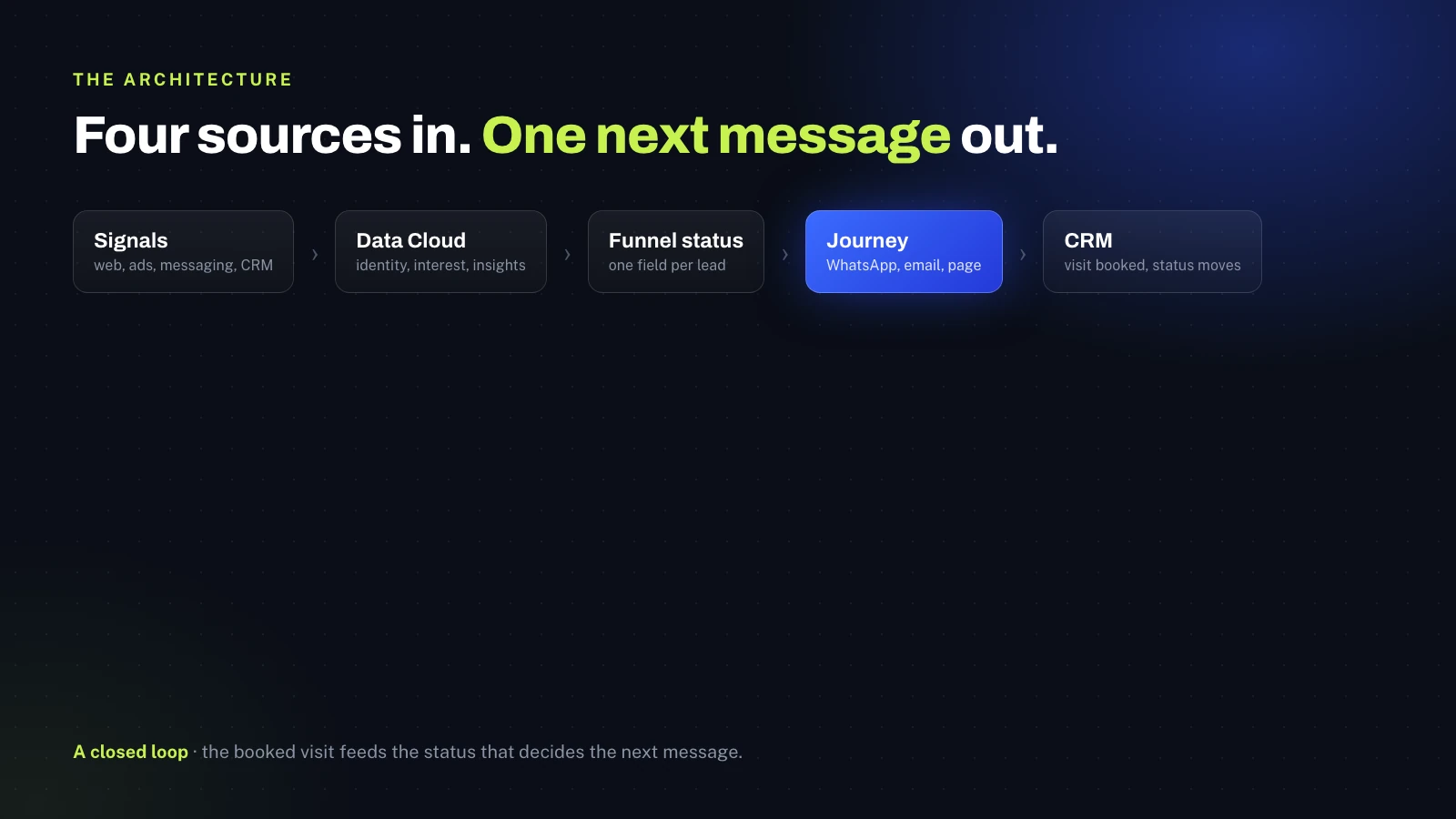
That separation is what makes the system extensible. A new project does not need new journeys, because the journeys are driven by status rather than by project. A new channel does not need new segmentation, because interest already lives on the profile. And the loop closes: a booked site visit writes back to the CRM, which moves the funnel status, which decides the next message.
What a buyer browses predicts what they want far better than their age or their city does. Once the interest is on the profile and the funnel status is one honest field, the messaging almost writes itself.
Subhash Panchani, Founder & CEO, iTechCloud Solution
What we built
From raw events to the next right message.
Data Cloud: turning behaviour into interest
We designed the Web SDK event schema: three profile streams for identity, phone and email, and twelve engagement streams covering project views, configuration and amenity interest, investor intent and form submissions. Browsing events carry only a session ID, so the enquiry form is what fires the identity events; identity resolution then stitches all the earlier anonymous browsing onto the now-known buyer, which is how a first message can already reflect three weeks of research.
On top of that, Calculated Insights and batch data transforms roll the raw events up into something a marketer can use: per buyer, per project, a preferred configuration and a set of preferred amenities, written into a customer-interest data model object that Marketing Cloud can read directly. The CRM side was specified field by field, mapping the Lead, Task, Site Visit, Opportunity and Project fields the segmentation strategy actually needs into the Data Cloud model. We also ran a segmentation gap analysis across the whole strategy, showing which segments were ready immediately, which needed a connector or configuration, and which needed data that did not exist yet, such as telephony.
One funnel status per lead, and it only climbs
A SQL query activity computes a single marketing funnel status per lead from Lead, Task call outcome, Site Visit and booked Quote data: new lead, pre-sales no answer, site visit scheduled, scheduled but not done, done, revisit done, booking done.
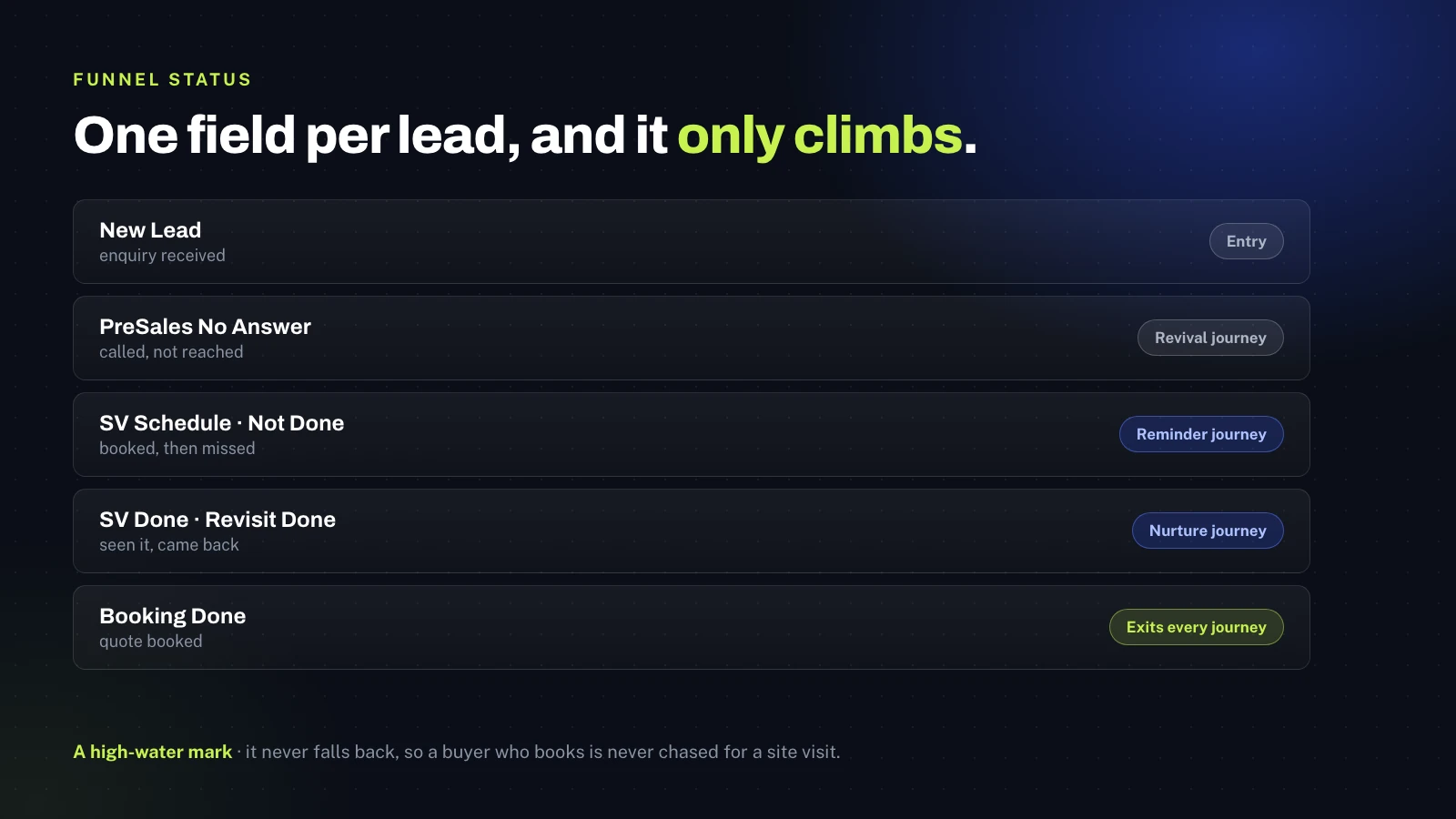
The important property is that it never falls back. It is a high-water mark, built from whether each event has ever happened rather than from the most recent record, which makes it a stable trigger for both journey entry and stage-based exit. The practical effect is that a buyer who has booked is never chased with a site-visit reminder, which is the kind of error that costs a developer credibility at exactly the wrong moment.
Journeys that scale with projects, not with flows
Revival, pre-sales, site-visit, revisit and booking journeys are each entered and exited by funnel status. An interest-key subscriber design lets one person sit in journeys for several projects at once without collisions, which matters when a buyer is comparing two of the developer's launches against each other.
Dynamic content instead of duplicated templates
A property-assets data extension holds each project's amenities, connectivity points and selling points. AMPscript picks the variant matching the buyer's Data Cloud interest, so the investor sees investment-led content and the family buyer sees amenities, from the same message. Same-shape WhatsApp messages were merged into shared templates with one dynamic variable per line, which keeps the number of templates to approve and maintain flat as the portfolio grows rather than multiplying with every journey and project.
Booking the site visit inside the conversation
A CloudPage linked from WhatsApp and email lets a buyer pick a slot and book a site visit there and then. The booking writes straight back to Salesforce CRM, which moves the funnel status and hands the lead to the sales team. In residential real estate the site visit is the conversion that matters, and shortening the path to it from a phone call and a diary to two taps in a message is the single most valuable thing the platform does.
The outcome
What changed operationally.
Journeys run themselves
Buyers are enrolled and released automatically from funnel status. No manual list pulls, and no stale reminders going out to people who have already moved on.
One template set, every project
Launching a new project means adding a row of property assets, not rebuilding flows. WhatsApp approvals and maintenance stay flat as the portfolio grows.
Messages reflect the research
What a buyer browsed for weeks now shapes what they receive, across both WhatsApp and email, rather than everyone getting the same project brochure.
Anonymous browsing is not wasted
Identity resolution attaches weeks of pre-enquiry behaviour to the buyer the moment they fill the form, so the first message is already informed.
Site visits land in the CRM
A visit booked from a message appears immediately against the lead, with the sales team notified and the funnel status moved.
Sales and marketing share a language
One funnel field, defined once, means both teams describe a lead's progress the same way instead of reconciling three objects by hand.
How impact is measured
The platform is live in production, and impact is measured through an agreed KPI framework rather than campaign-level open rates: the share of leads reaching qualified or site-visit-scheduled, how long leads stay engaged before going cold, WhatsApp and email engagement alongside the site-visit schedule rate, and the share of leads stalling at each funnel stage. Each is read against a baseline period, with a holdout group recommended so any lift can be credited to the journeys rather than to seasonality or media spend.
Why this matters beyond one developer
A repeatable pattern for multi-project sales.
Interest beats demographics
What a buyer browses, the configuration, the amenities, the investor content, predicts what they want better than their age or their city.
One funnel field runs everything
A single, never-regressing status per lead makes journeys reliable and gives sales and marketing the same vocabulary.
Templates should scale with projects
Dynamic content keeps approvals and maintenance flat as the portfolio grows, instead of one flow per journey per project.
Close the loop to the visit
In real estate the site visit is the conversion that matters. Booking it in-message and writing it back to CRM shortens the path to it.
Measure against a baseline
Qualification and drop-off KPIs, with a holdout, turn marketing automation from a cost line into a provable lever.
It extends
The same architecture takes Meta and Google Conversions API, telephony call signals and post-sales communication without redesign.
Platform & tooling
What's under the hood.
Salesforce Data Cloud
Sixty-three data streams, Web SDK event schema, identity resolution from anonymous to known, Calculated Insights and batch data transforms into a customer-interest object.
Marketing Cloud Engagement
Journey Builder architecture driven by funnel status, SQL query activity for the status engine, data extensions for property assets and interest.
Sales Cloud
Lead, Task, Site Visit, Opportunity and Project as the CRM source of truth, and the destination a booked site visit writes back to.
AMPscript
Dynamic content selection per buyer, so one template serves the investor and the end-user without a second version to maintain.
WhatsApp & email
Shared templates with one dynamic variable per line, keeping the approved template count flat across projects.
CloudPages
The site-visit booking page linked from a message, writing the booking straight back to the CRM.
Working with iTechCloud
How the engagement ran.
Most of the value in this build is in decisions taken before anything was configured: what counts as interest, what the funnel statuses are and in what order, and which of them a journey should enter or exit on. Those were agreed with the marketing and sales teams first, because a status model that does not match how the pre-sales floor actually works will be quietly worked around within a month.
Engagement model
A platform build across Data Cloud and Marketing Cloud, delivered in stages: data model and identity first, then the funnel engine, then journeys and dynamic content, then the booking flow and the KPI framework. Each stage was usable on its own, so value did not wait for the last one.
Measurement built in, not bolted on
The KPI framework was agreed during the build rather than after it, with a baseline period captured before the journeys went live and a holdout group recommended. That is the only way to answer the question leadership actually asks, which is not whether open rates improved but whether more leads became qualified buyers.