Executive summary
A broker portal built for how brokers actually work.
A leading US-based workers' compensation insurance carrier engaged iTechCloud Solution to retire an aging Duck Creek-based broker portal and rebuild the agent experience on a modern, maintainable platform. The engagement was delivered on Salesforce Industries for Insurance (OmniStudio), with Financial Services Cloud as the data foundation, an Experience Cloud portal for brokers, a dedicated underwriting workbench, and Synatic as the integration layer to the carrier's existing policy admin environment.
The result is a modernized broker experience that compresses submission turnaround from days to hours, a release cadence measured in weeks rather than quarters, and a maintainable platform that frees the carrier's IT budget from the growing cost of legacy upkeep.
- Client
- A leading US-based workers' compensation insurance carrier
- Industry
- Property & Casualty Insurance: Workers' Compensation
- Challenge
- Retire an aging Duck Creek-based broker portal and rebuild the agent experience on a modern, maintainable platform
- Solution
- Salesforce Financial Services Cloud, Salesforce Industries for Insurance (OmniStudio), Experience Cloud broker portal, Synatic integration layer
- Engagement
- Full-lifecycle delivery: discovery, design, build, release management and managed services
The client
A workers' compensation specialist, built on broker relationships.
Our client is a leading US-based workers' compensation insurance carrier, writing coverage across a nationwide network of independent agents and brokers. They occupy a specialist position in a market where most carriers try to be everything to everyone: their entire business is built around a single line of coverage, done with discipline, and distributed through long-standing broker relationships.
That specialization is the business. It is why underwriters know their book, why brokers trust the carrier with their better accounts, and why the business has grown steadily over decades. It is also why the agent-facing experience matters so much. Brokers choose which carrier gets each submission, and ease of doing business is one of the quieter but more decisive factors in that choice.
By the time they came to us, the business was growing faster than its platform could serve. The portal brokers used to transact with the carrier, the front door to new business, renewals and endorsements, had become a drag on the very relationships the business depended on.
The situation
A legacy platform that was holding the business back.
The existing broker portal had been built a decade earlier on a proprietary Duck Creek foundation. It had served the business well in its first years: a reasonable choice at the time, and a workable platform for a book of business that was smaller and simpler than it is today.
A decade on, that story had changed. The portal still worked, but every year it worked a little worse. Performance had degraded. The user experience felt dated next to the carriers brokers compared against. There was no meaningful mobile experience, which mattered more every year as brokers increasingly worked from client sites and phones rather than desks. Reporting required workarounds. And every feature request took longer and cost more than the one before, because the stack had accumulated years of customizations that fewer and fewer people on the team fully understood.
Underneath the surface problems was a strategic one. Workers' compensation is a relationship business, and the portal was eroding a relationship the carrier had spent decades building. Brokers were quietly routing more submissions to competitors whose portals were easier. Internal teams had learned to work around the platform rather than through it. The IT budget was being consumed by maintenance of a system that no longer earned it: budget the business needed for the growth ahead of it, not the technology behind it.
The decision to modernize was already clear by the time our conversations started. What was less clear was how to do it without a two-year project that would freeze the business in the meantime.
Our approach
Modernize the experience, not just the technology.
The temptation in a project like this is to recreate the old system in a new tool. The business has been running on it for years, people are used to it, and "just do what we have now, but better" feels like the safe path. In our experience, it is the path that leads to a modern platform shaped by a decade of obsolete constraints.
So we started by refusing to short-circuit discovery. We spent the first phase doing proper as-is and to-be process analysis: mapping the real work of a submission, a renewal and an endorsement end to end, including the parts that happened outside the portal because the portal couldn't handle them. Only then did we map the to-be state: what each process would look like if it were designed today, for the business the carrier is now, on a platform built for insurance.
The gap between the two became the project. Not a feature list copied from the old system, but a change in how the business operated, enabled by a change in platform.
The second decision was equally important. Rather than attempting a wholesale replacement of the policy admin environment, a multi-year undertaking that would have delayed every benefit, we kept the existing policy admin as the system of record for now and built an entirely new broker and underwriting experience on Salesforce in front of it. Synatic sat between the two as a modern integration layer, exposing clean APIs the Salesforce side could consume without caring about the complexity behind them. The brokers would never see the legacy stack, and the carrier could modernize the policy admin layer on its own timeline, without blocking the experience work.
We don't start by asking what to automate. We start by asking what shouldn't be happening at all. The platform choice follows from that, not the other way around.
Subhash Panchani, CEO & Co-Founder, iTechCloud Solution
What we built
A Salesforce Industries platform engineered for insurance work.
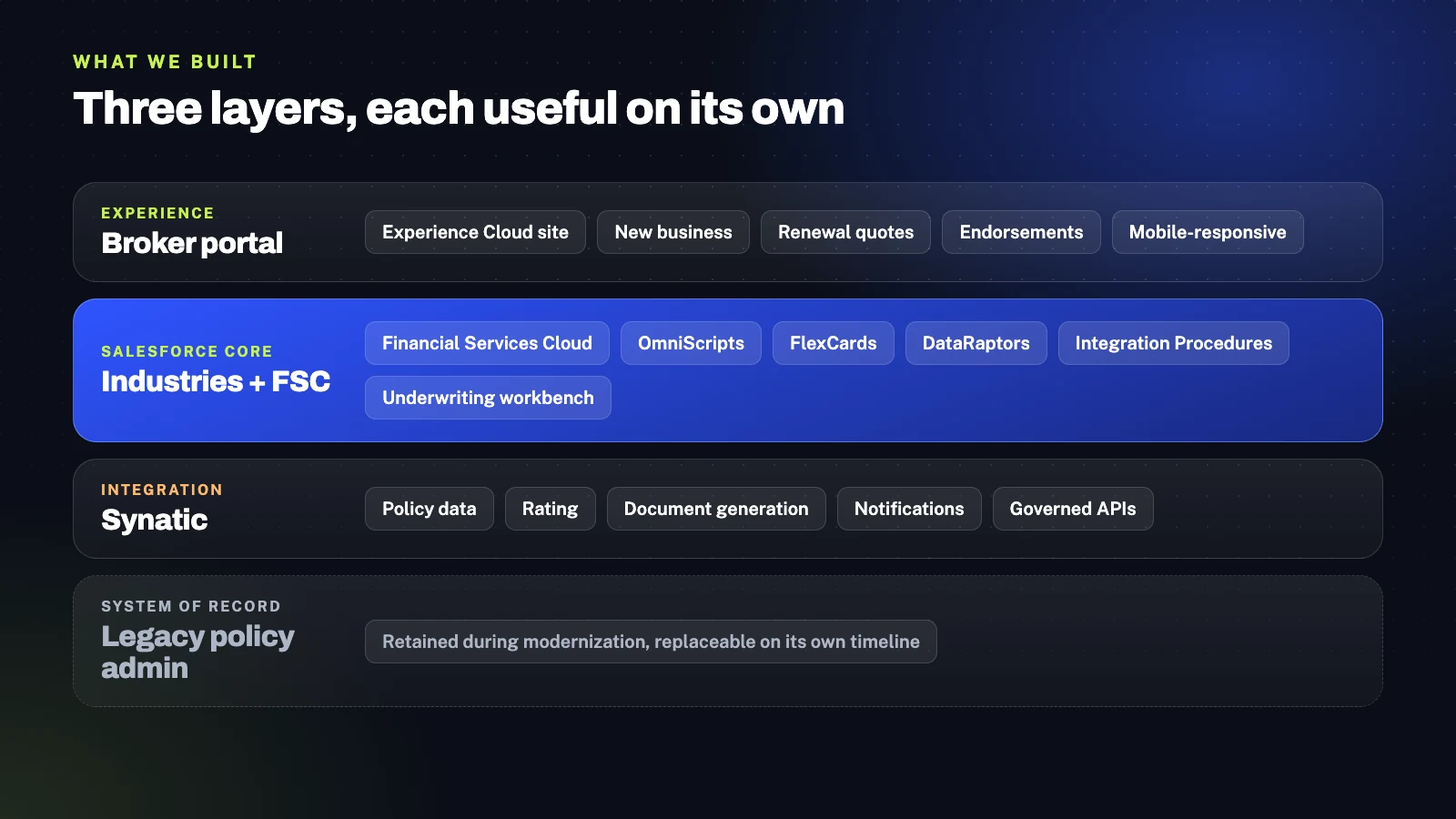
The platform has three layers: a modern broker-facing experience on top, a dedicated underwriting workbench in the middle, and a clean integration layer between Salesforce and the existing policy admin environment underneath. Each layer was designed to be useful on its own, and to compound in value as it connected to the layers around it.
Financial Services Cloud upgrade
The client was already on Salesforce, running Sales Cloud. We upgraded the org to Financial Services Cloud, which brought the Insurance Policy data model, Producer and Agency management, and the relationship structures a workers' compensation carrier actually needs: between agencies and their producers, between policyholders and their locations, between policies and the people they cover. The data model stopped working against the business and started working with it.
Salesforce Industries for Insurance (OmniStudio) foundation
We installed and configured Salesforce Industries for Insurance (formerly Vlocity) as the framework for the broker and underwriting experiences. OmniScripts drove the multi-step submission, renewal quote and endorsement workflows: guided flows that collected the right information at the right moment, with validation and branching logic for each process. DataRaptors handled data transformations into and out of surrounding systems. Integration Procedures orchestrated the multi-system calls each major action required. FlexCards surfaced policy, submission and account information in the broker console and the underwriting workbench. Delivering this on a low-code industry framework rather than hand-coding from scratch materially shortened the time between a design decision and a working feature.
A modern broker portal on Experience Cloud
The broker-facing experience was built as a Salesforce Experience Cloud Digital Experience Site. Brokers now have a single, unified place to submit new business, generate renewal quotes and manage endorsements, a workflow previously split across the legacy portal, email, spreadsheets and phone calls. The experience is responsive from the first screen: a broker can start a submission at the client's office on a phone and finish it at a desk without losing context. Visual design was prototyped in Figma, iterated with real brokers before anyone wrote code, and refined through the build so the final product reflected how the business actually works, not how the old portal had conditioned everyone to work around it.
An underwriting workbench inside Salesforce
Alongside the broker experience, we built a dedicated workspace for the underwriting team. Submissions arrive from the portal with context pre-assembled (the broker, the agency, prior history, the account, the submission detail), surfaced through FlexCards and OmniScripts rather than hunted for across tabs. Decisioning paths are clear and audit-ready. Underwriters stopped losing time to context assembly and started spending it on the judgment calls only they can make.
Synatic as the integration layer
Between Salesforce and the legacy policy admin environment, we deployed Synatic as the integration hub. Every endpoint OmniStudio needed to call, for policy data, rating, document generation and downstream notifications, was exposed and governed through Synatic. The client kept their existing policy admin as the system of record; brokers and underwriters worked in Salesforce; and Synatic kept the two in near-real-time alignment. This decoupling was deliberate: the client can modernize the policy admin layer on its own timeline later, without disturbing the experience work we delivered.
Agile delivery and automated release management
The build ran in iterative agile cycles, with user stories, sprints, demos and continuous feedback from the client's business leads throughout. We stood up a proper release management pipeline from Dev to UAT to Production, automated end to end. The client can now evolve the platform at the cadence of broker feedback rather than quarterly releases: new features land in weeks, not months.
How we delivered it
Discovery first. Design second. Build third.
The engagement moved through a disciplined sequence, each phase feeding the next:
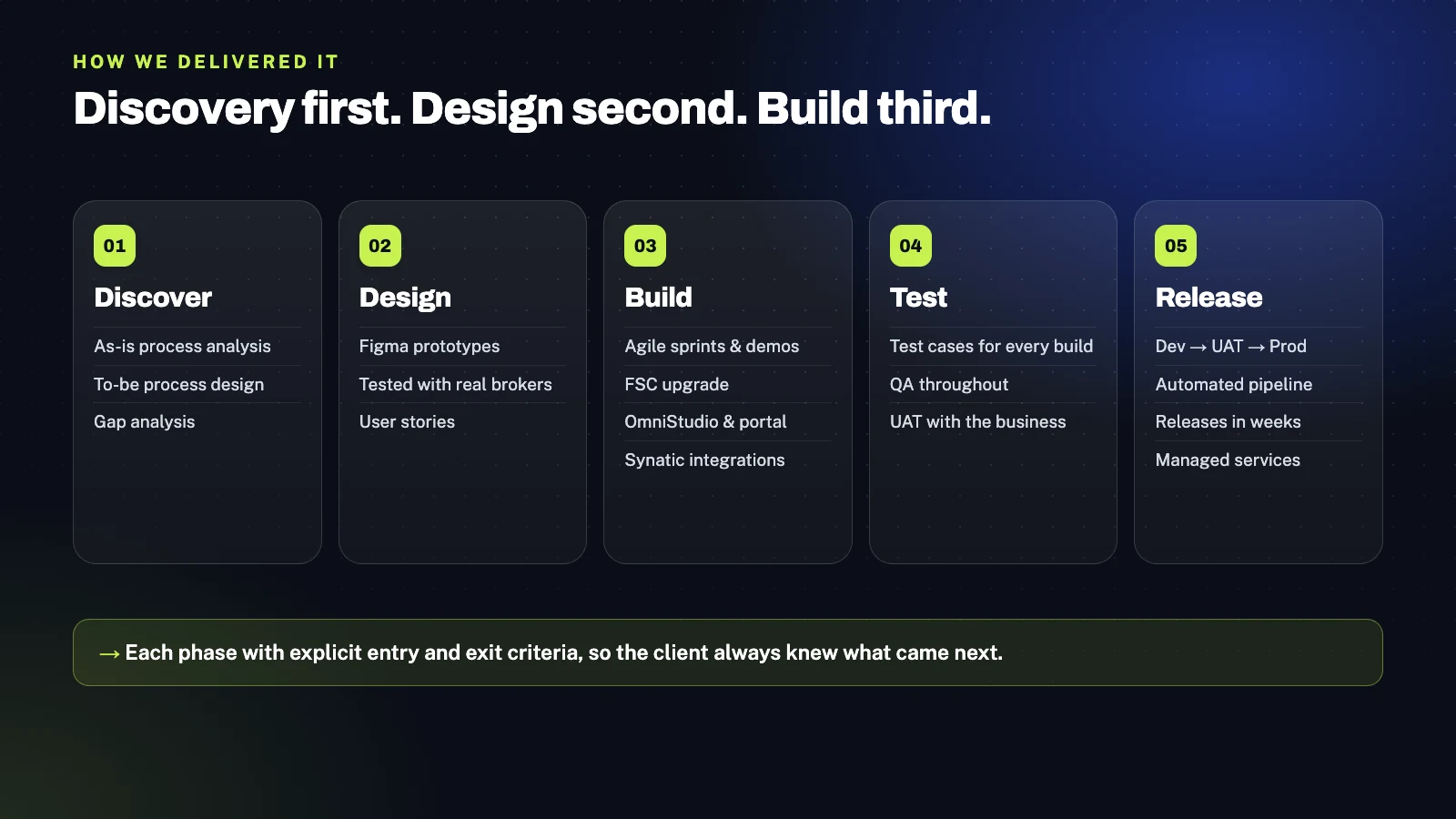
- As-is process analysis Mapping how new business, renewals and endorsements actually worked in the business today, including the workarounds.
- To-be process design Defining what each process should look like on a modern platform, free of the legacy constraints.
- Gap analysis Identifying what had to change in people, process and platform to get from one to the other.
- High-fidelity Figma prototypes Designing the broker experience in detail and iterating with real brokers before writing code.
- User story definition Translating the designs and processes into buildable, testable stories.
- Agile build cycles Iterative sprints with regular business review and demo.
- Integration design and build Identifying every integration point, specifying the contract, and implementing it in Synatic.
- Salesforce platform work Financial Services Cloud upgrade from Sales Cloud, Salesforce Industries installation and configuration, Experience Cloud portal build, underwriting workbench build.
- QA and test case authoring Across every build.
- Automated release management Dev to UAT to Production, run as a continuous pipeline rather than a quarterly event.
The results
What changed, measured against the baseline.
The headline shift is the one brokers feel every time they log in. The portal they used to tolerate has become a portal they actually use. The submission experience that used to take days of back-and-forth is now something they complete in a sitting. Mobile responsiveness means they can work from wherever the client is. And the three core processes, new business, renewals and endorsements, are now standardized across the brokerage network rather than reinvented by each broker's workaround.
Faster submission turnaround
The multi-step submission flow, driven by OmniScripts, collects the right information at the right moment and routes it cleanly to underwriting. What used to take days of back-and-forth across the legacy portal, email and spreadsheets now moves through the system in hours, and the underwriting workbench receives submissions with context already assembled.
A release cadence the business can use
The automated Dev to UAT to Production pipeline moved the business from quarterly release cycles to a cadence measured in weeks. Broker feedback can reach the live platform in the same quarter it was given, and IT spends less time managing releases and more time delivering what the business needs next.
A platform the team can maintain
The maintenance load that consumed the IT budget on the legacy stack has materially reduced. Low-code OmniStudio components can be adjusted without a legacy-framework specialist, and Financial Services Cloud and Experience Cloud draw on a far broader talent pool than Duck Creek customization.
A broker experience worth having
The clearest signal is the hardest to put on a dashboard: brokers describe the portal differently now. It stopped being a thing they endured and became a tool they use. For a carrier whose business runs on broker relationships, that shift matters more than any single metric.
An honest caveat
The full business impact of a platform like this plays out over renewal cycles. A modern broker experience earns its ROI over years, not quarters, as submission share, quote-to-bind rates and broker retention compound. We will have a sharper view of those numbers at the first anniversary of go-live than we do today. What we can say with confidence is that the foundation is in place to let that story play out.
Platform & tooling
What's under the hood.
Salesforce platform
Financial Services Cloud (upgraded from Sales Cloud), Experience Cloud, Salesforce Industries for Insurance (formerly Vlocity).
Industries components
OmniScripts, Integration Procedures, DataRaptors, FlexCards, OmniStudio data model.
Broker portal
Experience Cloud Digital Experience Site, responsive mobile design, Figma prototype-led UX.
Underwriting workbench
Native Salesforce workspace, FlexCards for context assembly, OmniScript decisioning flows.
Integration layer
Synatic: middleware and API gateway between Salesforce and the legacy policy admin environment.
Policy admin (source of truth)
Existing Duck Creek-based policy admin platform, retained during modernization.
Design & delivery
Figma prototypes, Agile / Scrum delivery, Salesforce DX, automated CI/CD pipeline (Dev, UAT, Production).
Working with iTechCloud
How the engagement actually ran.
Insurance platform work rewards discipline over speed and partnership over transaction. The way we structured this engagement reflects that.
Engagement model
Full-lifecycle implementation delivered under a defined scope, followed by ongoing managed services to evolve the platform as the business evolves. The implementation was organized into phases (discovery, design, build, QA, release), each with explicit entry and exit criteria, so the client always knew where we were and what came next.
Team shape
The engagement was led by a solution architect with Salesforce Industries for Insurance expertise, supported by developers across OmniStudio, Experience Cloud and integration, a dedicated business analyst, and QA throughout. CEO and Co-Founder Subhash Panchani sponsored the engagement and stayed personally involved through its critical phases, the founder-engaged model we apply to every major client engagement.
Governance
Weekly client steering reviews, daily stand-ups within the delivery team, and architecture reviews at the key design decisions. Full transparency on scope, progress and risk throughout. When trade-offs had to be made, they were made deliberately and documented.