Executive summary
Service Cloud rebuilt around country, region and brand.
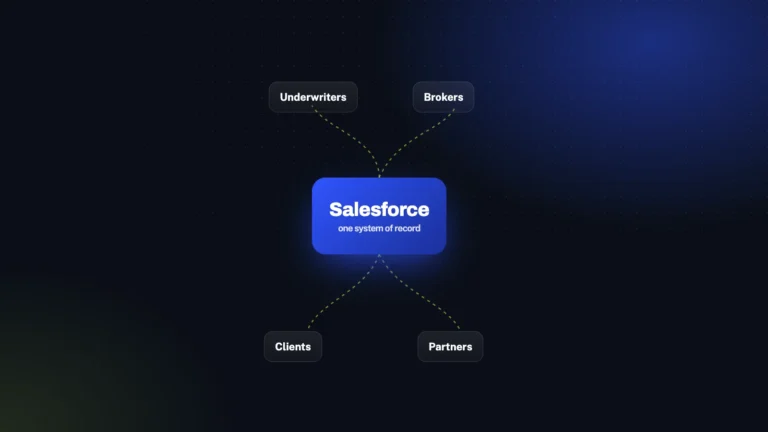
Our client is a global leader in test and inspection solutions, operating across a family of specialty brands and serving manufacturers, laboratories and production facilities worldwide. iTechCloud Solution partnered with the client to replace a manual, email-driven case and lead management operation with a Salesforce Service Cloud and Sales Cloud platform engineered for a global, multi-brand service organization: automated routing by country, region and brand; SLA enforcement with milestones and escalation; expert collaboration without case reassignment; and seamless integration between the client's website and Salesforce.
The result is a service and sales operation where cases and leads land with the right person on the first try, SLAs are tracked and enforced rather than hoped for, and the manual effort that consumed significant time from service agents and sales teams has been engineered out of the day-to-day.
- Client
- A global leader in test and inspection solutions, operating across a family of specialty brands
- Industry
- Industrial Manufacturing: test and inspection equipment and solutions
- Challenge
- Replace manual, email-driven case and lead management with an automated, SLA-enforced platform that routes by country, region and brand
- Solution
- Salesforce Service Cloud and Sales Cloud: automated case routing, Entitlement Process with SLA escalation, Service Cloud Swarming, custom web-to-case REST API, lead assignment rules, country/region data model
- Engagement
- Full-lifecycle delivery: discovery, design, build, release and ongoing managed services
The client
A century of test and inspection expertise, delivered globally.
Our client is a globally recognized leader in test and inspection solutions, with a history spanning nearly a century. The business has built its reputation on safeguarding the integrity of some of the world's most prominent brands, offering test and inspection equipment and services that manufacturers, laboratories and production facilities depend on for quality assurance.
The business operates across a family of specialty brands, each with its own market position and customer base. Together, they give the client deep technical expertise across a broad range of test and inspection categories, and a worldwide footprint of customers who rely on the business for both equipment and ongoing service.
A business of this scale and shape (multi-brand, multi-country, service-intensive, with customers who depend on timely expert support) places particular demands on its case and lead management. By the time we were engaged, the operation no longer matched the shape of the business it supported.
The situation
Service and sales operations running on manual routing and email.
The client's case and lead management had grown by accretion rather than design. There was no proper case management system, no automated routing, no SLA structure, and no in-platform way for front-line agents to get help from experts. Every case and every lead needed a human to look at it, understand its country, region and brand context, and decide where it should go. At the scale and global spread of the business, that effort was both expensive and error-prone.
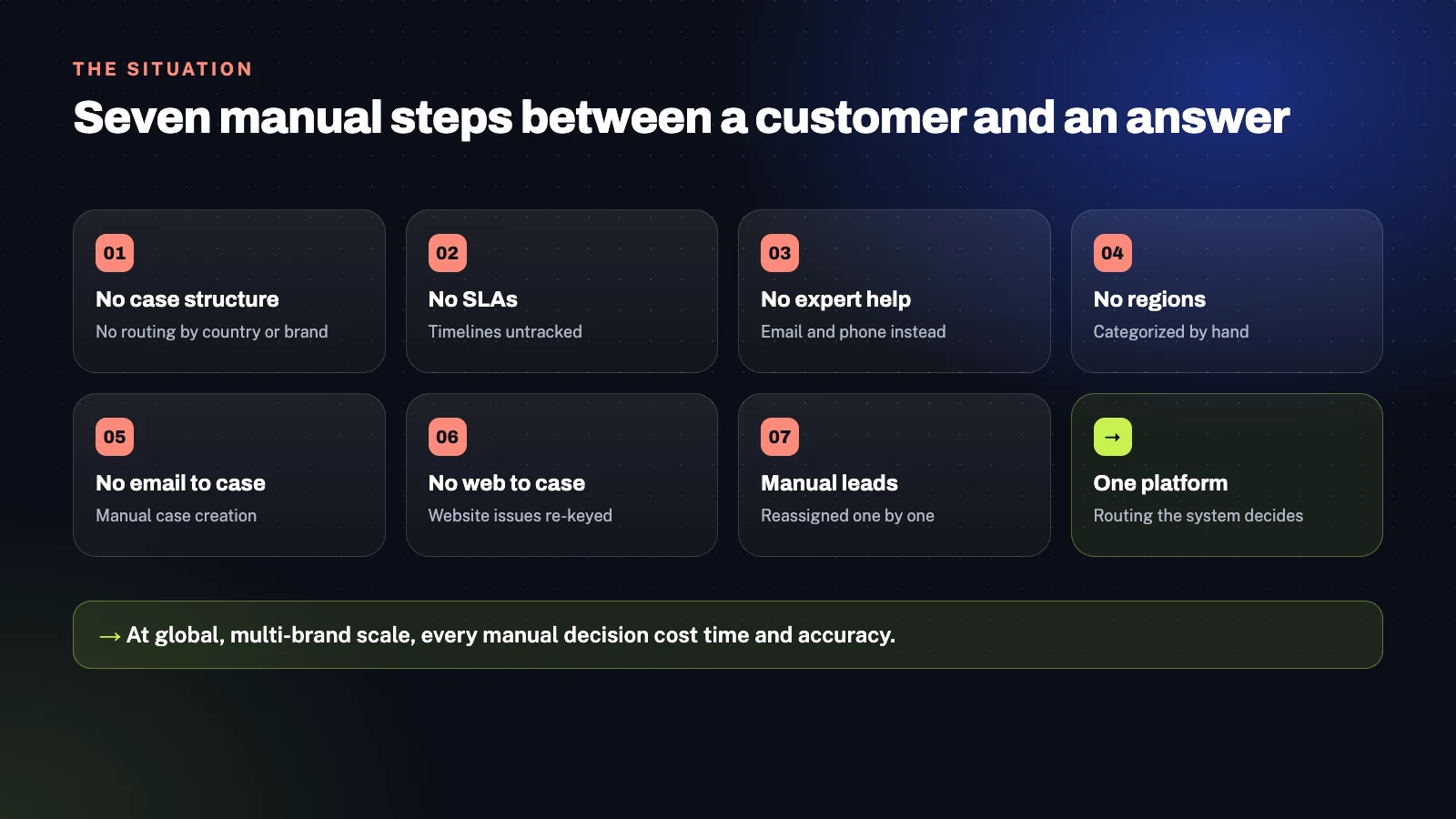
Specifically, the operation was constrained by seven interlocking problems:
- No case management structure. No system of record for cases, and no automation for assignment by country, region, brand or the other parameters that determined who should handle each case.
- No SLAs or milestones. No concept of SLA or milestone against the account or country of a case, so resolution timelines were effectively untracked and unenforced.
- No in-platform expert collaboration. Agents who needed a subject-matter expert fell back on email, phone calls and informal channels, which took longer and left no trail.
- No region-based categorization. Assignment often needed region-level logic, but cases had to be categorized by region by hand before they could be assigned.
- No email-to-case automation. Emails to support addresses created no case, collected no structured information and routed to no queue automatically.
- No website-to-case integration. Issues raised through the website's support section did not flow into Salesforce; someone had to create each case and assign it by brand, country or region.
- Manual lead handling at scale. A large and growing volume of leads was analysed and reassigned by hand by brand, country or region: slow, and a frequent source of misrouted leads, duplicates and follow-up delays.
Any one of these would have been a legitimate improvement target in isolation. Together, they were a structural drag on the service and sales operation of a global business, and a growing one, as volume increased year over year.
Our approach
Automate the routing. Enforce the SLAs. Keep the expertise close to the agent.
The design principle was simple: the system should know enough about the shape of the business to make routine routing decisions on its own, and should support the people doing the non-routine work rather than making them redo the routing in their heads for every case and lead.
That meant three things in practice. First, encoding the business's actual routing logic (country, region, brand, product line) into the platform, so cases and leads are assigned automatically and correctly on arrival. Second, making SLAs and milestones first-class concepts, so resolution timelines are tracked, escalated when needed, and visible to managers in real time. Third, keeping experts close to agents, using Service Cloud's native swarming to bring in subject-matter experts without reassigning cases and losing continuity.
Around that core, we built the integration layer that makes the platform the single system of record for cases and leads however they enter: email to case, web to case from the client's website, and direct creation from any other channel the business uses.
The best automation is the kind nobody notices. Cases arrive, land with the right person, carry the context they need, and advance against SLAs the system is tracking, all without anyone having had to think about routing.
Subhash Panchani, CEO & Co-Founder, iTechCloud Solution
What we built
A Service Cloud + Sales Cloud platform engineered for the business.
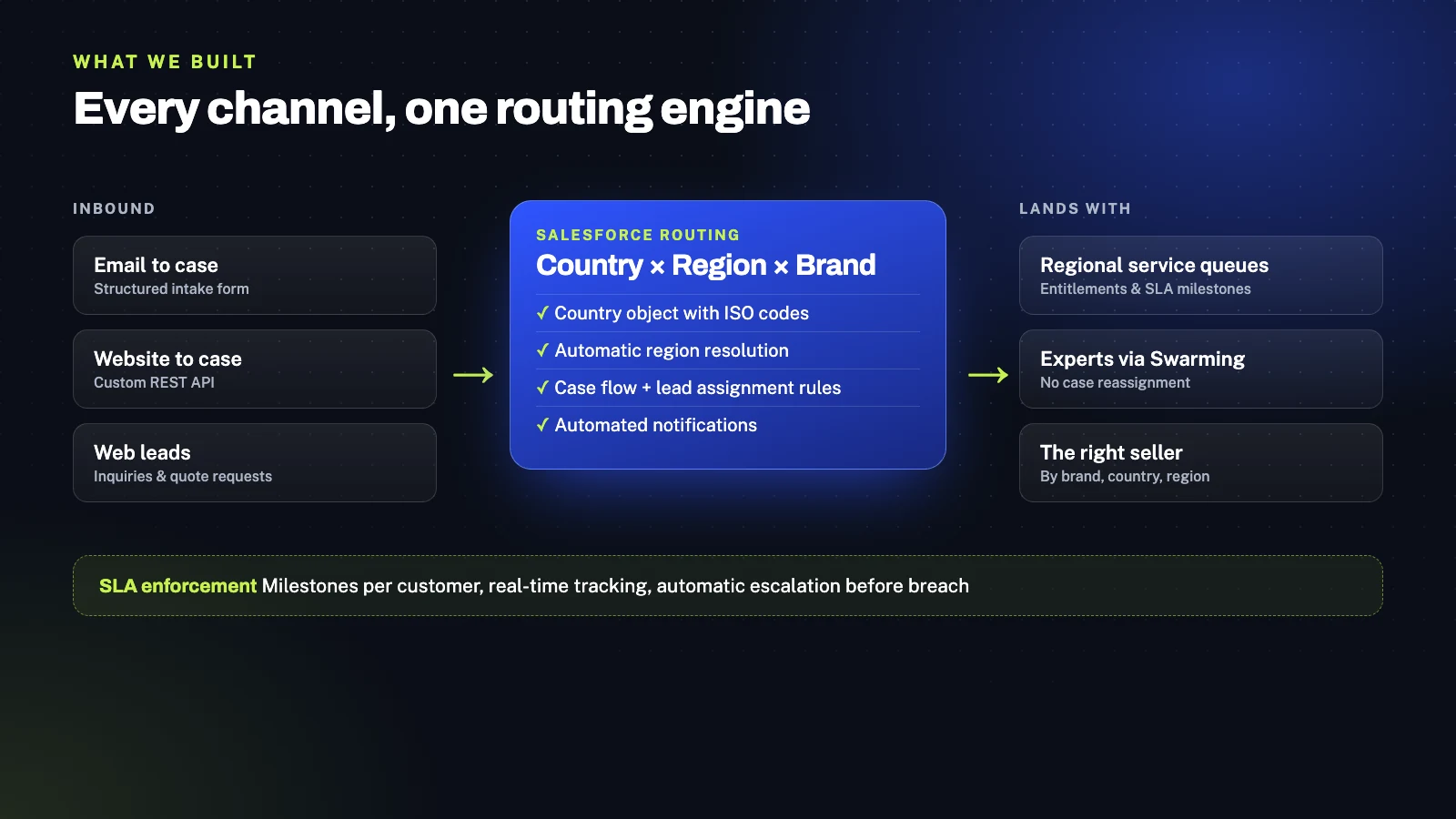
The platform reorganizes case and lead management around how the client's business actually operates, with six closely integrated capabilities: automated case assignment, SLA and milestone enforcement, in-platform expert swarming, email-to-case and website-to-case integration, automated lead assignment, and the country-region data model that underpins them all.
Automated case assignment by country, region and brand
We designed a dedicated case management flow in Service Cloud that encodes the client's routing logic (country, region, brand, product line) directly into the platform. When a case is created, the flow evaluates its attributes and routes it to the correct queue automatically. The combinatorial complexity of country × brand × region routing, which had consumed agent time to resolve by hand, is now solved on arrival. Alongside it, automated email notifications ensure case creation and assignment trigger the right communications to the right people without manual follow-up.
SLA and milestone enforcement with the Entitlement Process
We implemented Salesforce's Entitlement Process to make SLAs and milestones first-class concepts. SLAs are defined per customer-specific criteria: a global customer, a key account or a specific country or region may each have different resolution expectations. The platform tracks progress against those SLAs in real time, raises milestone events as cases advance, and automatically escalates cases that approach or breach their deadlines. Managers now see the health of their case backlog in a way that was previously impossible to construct from their data.
Expert collaboration with Service Cloud Swarming
To solve the "agent needs expert help" problem without case reassignment, we deployed Service Cloud Swarming. Agents pull expert collaborators into a case directly from the platform, work the issue together, and keep the full discussion threaded on the case record. Ownership and continuity stay with the agent; the expertise comes to the case rather than the case moving to the expert. The slower, hard-to-audit email and phone workflows were replaced with a tracked, native collaboration model.
Email-to-case with structured intake
When a customer emails a designated support address, the platform now creates a case automatically. A structured intake step sends the customer a form link that captures the information needed to classify and route the issue. Once submitted, the case is assigned to the right queue based on that structured data: no manual triage, no back-and-forth to establish the basics, and a case that arrives with the context the agent would otherwise have gathered by hand.
Website-to-case via custom REST API
The client's website support section needed to flow straight into Salesforce. We built a custom REST API that accepts case submissions from the website in real time, applies the same brand, country and region routing as every other channel, and creates the case in the correct queue with the correct owner. Customers who raise an issue on the website no longer wait for someone to pick it up: the case is live the moment they submit.
Automated lead assignment and region-based reporting
On the Sales Cloud side, lead assignment rules eliminated manual lead triage. Leads route to the right business user by brand, country or region on arrival. To make region logic work cleanly, we built a country object with ISO codes and region mappings: any country on a lead resolves automatically to the right region, which drives both assignment and reporting. On the website, web-lead functionality turns product inquiries and quote requests into Salesforce leads, assigned to the right business user for follow-up.
The results
What changed, across service and sales.
The platform did not just automate the previous operation; it changed how the service and sales teams spend their time.
Efficient case and lead management by region
Assignment rules driven by country, region, brand and the other parameters that determine the right handler make it materially easier to allocate cases and leads. They land with the right teams on arrival, cutting triage time and increasing time for resolution and selling.
Time savings and less manual work
With manual case and lead assignment gone, service agents no longer spend their day deciding who should own a case, and sales operations no longer reassign leads by hand. That time has shifted to resolving customer issues and converting qualified leads.
Enhanced case tracking and management
SLAs and milestones bring visibility and control that were not possible before. Managers monitor case progress in real time, see which cases are at risk, and step in before deadlines slip, improving efficiency and the predictability of the customer experience.
Improved sales team efficiency
Leads reach the right sales person immediately, compressing response time and raising the chance of conversion. The sales operation is now limited only by its capacity to work leads, not by the time cost of routing them.
Platform & tooling
What's under the hood.
Salesforce platform
Service Cloud and Sales Cloud: case management, Entitlement Process, lead management, standard reports and dashboards.
Case automation
Dedicated case management flow, country, region and brand routing logic, automated queue assignment and email notifications.
SLA management
Entitlement Process with customer-specific SLAs, milestone tracking, automated escalation on SLA risk.
Expert collaboration
Service Cloud Swarming: in-platform expert collaboration without case reassignment, full discussion captured on the case.
Website integration
Custom REST API for web-to-case, web-lead functionality turning product inquiries and quote requests into Salesforce leads.
Data model
Country object with ISO codes and region mappings, automatic region resolution for cases and leads, region-based reporting.
Design & delivery
iTechCloud delivery methodology: discovery, design, Agile build, QA and automated release management (Dev, UAT, Production).
Working with iTechCloud
How the engagement actually ran.
A case and lead management transformation of this shape depends on understanding the client's business logic in detail: the specific routing rules that reflect how brands, countries and regions map to teams and ownership. We structured the engagement around getting that detail right the first time.
Engagement model
Full-lifecycle Service Cloud and Sales Cloud implementation under a defined scope, followed by ongoing managed services to evolve the platform as the business grows. The build ran in clearly scoped phases (discovery, design, build, QA, release), each with explicit entry and exit criteria, so the client always knew where the engagement was and what came next.
Team shape
The engagement was led by a solution architect with Service Cloud and Sales Cloud experience, supported by developers across the Salesforce platform, Flow automation and Apex (for the custom REST API and the more complex routing logic), a dedicated business analyst, and QA throughout. CEO and Co-Founder Subhash Panchani sponsored the engagement and stayed personally involved through its critical phases, the founder-engaged model we apply to every major client engagement.
Governance
Weekly client steering reviews, daily stand-ups within the delivery team, and architecture reviews at the key design decisions, with full transparency on scope, progress and risk. The country, region and brand routing logic was co-designed with the client's business owners, so the platform behaved on day one the way the business actually ran.