
Table of Contents
The Massive Salesforce Data Breach: What HappenedPotential Impact on BusinessesResponse from Salesforce and the Cybersecurity CommunityImplications for the Future of Cloud SecurityLessons for Enterprises and DevelopersA Defining Moment for Salesforce
The Massive Salesforce Data Breach: What Happened
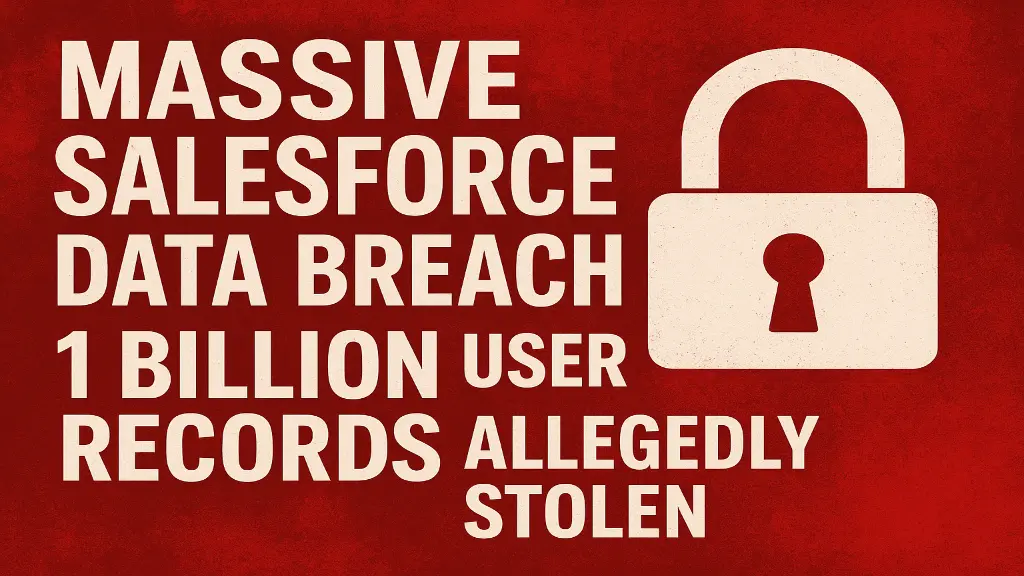
According to preliminary sources, a large dataset containing sales for user records appeared on the Dark Web Forum, offered for sale by an unknown hacker group. The dataset alleges names, email addresses, phone numbers, and login credentials and, in some cases, contains sensitive metadata regarding customer interactions. While Salesforce has yet to confirm the honesty or proportion of violations in public, cybersecurity researchers investigating sample data claim that it appears consistent with the database architecture of Salesforce.
Initial analysis points to the possibility of a potentially obtained entrance certificate obtained by third-party integration or an incorrectly configured API endpoint. Cloud-based platforms such as Salesforce depend on numerous integrations with external systems, and if not properly secured, the weaknesses in these connections can reveal user data. Some experts guess that the violation may be facilitated by a large-scale fishing campaign or a stolen API key that gave unauthorised access.
Potential Impact on Businesses
Salesforce globally empowers consumer data operations of more than 150,000 companies, including major financial institutions, healthcare providers, and government agencies. If the alleged violation is tested, it can expose sensitive customer information from thousands of organizations and disrupt business operations globally.
Immediate impact will probably include an immediate review of data access policies in the high-security protocol and Salesforce environment. Companies depending on the Salesforce may require resetting credits, recertifying attached applications, and auditing a user activity log for indication signals. More importantly, they can withstand regulatory challenges under global data protection structures such as the GDPR of the European Union and California, which mandate strict inspection and therapy measures for both tampered and personal data.
Sales for dignity can also cause significant damage. The company has long been one of the reliable stewards of consumer data, emphasising its commitment to security and compliance. Violation of this dimension weakens faith and can lead to reconsideration of how to manage and distribute data to industry in cloud ecosystems.
According to internal sources, the initial response of Salesforce involves activating its global phenomena response team and collaborating with independent cybersecurity companies to investigate the violation. The company has allegedly taken steps to separate the potentially affected systems, increase its data centres, and notify the affected customers.
Cybersecurity experts have expressed concern that the violation may be a wake-up call for the entire mother-in-law industry. As the cloud adoption process boosts, the attackers are focusing on large service providers from individual bodies that have overall consumer data. This type of supply chain allows hackers to target multiple businesses simultaneously at a point of weakness.
Security researchers emphasise the importance of “Zero Trust” architecture and strong identification management protocols for cloud service providers. Continuous authentication, real-time discrepancy detection, and a strict API regime are some of the main steps recommended. The occurrence of Salesforce also underlines the need for companies using the SaaS platform to implement layered security methods, including encryption, access controls, and regular admission tests.
The alleged Salesforce breach can mark a crucial moment for how organizations think about cloud data protection. As businesses become more and more dependent on the third-party platform for CRM, analytics, and automation, the risks associated with a shared cloud environment become more complicated. Violations can induce new rules around the cloud service security standards, in which providers have to go through strict audits and transparency in the reports of the incident.
In addition, industries can begin to prioritize hybrids or multi-eat strategies to reduce dependence on a single provider. By diversifying where and how the data is stored, companies can reduce the potential explosion radius of any one violation. This event can also accelerate investment in data anonymity and tokenisation techniques, ensuring that it cannot be easily used even if data is accessed.
This phenomenon strengthens some crucial lessons for sales for users and enterprise developers. First, data protection cannot be completely outsourced to the cloud provider. Organizations should actively manage their security posture within the shared liability model. This includes maintaining advanced user permissions, using strong passwords and multi-powered authentication policies, and regularly auditing attached applications.
Second, developers should be careful of developers who integrate third-party equipment in Salesforce. Although necessary for API, automation, and connectivity, often the attack vector remains. Exposure risks can be significantly reduced by implementing safe authentication methods such as OAuth 2.0, rotating API keys, and traffic monitoring for abnormal behavior.
After all, employee awareness is the defence of the leading row. Phishing and social engineering attacks lie in the most common entrance points for violation. Regular training, simulated attacks, and a strong security culture can make a meaningful difference in preventing a standard settlement.
While full details of the violation are still coming out, a possible exposure to a billion user records can redefine the cybersecurity landscape for cloud CRM platforms. Salesforce will need to work decisively to restore confidence through both transparency and technical improvements. The company’s ability to identify the basic causes, reduce damage, and strengthen its systems effectively will probably determine how quickly it can rebuild confidence in its global customers.
For businesses and IT leaders, this acts as a complete reminder that the most advanced cloud platforms are also not free from violations. Data is a new currency, and as long as it is valuable, cybercriminals will continue to innovate. The event of Salesforce highlights the urgent need to focus on the protection of digital trust through mass vigilance, strong security methods, and more and more connections.
Part of the team turning Salesforce and AI strategy into shipped, measurable outcomes for enterprises across five regions.