

Introduction: Salesforce Summer 26 Updates
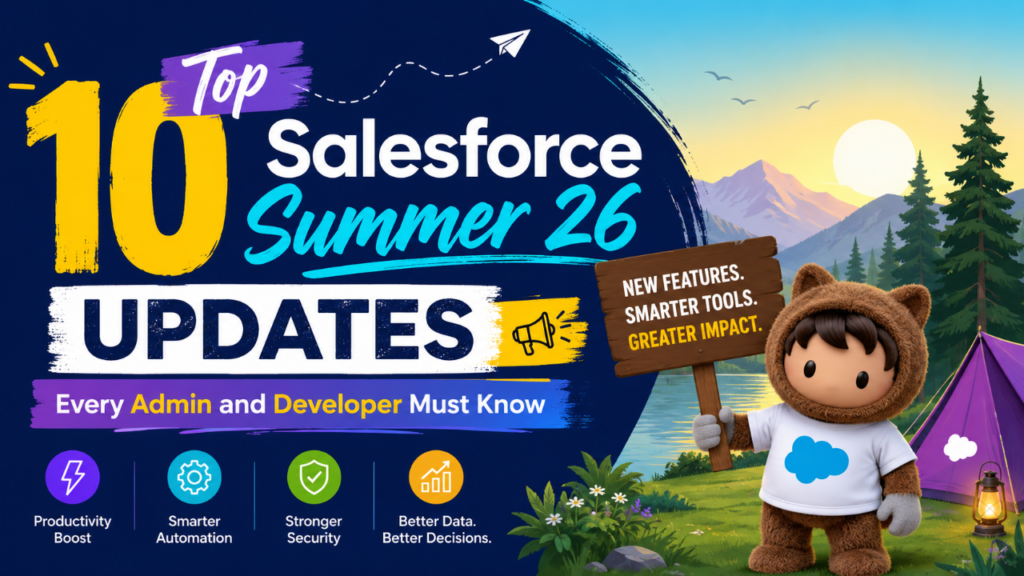
The Salesforce Summer ’26 release represents a significant milestone in the platform’s evolution, introducing features that change how admins and developers build, deploy, and maintain enterprise applications. This release marks a key step toward operational maturity and AI-powered productivity, with mandatory security migrations and production-ready AI agent capabilities. Whether you’re managing field-level security across hundreds of profiles or writing Apex code, the Summer ’26 update includes changes that directly impact your work. Here are the top ten updates you need to know about.
Table of Contents
Introduction: Salesforce Summer 26 Updates
1. Agentforce Agents Directly in Flow Builder
2. Enhanced Flow Builder Date Operators
3. Radio Button Group Component in Flow Screens
4. Default-Secure Apex Code with User Mode Execution
5. Multiline Strings and String Templates in Apex
6. Customizable Apex Action Configuration in Flow Builder
7. Field Access Summary for Permission Management
8. Mandatory SAML Framework Migration
9. Salesforce Web Console for In-Org Development
10. AI-Powered Debugging with Ask Agentforce
Additional Considerations
Preparing for Summer ’26
1. Agentforce Agents Directly in Flow Builder
The most groundbreaking feature in Summer ’26 is the ability to create and use Agentforce agents directly in Flow Builder. This feature fundamentally changes how admins approach automation by collapsing the divide between deterministic automation and agentic automation. Admins can now deploy AI-powered agents directly in their flows to handle various tasks without leaving the Flow Builder interface. You can select from existing agents or create task-specific agents with custom instructions and actions, all within the Flow Builder canvas. This integration allows organisations to use AI capabilities for smarter, context-aware automation workflows that adjust to complex business scenarios.
2. Enhanced Flow Builder Date Operators
Flow Builder introduces a comprehensive set of new operators specifically for date fields, making temporal logic significantly easier to implement. The new operators include “Is Today”, “Is Tomorrow”, “Is On”, and even the ability to reference anniversaries. This is particularly valuable for business use cases like birthday reminders, renewal communications, and time-sensitive workflow triggers. Admins can now build more sophisticated date-based logic without relying on formula fields or complex conditional structures, streamlining automation design and reducing configuration errors.
3. Radio Button Group Component in Flow Screens
Following the success of the Visual Picker component introduced in Summer ’25, Salesforce has now introduced a new Radio Button Group component that provides a more user-friendly alternative to standard radio buttons. This new component takes up less screen real estate while delivering a cleaner, more modern user experience. Admins can now create more visually appealing and intuitive screen flows that better match modern UI/UX standards, improving user adoption and reducing support requests related to form usability.
4. Default-Secure Apex Code with User Mode Execution
One of the most significant developer-facing changes is that all new Apex code written using API version 67 will have improved security behaviours designed to make Apex and SOQL secure by default. Database operations will now run in user mode rather than system mode by default, meaning that queries will respect the end user’s field-level security and sharing rules. Additionally, if a class using this version has no sharing declaration, it will now default to “with sharing” instead of “without sharing.” While this change may require developers to refactor existing code that relied on system mode privileges, it represents a major step forward in platform security and helps organizations prevent unauthorised data access vulnerabilities.
5. Multiline Strings and String Templates in Apex
Apex development becomes more intuitive with the introduction of multiline strings and string templates. Developers can now write cleaner, more readable code that handles complex string operations more elegantly. Multiline strings eliminate the need for verbose string concatenation or builder patterns in simple cases, making the code easier to maintain and reducing common string-handling errors. These improvements may seem incremental but contribute significantly to developer productivity and code quality in large-scale implementations.
6. Customizable Apex Action Configuration in Flow Builder
Developers who build Apex actions for Flow now have powerful new customisation capabilities through InvocableActionExtension metadata enhancements. These improvements include the ability to add custom property editors to individual action inputs, define picklists for action parameters, assign metadata types, and add custom headers to the configuration page. These enhancements make it significantly easier to create user-friendly, guided experiences for Flow actions, reducing configuration errors and improving adoption rates. Managed package developers particularly benefit from these improvements, as they can now provide fully featured, guided user experiences that help customers adopt their tools more effectively.
7. Field Access Summary for Permission Management
The new Field Access Summary tab in Object Manager finally provides admins with a comprehensive view of field-level security across all profiles, permission sets, and permission set groups that they have long desired. This feature eliminates the tedious process of running multiple reports and cross-referencing them in spreadsheets. The Field Access Summary provides instant visibility into security configuration and serves as the fastest way to sanity-check what actually landed in the org, especially for teams that use Metadata API deployments for their security model. This single feature alone has the potential to save security-conscious administrators countless hours of manual auditing work.
8. Mandatory SAML Framework Migration
This change is a critical update that demands immediate attention from administrators managing single sign-on. Salesforce is retiring the single-configuration SAML framework and requires migration to the multiple-configuration SAML setup before enforcement. Failing to complete this migration before the deadline risks SSO failures, unauthorised data access, and potential compliance violations. Admins must map all identity providers, thoroughly test SSO flows, and complete migration well before the deadline. This is not an optional enhancement. It’s a mandatory security update that affects every org using SAML authentication.
9. Salesforce Web Console for In-Org Development
Summer ’26 introduces the Salesforce Web Console, a lightweight browser-based IDE built directly into Salesforce orgs. This represents the natural evolution of the legacy Developer Console and is available across all org types, including free and developer orgs. While it’s not a replacement for teams standardised on VS Code with Salesforce CLI, it provides a faster path for quick ad-hoc fixes and serves as an excellent learning surface for new developers who don’t yet want to install a local development toolchain. The Web Console democratises development by making the development experience more accessible to non-traditional developers and administrators who are exploring development work.
10. AI-Powered Debugging with Ask Agentforce
Flow debugging and troubleshooting reach a new level with the Ask Agentforce beta feature. This generative AI capability can diagnose both design-time issues in saved flows and runtime failures in active flows, identify root causes, and suggest remediation options in plain language. The system can even automatically apply fixes through the Fix Issue option. This feature significantly reduces the time admins and developers spend troubleshooting flow problems, making them more productive and allowing them to focus on higher-value strategic work rather than debugging common issues.
Additional Considerations
Beyond these ten major updates, the Summer ’26 release includes several other notable improvements: Flow Orchestration no longer has usage-based licensing limitations, making it a standard platform feature; developers gain access to the Agent Builder API for programmatically creating and configuring Agentforce agents; and the ability to restrict login access to the SOAP API provides enhanced security control over API authentication.
Security remains a paramount focus throughout this release, with multiple mandatory migrations and new permission controls requiring admin attention. Organizations should plan their sandbox testing and deployment schedules carefully, as production rollouts occur across multiple waves beginning May 15 through mid-June 2026.
Preparing for Summer ’26
Admins and developers should take advantage of the pre-release Developer Edition environments to explore these features thoroughly before they hit production. Understanding these changes early allows your team to plan for feature adoption, identify potential impacts on existing customisations, and prepare training materials for your user base. The Summer ’26 release represents significant investment by Salesforce in both AI capabilities and operational maturity, making it one of the most developer-centric and admin-friendly updates in recent memory.
The key to successfully adopting these updates lies in early exploration, thorough testing, and clear communication across your technical and business teams. Start your evaluation today to ensure your organization is ready to leverage these powerful new capabilities when they arrive in your production environment.
Part of the team turning Salesforce and AI strategy into shipped, measurable outcomes for enterprises across five regions.