
Introduction: Salesforce UK GDPR Guide 2026
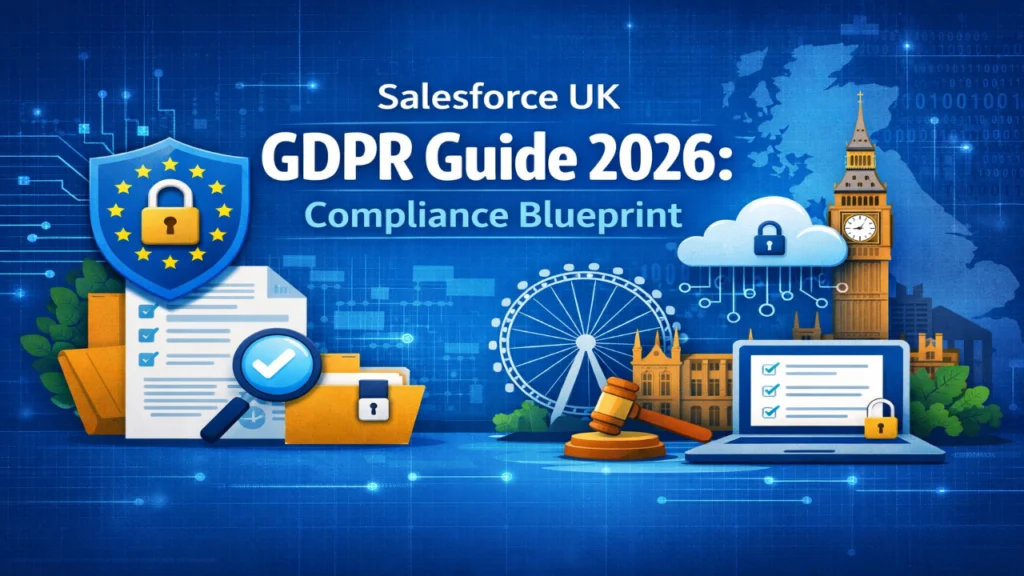
Salesforce UK GDPR Guide 2026: Compliance Blueprint is a practical, platform‑specific roadmap for organizations using Salesforce to meet UK General Data Protection Regulation (UK GDPR) obligations in 2026.
Table of Contents
Introduction: Salesforce UK GDPR Guide 2026
What UK GDPR Means for Salesforce
Core Principles Applied in SalesforceLawfulness, fairness, and transparency
Data minimisation and purpose limitation
Data accuracy and integrity
Key UK‑Specific Obligations in 2026Right to be forgotten (erasure)
Data retention and storage limitation
Data‑subject access and portability
Configuring Salesforce for UK GDPR CompliancePrivacy‑by‑design and default settings
Consent and lawful‑basis managementAccess controls and security
Data Retention and Erasure Automation
Governance, Training, and DocumentationAccountability and record‑keeping
Training and internal processes
Vendor and subcontractor management
Summary for a 2026‑Ready Salesforce UK GDPR Blueprint
What UK GDPR Means for Salesforce
UK GDPR is the UK’s version of the EU GDPR, enforced by the Information Commissioner’s Office (ICO) and aligned with the same core principles: lawfulness, fairness, transparency, data minimisation, storage limitation, integrity, confidentiality, and accountability. For Salesforce users, this means that your CRM is not “automatically compliant”; you remain the data controller and must configure the platform so that the personal data of UK‑based individuals is handled in line with these rules.
In 2026, the distinction between UK and EU data-protection regimes is especially relevant because they are now legally distinct, even though they look very similar. A single Salesforce org can simultaneously hold both UK‑resident and EU‑resident personal data, so many businesses must design their architecture to satisfy both frameworks side by side.
Core Principles Applied in Salesforce
Lawfulness, fairness, and transparency
Every piece of personal data stored in Salesforce (e.g., leads, contacts, accounts, and custom objects with customer details) must have a lawful basis, such as consent, contract performance, or legitimate interest. In practice, teams should document data‑processing purposes for each object and field, map where consent is required, and ensure that individuals can easily understand how their data is used.
Salesforce can support the management of consent through preference-centre flows, consent fields on contact records, and audit-trail fields that log when consent was given or withdrawn. This helps satisfy the transparency requirement that individuals receive clear information about what personal data you hold and why.
Data minimisation and purpose limitation
UK GDPR requires that you only collect and retain personal data that is necessary for specified, explicit purposes. In Salesforce, this means revisiting page layouts, record types, and custom fields to avoid capturing “nice‑to‑have” information that does not support a documented business need.
Teams should also define data‑retention rules per object (e.g., how long to keep inactive leads, closed‑lost opportunities, or service cases) and align them with UK‑specific retention schedules. Where data is no longer needed, it should be securely deleted or archived, rather than left in production indefinitely.
Data accuracy and integrity
Individuals have the right to rectification, meaning they can request that we correct inaccurate personal data. Salesforce administrators can support this by enabling duplicate management, validation rules, and automated cleansing workflows so that contact and account records are kept up to date.
Access controls and field-level security also play a role here: only authorised users should be allowed to edit core personal data, reducing the risk of erroneous or unauthorised changes.
Key UK‑Specific Obligations in 2026
Right to be forgotten (erasure)
Under Article 17 of the UK GDPR, data subjects can request the deletion of their personal data, and organisations generally have 30 days to respond. In Salesforce, the data model is complicated because personal data may live in multiple objects, related records, history tracking, and even sandboxes.
A UK‑focused compliance blueprint in 2026 should, therefore, include the following:
A clear DSAR (data‑subject access request) intake process, ideally integrated with Salesforce Service Cloud or custom cases.
Flows or automation that cascade deletion requests across related records, flags, and audit fields while documenting what was deleted and when for ICO‑ready evidence.
Separate retention and deletion schedules should be established for UK-resident records, ensuring that cloud-based automation removes personal data in accordance with UK-specific rules once the retention period expires.
Data retention and storage limitation
UK GDPR does not allow open‑ended retention of personal data. Many organisations now implement a “data‑retention blueprint” in Salesforce, where each object or record type is assigned a UK‑specific retention period (for example, 3 years for closed opportunities, 6 years for financial data, or 1 year for marketing‑only leads).
In 2026, leading practices use Salesforce automation (scheduled flows, record‑aging rules, or vendor‑type tools) to enforce these schedules and automatically archive or delete records that go beyond their UK‑defined retention window. This supports both legal compliance and data‑quality goals, reducing the volume of stale personal data sitting in production.
Data‑subject access and portability
Individuals have the right to access their personal data and, in some cases, port it to another service. Salesforce can support this by:
Building secure self‑service portals or community sites where users can view their data and request changes.
Using standard reports, exports, or custom APIs that can respond to DSARs with a structured export of a data subject’s records while respecting record-level sharing and field-level security.
Where data portability applies, organisations should be able to provide a machine-readable format of the data that can be scripted or templated using Salesforce’s native export or integration capabilities.
Configuring Salesforce for UK GDPR Compliance
Privacy‑by‑design and default settings
The UK GDPR emphasises privacy by design and default privacy settings, meaning that data protection should be built into systems from the outset. For Salesforce, this translates into:
Starting new projects with privacy classification of fields (e.g., “personal”, “sensitive”, “UK‑data‑subject”) and aligning them with UK-specific policies.
Using field‑level security and permission sets so that only users with a genuine business need can see or edit personal data.
Ensuring that new custom objects or page layouts are configured so that sensitive fields are hidden or masked by default.
Consent and lawful‑basis management
Managing consent is a central pillar of UK GDPR compliance. Salesforce environments typically implement the following:
Dedicated consent fields on contact, lead, or custom object records, with picklists such as “granted”, “withdrawn”, or “not required”.
Flows or triggers that update downstream records (campaign members, marketing emails, and service records) when consent is revoked, ensuring that communications stop and data processing is aligned with the lawful basis state.
Timestamps and audit fields that record when consent was given, how, and by what channel, providing an audit trail that can be presented to the ICO if required.
Effective 2026, regulators are increasingly focused on “dark patterns” and manipulative consent designs, so teams should ensure that consent forms and Salesforce‑integrated web forms are clear, unambiguous, and straightforward to withdraw.
Access controls and security
UK GDPR requires appropriate technical and organisational measures to protect personal data. In Salesforce, this means:
Role hierarchies, profiles, and permission sets that follow the principle of least privilege.
Regular reviews of active users, login history checks, and MFA enforcement help reduce the risk of unauthorised access.
Field‑level security and record‑type controls that restrict visibility of sensitive UK personal data only to those who need it.
Organisations should also consider network-level protections, such as IP restrictions on login flows and monitoring of unusual export patterns, to detect and prevent bulk data exfiltration.
Data Retention and Erasure Automation
A 2026‑ready UK GDPR blueprint for Salesforce will treat data retention as a first‑class design concern. Practically, this involves:
Running a data audit to classify which objects and records contain UK personal data and mapping each to a documented retention period.
Configuring scheduled automation or retention management tools that either archive or delete records when they pass the UK-defined retention window, while keeping an audit log for compliance evidence.
Erasure must similarly be automated and traceable. When a UK data subject exercises their right to erasure, Salesforce workflows should remove visible records, clear related fields, and mask or delete copies in sandboxes or test data, all within the 30‑day window. Organisations should also maintain an internal log of erasure actions, including the data subject’s ID and the date of the request, to demonstrate accountability.
Governance, Training, and Documentation
Accountability and record‑keeping
UK GDPR places a strong emphasis on accountability; organisations must be able to prove that they comply. In a Salesforce context, this means:
Documenting data‑processing activities for each object and integration, including what data is collected, why, and how long it is kept.
Maintaining records of data‑protection impact assessments (DPIAs) for higher‑risk processing, such as profiling or large‑scale marketing automation.
We are storing evidence of consent, DSAR responses, and retention actions in a searchable way, often within custom objects or Salesforce Notes.
Training and internal processes
Tools and configuration alone are not enough. UK‑focused Salesforce teams in 2026 should run regular training for admins, developers, and business users on:
When and how to handle DSARs in Salesforce.
How to update consent fields and respect data‑retention rules in day‑to‑day operations.
How to report suspicious activity, such as unusual exports or bulk deletions, so that the organisation can respond quickly.
Vendor and subcontractor management
Salesforce itself acts as a data processor for many customers, but UK-based organisations remain data controllers and must ensure that their wider tech stack complies with UK GDPR. This includes:
Reviewing data‑processing agreements and contracts with any third‑party apps or integrations that connect to Salesforce.
Mapping data flows between Salesforce and external platforms (e-mail tools, marketing platforms, and analytics systems) and ensuring those partners have appropriate security and retention controls.
Summary for a 2026‑Ready Salesforce UK GDPR Blueprint
A modern Salesforce UK GDPR blueprint for 2026 is built on five pillars: documenting lawful bases and transparency, enforcing data minimisation and retention, fully automating DSARs and erasure, embedding privacy by design into every configuration, and maintaining strong governance and training. By aligning the design of the Salesforce environment with UK-specific rules (such as 30-day erasure windows, UK-only retention schedules, and clear consent tracking) organisations can simultaneously meet regulatory expectations, reduce the risk of ICO fines, and run a cleaner, more accountable CRM environment.
Founder and CEO of iTechCloud Solution, a Salesforce consulting and product partner since 2017. He sets engagement strategy and stays the commercial owner of every account, working with clients across Salesforce, AI and data from the first call through to go-live.
Connect on LinkedIn