
Introduction
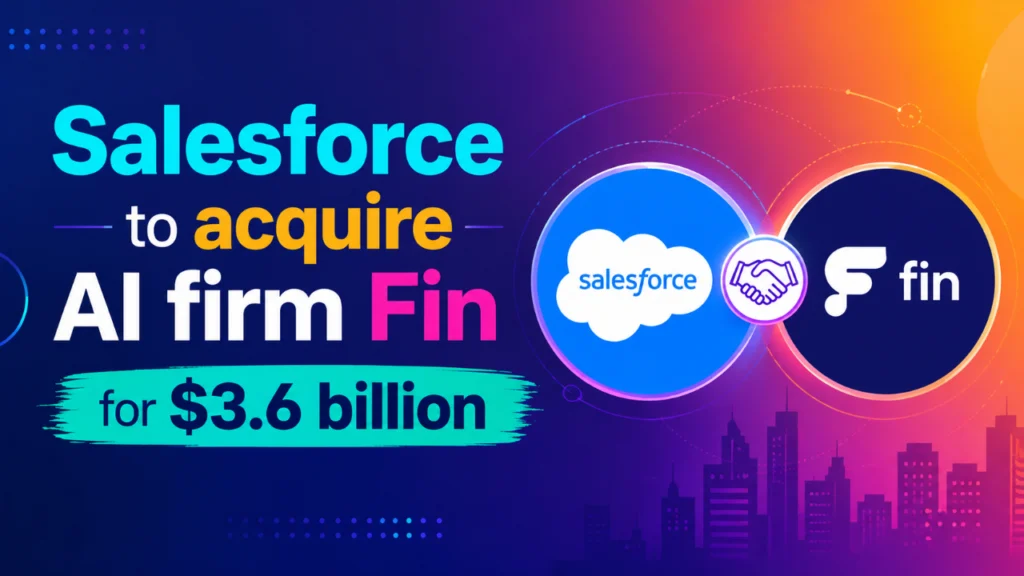
Salesforce has made its boldest AI move yet in 2026. On June 15, the CRM giant announced a definitive agreement to acquire Fin, the AI-powered customer service company formerly known as Intercom, in a deal valued at approximately $3.6 billion. The acquisition reinforces Agentforce, Salesforce’s flagship autonomous AI agent platform, and signals just how aggressively enterprise software vendors are racing to own the “agentic” layer of customer experience.
For Salesforce watchers, partners, and customers, this deal reflects where Salesforce believes the next phase of CRM value will be created, and it reshapes the competitive map for every company building AI-driven support tools.
Table of Contents
Introduction
What Exactly Is Fin?
Deal Terms and Timeline
Why Salesforce Is Making This Move Now
How This Fits Into Salesforce’s Broader Acquisition Strategy
The Competitive Landscape
What This Means for Salesforce Customers and Partners
Looking Ahead
What Exactly Is Fin?
Fin began life as Intercom, a well-known customer messaging and support platform. Over the past couple of years, the company has pivoted hard toward AI, eventually rebranding itself entirely as Fin this past May to reflect that its AI agent business has become its core identity.
Fin’s flagship product is an AI agent capable of resolving customer support conversations end-to-end across nearly every channel a business might use, including live chat, email, phone, WhatsApp, SMS, and Slack. The agent runs on Apex, a proprietary model Fin built specifically for support scenarios. The company claims that Apex has better support-specific resolution rates than commercially available frontier models, including those from OpenAI and Anthropic.
The numbers behind Fin’s business are notable: well over two million customer conversations handled weekly, an average resolution rate of 76% without human intervention, over 30,000 business customers globally, and more than $400 million in annual recurring revenue.
Deal Terms and Timeline
Salesforce will pay approximately $3.6 billion for Fin, subject to standard purchase price adjustments, in a structure reported to include both cash and stock. Salesforce has stated the transaction will not affect its full-year fiscal 2027 financial guidance or its existing share buyback commitments. The deal still requires regulatory approval, and Salesforce expects it to close before the end of its fourth fiscal quarter of 2027.
Marc Benioff, Salesforce’s CEO, framed the rationale around capability and talent, describing Fin as bringing proven agent technology and a strong AI team that will strengthen Agentforce’s service-agent capabilities.
Why Salesforce Is Making This Move Now
To understand why Salesforce is willing to spend $3.6 billion on a customer service AI company, it helps to look at the pressure the company is under. Agentforce has seen adoption that some analysts consider underwhelming, despite being central to Benioff’s public narrative about Salesforce’s future: roughly 12% of Salesforce’s customer base has adopted the platform so far. At the same time, Salesforce’s stock has lost more than a third of its value over the past year, reflecting investor anxiety that generative AI could erode demand for traditional, seat-based CRM software rather than expand it.
Against that backdrop, buying Fin looks like an attempt to skip a slower internal build cycle and acquire a customer-facing AI agent with years of real-world deployment data already behind it. Where Agentforce has largely been positioned as a highly customizable platform for large enterprises, Fin offers packaged, fast-to-deploy agents that smaller and mid-sized businesses can implement quickly. That speed-to-value proposition is one of the most frequently cited reasons analysts see strategic logic in the deal.
Agentforce itself is not struggling on every metric, however. The platform reportedly reached $1.2 billion in annual recurring revenue last quarter, a 205% increase year-over-year. Fin’s customer base and technology are meant to accelerate that trajectory further, particularly among smaller organizations that may not have the resources for a heavily customized build.
How This Fits Into Salesforce’s Broader Acquisition Strategy
The Fin deal does not exist in isolation. Salesforce has reportedly made more than a dozen AI-related acquisitions since the start of 2025, all aimed at reinforcing various aspects of its agentic AI strategy. This pace has drawn sharp criticism. Scott Bickley, an advisory fellow at Info-Tech Research, described the acquisitions as difficult to parse, suggesting Salesforce will face significant work integrating numerous codebases in a short timeframe and that the company’s overall focus appears scattered.
Other analysts have raised similar concerns about execution. Sanchit Vir Gogia of Greyhound Research noted that Salesforce has given a closing timeline but no integration timetable, arguing true architectural convergence, where identity, data, and governance systems actually merge, typically takes twelve to twenty-four months after a deal closes rather than a single quarter. The risk, as he frames it, is “acquisition indigestion”, where rapid deal-making outpaces the company’s ability to turn separate platforms into a single, coherent product.
Not all reactions have been negative. Analysts at Jefferies and Truist have pointed to Fin’s outcome-based pricing model and strong traction among smaller businesses as meaningful additions to Salesforce’s AI product set. Jefferies analyst Brent Thill specifically highlighted Fin’s rapid deployment model as a way to accelerate AI adoption across Salesforce’s existing customer base, rather than requiring every customer to build a custom Agentforce implementation from scratch.
The Competitive Landscape
This acquisition lands in a market for customer experience software where nearly every major vendor is racing toward the same destination: autonomous AI agents that resolve support issues without human involvement. Salesforce’s move puts pressure on a wide field of competitors, including NICE, Five9, Genesys, Zendesk, HubSpot, ServiceNow, Freshworks, and Microsoft, all investing heavily in their own conversational AI and automation capabilities.
It is worth placing the Fin deal alongside other large customer experience acquisitions recently, including SAP’s $8 billion purchase of Qualtrics, Hellman & Friedman’s $10.2 billion take-private of Zendesk, and Thoma Bravo’s $6.4 billion acquisition of Medallia. While not the largest deal in the category, Fin is considered one of the largest “agentic CX” deals to date, specifically tied to autonomous, conversational AI agents rather than traditional CX software.
Industry observers expect this deal to accelerate similar moves elsewhere. If Salesforce successfully folds Fin’s technology into Agentforce, competitors will likely face pressure to either build comparable agentic capabilities internally or pursue their own acquisitions to keep pace.
What This Means for Salesforce Customers and Partners
For organizations already using Salesforce, particularly those leaning on Service Cloud or exploring Agentforce, the Fin acquisition points toward a future where AI agents handle a much larger share of routine support volume, escalating only complex or sensitive cases to humans. That could lead to meaningful reductions in support costs and faster response times once the technology is fully integrated.
For the broader Salesforce partner ecosystem, including consulting and implementation firms, the acquisition merits close attention. As Salesforce works to combine Fin’s packaged, fast-deployment model with Agentforce’s more customizable enterprise approach, there will likely be new opportunities, and new complexity, in helping clients decide which AI agent approach fits their needs.
Looking Ahead
The Salesforce-Fin deal is a clear marker of where enterprise software is heading: away from tools that merely assist human employees and toward systems designed to operate independently within defined guardrails. Whether Salesforce can translate this $3.6 billion bet into smooth integration and tangible customer value, rather than the “licensing fog” some analysts warn about, will likely become clearer over the next twelve to twenty-four months as the deal moves from announcement to execution.
For now, the message from Salesforce is unambiguous: in the race to define agentic AI in customer experience, the company would rather buy proven technology than wait to build it.
Founder and CEO of iTechCloud Solution, a Salesforce consulting and product partner since 2017. He sets engagement strategy and stays the commercial owner of every account, working with clients across Salesforce, AI and data from the first call through to go-live.
Connect on LinkedIn