
The Strategic Pivot: From Traditional CRM to Agent-First Enterprise
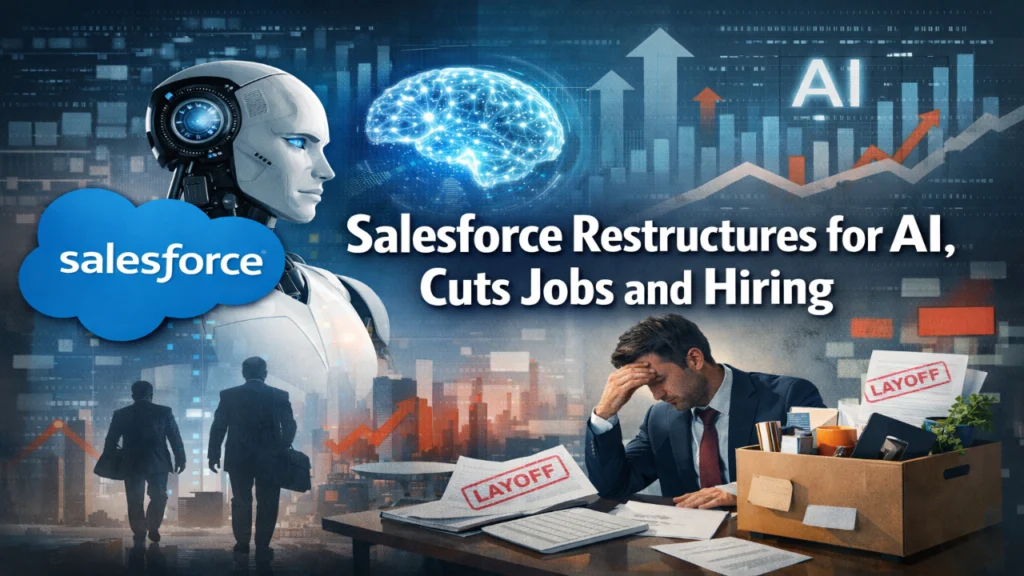
Salesforce, one of the world’s leading customer relationship management (CRM) software giants, has announced a major restructuring that highlights the dramatic shift in technology priorities across the industry. The company is cutting over 1,000 jobs while simultaneously expanding its hiring efforts for roles focused on artificial intelligence, particularly around its flagship AI product, Agentforce. This paradoxical move of cutting jobs while hiring represents a fundamental transformation in how the company views its future and where it will concentrate its resources.
Salesforce is not simply downsizing for cost-cutting purposes. Rather, the company is undergoing a deliberate reallocation of its workforce to support its ambitious pivot toward becoming an “agent-first” enterprise. This transformation reflects the broader trend across the technology sector, where companies are fundamentally reassessing their business models and workforce strategies in light of artificial intelligence advancements.
Table of Contents
The Strategic Pivot: From Traditional CRM to Agent-First Enterprise
Understanding Agentforce: The Heart of Transformation
The Numbers Behind the Restructuring
The Dual Strategy: Cutting and Hiring Simultaneously
The Software Engineering Question: A Potential Hiring Freeze?
Industry-Wide Context: Part of a Larger Trend
Clarifications and Controversies: Setting the Record Straight
Financial Performance and Strategic Confidence
Looking Ahead: What This Means for the Industry
Conclusion: Salesforce Restructures for AI
Understanding Agentforce: The Heart of Transformation
At the core of Salesforce’s restructuring lies Agentforce, the company’s breakthrough autonomous AI agent platform. Launched in September 2024, Agentforce represents Marc Benioff’s vision as CEO for the future of enterprise software. Rather than relying on traditional chatbots or human-driven workflows, Agentforce enables businesses to build and deploy autonomous AI agents that can independently perform complex tasks across various business functions.
The platform has already demonstrated significant market traction. CEO Marc Benioff announced that Salesforce has secured over 1,000 paid deals for Agentforce, a remarkable achievement that underscores strong customer demand for the technology. The second generation of Agentforce technology became available to customers in early 2025, further cementing this product’s central role in the company’s future strategy by creating and operating even more sophisticated AI agents.
Benioff has been notably vocal about his belief in AI agents’ transformative potential. In various interviews and statements, he has emphasised that autonomous agents will eventually replace traditional chatbots and may even take over certain human workflows. This conviction has directly influenced the company’s staffing decisions, making the restructuring not a reluctant cost-cutting measure but a confident bet on AI’s ability to increase productivity and efficiency.
The Numbers Behind the Restructuring
As of January 2024, Salesforce employed approximately 72,000 to 73,000 people globally. The current round of job cuts targeting over 1,000 positions represents approximately 1.4% of the total workforce. While this percentage might seem modest, the significance lies in the strategic nature of these cuts. They are not random across the organization but carefully targeted to reallocate resources toward AI-focused initiatives.
This is not the first major restructuring Salesforce has undertaken recently. In early 2023, the company cut 10% of its global workforce (approximately 8,000 employees) as part of a comprehensive cost-reduction programme. This was followed by another round of layoffs in January 2024 that eliminated around 700 positions. An additional 300 employees were let go in July 2024. The current cuts in February 2025 represent the company’s third significant restructuring in roughly two years, though each successive round has been smaller in scale.
The Dual Strategy: Cutting and Hiring Simultaneously
What makes Salesforce’s current restructuring particularly noteworthy is its dual nature. While the company is cutting over 1,000 jobs, it is simultaneously launching aggressive hiring campaigns specifically targeting salespeople and other roles focused on promoting and implementing its new AI products. This approach reflects a calculated strategy: reduce headcount in areas deemed less critical while expanding capacity in areas aligned with future growth.
Affected employees are being given the opportunity to apply for other positions within the company, a gesture that acknowledges the company’s commitment to retaining talent where possible. However, Salesforce has not specified which divisions will face the largest reductions, leaving some uncertainty about which business units it is deprioritizing.
The sales focus of the new hiring shows Salesforce’s confidence in its ability to monetise Agentforce and other AI offerings. The company recognises that having innovative technology is only part of the challenge; equally important is having the sales infrastructure to convert market interest into revenue. By expanding its sales organization while trimming other areas, Salesforce is positioning itself to capitalise on the growing enterprise demand for AI-powered business solutions.
The Software Engineering Question: A Potential Hiring Freeze?
One particularly intriguing aspect of Salesforce’s AI transition came to light when CEO Marc Benioff suggested the company might consider freezing software engineering hires in 2025. During a podcast interview, Benioff stated, “In engineering this year at Salesforce, we’re seriously debating whether we might not hire anyone this year. ” We have seen such incredible productivity gains because of the agents that work side by side with our engineers.”
This comment, while not an official policy announcement, hints at the dramatic productivity improvements Salesforce is experiencing from its AI tools. If the company can achieve the same engineering output with fewer people or with the same people but with AI assistance, it raises fundamental questions about future staffing needs in technical roles across the entire industry. This sentiment has echoed in statements from other tech leaders, with Amazon CEO Andy Jassy warning that generative AI tools will inevitably lead to “fewer people doing some of the jobs that are being done today.”
Industry-Wide Context: Part of a Larger Trend
Salesforce’s restructuring is not happening in isolation. The technology sector has entered a period of significant workforce realignment driven by AI investments. Major companies like Amazon, Microsoft, Meta, Google, and Oracle have all announced substantial job cuts recently. However, Salesforce’s restructuring stands out because it is explicitly tied to a specific product pivot rather than being characterised as general cost-cutting or workforce optimisation.
Similar motivations have driven other companies’ decisions. In the same period, Workday announced plans to cut 10% of its staff to further invest in AI technology. CEO Carl Eschenbach explained: “AI is changing how work gets done and opening up potential areas of growth for the company. This creates a massive opportunity for us, but we need to make some changes to better align our resources with our customers’ evolving needs.”
Clarifications and Controversies: Setting the Record Straight
Following initial reports about the restructuring, there was some confusion regarding the scale and nature of Salesforce’s workforce reductions. A report suggested that Salesforce had fired 4,000 experienced staff and replaced them with AI agents. The company subsequently clarified that it did not lay off 4,000 employees. According to Salesforce, the confusion stemmed from remarks CEO Marc Benioff made during a video interview on August 29, 2025. Rather than replacing staff with AI, Salesforce undertook strategic rebalancing, redeploying roles from support functions into sales teams and other customer-facing areas.
This clarification is important because it reframes the restructuring from a story of wholesale workforce replacement to one of functional reallocation. While AI productivity gains are enabling the company to do more with fewer people in certain areas, the primary goal is not to replace humans with algorithms but to redeploy human talent toward higher-value activities.
Financial Performance and Strategic Confidence
Solid financial performance buttresses Salesforce’s confidence in its AI strategy. During the third quarter of fiscal 2025, which ended on October 31, 2024, the company reported revenue of $9.44 billion, representing an 8% year-over-year increase. This growth provides the financial foundation for the company’s aggressive investment in AI technology and product development.
The company’s chief emphasised during earnings that Agentforce and its complete AI system for enterprises, built into the Salesforce platform, represent “the heart of a groundbreaking transformation.” The rise of autonomous AI agents, Benioff stated, is revolutionising global business operations, and Salesforce intends to be at the forefront of this revolution.
Looking Ahead: What This Means for the Industry
Salesforce’s restructuring sends several important signals to the broader technology industry. First, it demonstrates that even large, profitable companies are willing to make difficult workforce decisions to align their organizations with AI-driven futures. Second, it indicates that companies see AI as a productivity multiplier that could fundamentally change staffing requirements. Third, it emphasises the necessity of workforce retraining and transition support, as employees in traditional support and administrative roles face displacement.
For prospective employees and current Salesforce workers, the message is clear: the company is betting heavily on AI and autonomous agents as its future. Companies demand those whose skills align with AI sales, implementation, and support, while AI can optimise roles that face potential restructuring.
Conclusion: Salesforce Restructures for AI
Salesforce’s decision to cut over 1,000 jobs and expand its AI-focused workforce represents more than a simple staffing adjustment. It is a declaration of the company’s confidence in AI’s transformative potential and a bet that autonomous agents will become central to how enterprises operate. Whether this gamble pays off will depend on market acceptance of Agentforce, the company’s ability to retain and develop talent in AI-focused roles, and the broader question of whether AI can deliver the promised productivity gains.
As the technology industry continues to grapple with AI’s workforce implications, Salesforce’s approach (cutting to restructure, not just to save costs) may become the template that other companies follow in the years ahead. The company’s journey will be closely watched as evidence of whether AI-driven corporate transformation can be executed successfully while minimising disruption to employees and maintaining organisational effectiveness.
Founder and CEO of iTechCloud Solution, a Salesforce consulting and product partner since 2017. He sets engagement strategy and stays the commercial owner of every account, working with clients across Salesforce, AI and data from the first call through to go-live.
Connect on LinkedIn