
Introduction: Salesforce reskills 3000 employees
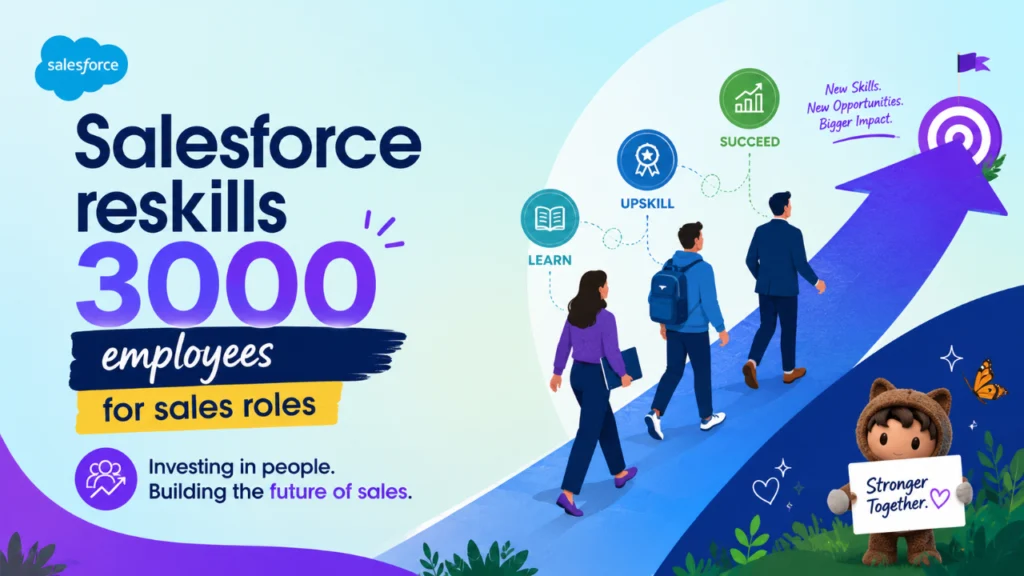
Salesforce is making one of its clearest workforce moves yet in the AI era: the company says it has reskilled and redeployed about 3,000 employees into sales roles as its agentic AI tools take over more repetitive, low-impact work. The update was reported on May 18-19, 2026, by PTI/ETHRWorld and Moneycontrol, making it one of the most talked-about workplace and AI stories of the week.
Table of Contents
Introduction: Salesforce reskills 3000 employees
What Happened
Why Salesforce Is Doing This
How AI Is Changing Roles Inside Salesforce
What This Means for Employees
Wider Business Impact
Conclusion
What Happened
According to Salesforce chief digital evangelist Vala Afshar, the company moved 3,000 employees from other internal functions into its sales organization without hiring the same number of people from outside. He said these workers were reskilled from repetitive tasks that AI agents can now handle and then shifted into higher-value roles.
Afshar also described the company’s direction as building “digital labour platforms” and said that Salesforce is not designing AI to replace humans. Instead, the goal is to use AI to augment people, improve productivity, and unlock more strategic work.
Why Salesforce Is Doing This
The core logic behind this move is simple: if AI can handle routine work, employees can be redirected toward customer-facing and growth-focused roles. Afshar said the reskilled employees had been doing low-impact work that agents now perform, which allowed Salesforce to expand its sales capacity without a major external hiring push.
This also fits Salesforce’s broader message that AI should support human talent rather than eliminate it. The company’s leadership is presenting reskilling as a practical response to automation, not just a defensive HR tactic. In that framing, AI becomes a tool for workforce redesign, not workforce removal.
How AI Is Changing Roles Inside Salesforce
Salesforce is using its own agentic AI tools to reshape work across the business. The reported shift shows that internal roles are being reorganised as automation absorbs repetitive tasks, while humans are moved into areas that need judgement, relationship-building, and sales execution.
That is why the company’s language matters. Afshar said Salesforce is building “a workforce of AIs”, but not to displace people. He argued the company is trying to create “boundless potential” for humans by pairing them with AI systems.
What This Means for Employees
For employees, this development is a strong signal that career mobility inside tech companies will increasingly depend on AI fluency. Salesforce’s reskilling push suggests that workers who can adapt, learn new tools, and shift into customer- or revenue-facing roles may find more opportunities even when old job functions shrink.
At the same time, the move reflects a major change in management strategy. Moneycontrol reported that Afshar suggested organisations may need to recalibrate their budget structures, leadership layers, and performance indicators as they become “a little bit flattened”. That implies AI transformation is not just about software adoption; it also changes how companies organise and measure themselves.
Wider Business Impact
Salesforce’s message is also important beyond its workforce. Afshar said companies across the US, Europe, and India are removing inefficiencies at scale and freeing up human talent that then needs reskilling. In that sense, Salesforce is positioning itself as an example of how enterprises can adapt to the agentic AI wave without relying solely on layoffs or external hiring.
He also said Salesforce sees India as strategically important and repeated a projection that the Salesforce economy could add USD 89 billion in new revenue to India by 2028. That claim reflects how closely the company is linking AI adoption, workforce transformation, and market growth in the region.
Conclusion
Salesforce’s reskilling of 3,000 employees into sales roles is a strong example of how AI is reshaping enterprise work in 2026. The company is not presenting AI as a replacement for people but as a tool that can absorb repetitive tasks and free employees for more valuable work.
For businesses, the lesson is clear: AI adoption is no longer only about efficiency. It is increasingly about redesigning roles, training employees for new functions, and building a workforce that can work alongside agents rather than compete with them. Salesforce’s latest move shows that reskilling may become one of the most important strategies for companies trying to stay competitive in an AI-driven market.
Part of the team turning Salesforce and AI strategy into shipped, measurable outcomes for enterprises across five regions.