
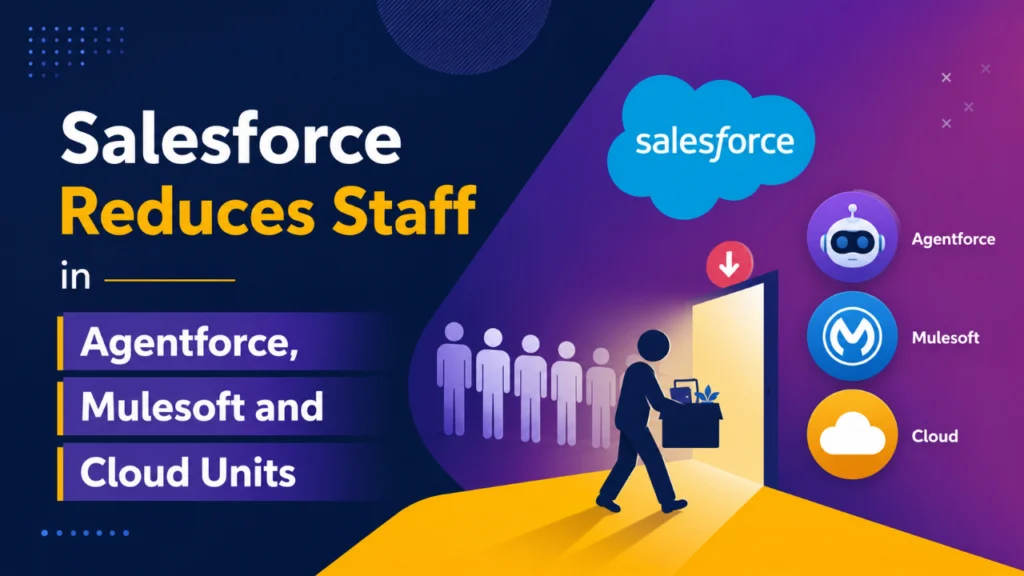
According to recent reports, Salesforce eliminated approximately 86 positions in California, with additional employees reportedly affected in other locations, including Washington state and international offices. The layoffs affected roles in sales, administration, technology, and product functions. While some reports indicate that employees connected to Agentforce, MuleSoft, and Marketing Cloud were affected, sources suggest that Salesforce’s main teams for Agentforce development were largely untouched. This indicates that the company remains committed to its long-term AI strategy despite the workforce restructuring.
Table of Contents
A New Phase of Salesforce’s Transformation
Why Agentforce Matters
MuleSoft and Marketing Cloud Also Impacted
Workforce Optimization in the Age of AI
Market Challenges and Investor Expectations
Impact on Employees
What Comes Next for Salesforce?
Conclusion: Salesforce reduces staff
A New Phase of Salesforce’s Transformation
The latest job cuts highlight the broader transformation taking place across the technology industry. Companies are increasingly investing in artificial intelligence and automation tools that can improve efficiency, reduce operational expenses, and accelerate innovation.
For Salesforce, AI has become a central part of its future vision. The company has spent the last two years positioning Agentforce as one of its most important strategic initiatives. Agentforce enables organizations to deploy autonomous AI agents that can assist with customer service, sales support, workflow automation, and business operations.
As enterprises continue to adopt AI-driven solutions, Salesforce is reorganising its resources to better align with changing customer needs and market demands.
Why Agentforce Matters
Agentforce has been one of Salesforce’s most heavily promoted products. CEO Marc Benioff has repeatedly emphasised the importance of AI agents in transforming how businesses operate.
The platform helps organizations automate routine work, improve customer experiences, and increase employee productivity. Businesses can deploy AI agents capable of handling customer enquiries, generating recommendations, performing administrative tasks, and supporting decision-making processes.
Despite significant investment and strong marketing efforts, industry observers have questioned how quickly organizations are adopting these AI capabilities. Agentforce, like many emerging AI platforms, faces challenges in turning its technological potential into large-scale enterprise adoption.
The recent layoffs have sparked discussions about whether Salesforce is adjusting expectations around AI growth or simply optimizing its workforce as it continues to scale its AI offerings.
MuleSoft and Marketing Cloud Also Impacted
In addition to Agentforce-related roles, the layoffs also reportedly affected employees associated with MuleSoft and Marketing Cloud.
MuleSoft has long been a key component of Salesforce’s integration strategy, helping organizations connect applications, systems, and data sources. It plays an important role in enabling digital transformation projects and enterprise connectivity.
Marketing Cloud remains one of Salesforce’s main platforms for customer engagement, providing businesses with tools for email marketing, personalization, analytics, and customer journey management.
The inclusion of these business units in the latest restructuring suggests Salesforce is reviewing priorities across multiple product lines rather than focusing exclusively on AI-related divisions.
Workforce Optimization in the Age of AI
The latest layoffs are part of a larger trend occurring throughout the technology industry. As AI systems become more capable, companies are reevaluating workforce requirements and operational structures.
Many technology firms are seeking ways to improve productivity through automation while maintaining profitability in a competitive environment. This often leads to organisational restructuring, resource reallocation, and strategic hiring in high-priority areas.
Salesforce has previously discussed how AI technologies are helping improve efficiency across customer support, operations, and internal business processes. The company continues to invest heavily in AI innovation while streamlining certain functions to support long-term growth objectives.
Industry analysts view these workforce adjustments as part of a broader shift toward AI-powered business models rather than a sign of weakening commitment to artificial intelligence.
Market Challenges and Investor Expectations
The restructuring also comes during a period of heightened pressure on technology companies to demonstrate sustainable growth.
Investors are closely watching how AI investments translate into revenue and profitability. While Salesforce has reported growing interest in Agentforce and other AI-related offerings, market expectations remain high.
Competition in the AI software market has intensified significantly. Large technology providers are racing to launch enterprise AI platforms, autonomous agents, and productivity solutions. As a result, Salesforce must balance innovation spending with operational efficiency.
The company’s recent workforce actions may be viewed as part of a broader effort to improve financial performance while continuing to invest in strategic growth initiatives.
Impact on Employees
For affected employees, the layoffs represent another challenging chapter in an industry that has experienced multiple rounds of workforce reductions over the past several years.
Reports indicate that impacted employees will receive severance packages based on tenure and position level. Salesforce has historically offered relatively competitive severance arrangements compared to many other technology firms.
While workforce reductions create uncertainty for employees, experienced Salesforce professionals remain in demand across consulting firms, implementation partners, system integrators, and enterprise organizations. Skills related to Salesforce administration, development, architecture, integration, and AI implementation continue to be valuable in the broader technology market.
What Comes Next for Salesforce?
Despite the workforce reductions, Salesforce continues to centre its long-term strategy on artificial intelligence, automation, and enterprise digital transformation.
The company continues to position Agentforce as a cornerstone of its future growth strategy. Investments in AI agents, customer automation, data intelligence, and integrated business workflows remain key priorities.
At the same time, Salesforce is likely to continue evaluating operational efficiency across its product portfolio. Organizations throughout the software industry are making similar adjustments as they adapt to changing economic conditions and evolving customer expectations.
The latest layoffs should therefore be viewed not simply as a cost-cutting exercise but as part of Salesforce’s ongoing effort to redefine itself for the AI era.
Conclusion: Salesforce reduces staff
Salesforce’s decision to reduce staff across Agentforce, MuleSoft, and Marketing Cloud teams reflects the significant transformation underway within the enterprise software industry. While approximately 86 reported job cuts have drawn attention, the broader story is about how technology companies are restructuring around artificial intelligence, automation, and future growth opportunities.
As Salesforce continues investing in Agentforce and next-generation AI solutions, the company is simultaneously optimizing its workforce and operational model. The coming months will reveal whether these changes help accelerate adoption of its AI offerings and strengthen its competitive position in the rapidly evolving enterprise technology market. For Salesforce customers, partners, and professionals, one thing remains clear: artificial intelligence will continue to shape the company’s strategy, products, and future direction.
Founder and CEO of iTechCloud Solution, a Salesforce consulting and product partner since 2017. He sets engagement strategy and stays the commercial owner of every account, working with clients across Salesforce, AI and data from the first call through to go-live.
Connect on LinkedIn