

Salesforce Org Technical Debt You Can’t Ignore in 2026
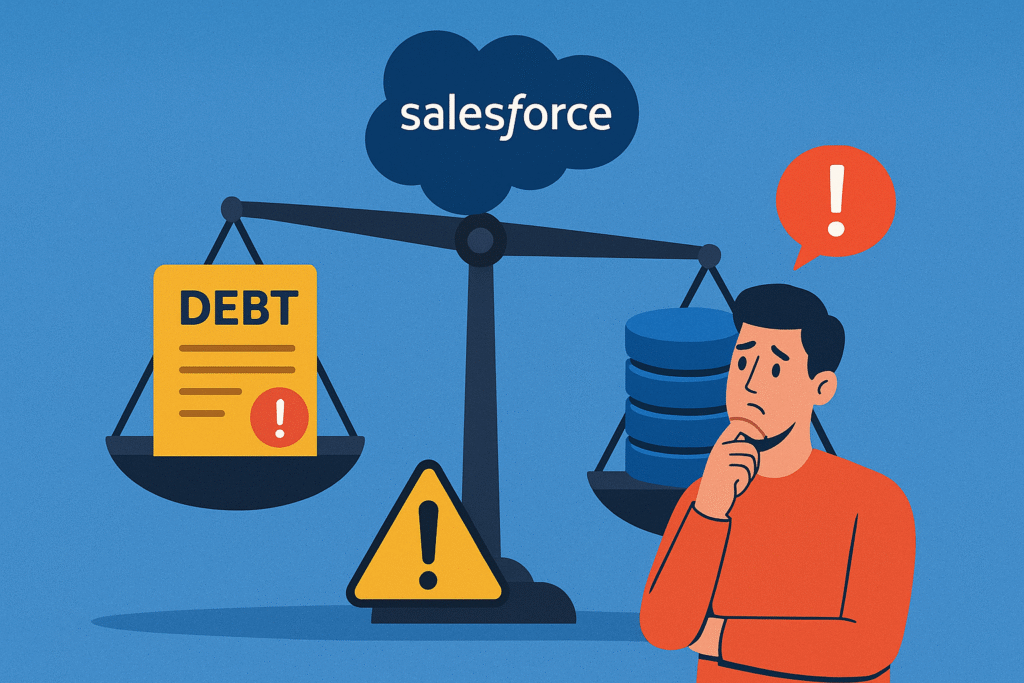
Introduction: Salesforce Org Technical Debt
As Salesforce continues to evolve rapidly with AI-powered features like Agentforce, Data Cloud, and industry-specific clouds, many organizations are entering 2026 with a hidden but growing problem: Salesforce technical debt. What once started as quick customizations, temporary workarounds, or rushed implementations has now become a major obstacle to scalability, performance, and innovation.
Salesforce technical debt in 2026 is no longer just a backend concern for admins and developers it directly impacts business agility, user adoption, system performance, and ROI. Organizations that fail to address it risk falling behind competitors who are building cleaner, smarter, and more future-ready Salesforce orgs.
This blog explores the common Salesforce technical debt issues, why they are more dangerous than ever in 2026, and how to reduce technical debt in Salesforce using proven Salesforce org optimization best practices.
Table of Contents
What Is Salesforce Technical Debt?
Salesforce technical debt refers to the accumulated inefficiencies, outdated configurations, poor design decisions, and unused or over-customized components within a Salesforce org. These issues typically arise from:
- Rapid implementations without long-term planning
- Excessive custom code instead of declarative tools
- Multiple admins or vendors working without governance
- Legacy automations not aligned with modern Salesforce architecture
In 2026, technical debt is especially risky because Salesforce is increasingly platform-driven, AI-enabled, and performance-sensitive. A cluttered org limits your ability to adopt new Salesforce innovations quickly.
Why Salesforce Technical Debt Is a Bigger Problem in 2026
1. AI and Automation Depend on Clean Data & Architecture
Salesforce AI tools like Einstein, Agentforce, and predictive analytics rely heavily on clean data models, optimized automations, and consistent object relationships. Technical debt weakens AI accuracy and trust.
2. Salesforce Release Velocity Is Faster Than Ever
With three major releases every year and continuous platform enhancements, outdated configurations break faster and require more maintenance.
3. Scalability Expectations Are Higher
Salesforce orgs are no longer supporting just CRM users they power customer portals, integrations, analytics, mobile apps, and AI agents. Technical debt blocks scalability.
Common Salesforce Technical Debt Issues in 2026
1. Excessive Custom Code Where Declarative Tools Exist
One of the most common Salesforce technical debt issues is over-reliance on Apex code. Older orgs often use custom triggers, workflows, and Visualforce pages for functionality now easily handled by:
- Flow Builder
- Validation Rules
- Dynamic Forms
- Lightning App Builder
This increases maintenance costs, creates testing overhead, and slows deployments.
Impact in 2026: Slower releases, higher failure rates, and difficulty adopting new Salesforce features.
2. Legacy Automation Chaos (Workflow Rules & Process Builder)
Many Salesforce orgs still run Workflow Rules and Process Builder automations alongside Flows. This creates:
- Conflicting logic
- Performance degradation
- Debugging nightmares
Salesforce has clearly positioned Flow as the future, making legacy automation a serious liability.
Impact in 2026: Automation conflicts, unpredictable behavior, and upgrade risks.
3. Poor Data Model Design
A weak data model is a silent killer. Common problems include:
- Too many custom objects doing the same job
- Incorrect master-detail vs lookup relationships
- Overloaded objects with hundreds of fields
- Inconsistent naming conventions
Impact in 2026: Poor reporting, inaccurate AI insights, slower queries, and reduced user trust.
4. Unused Fields, Objects, and Metadata
Over the years, Salesforce orgs accumulate:
- Unused custom fields
- Deprecated objects
- Old record types
- Redundant page layouts
These elements confuse users, slow down performance, and increase deployment risks.
Impact in 2026: Lower adoption, higher admin effort, and slower org performance.
5. Inconsistent Security & Access Controls
Salesforce orgs often suffer from:
- Over-permissive profiles
- Too many permission sets
- Hard-coded sharing logic
- Manual access management
This not only creates technical debt but also introduces security and compliance risks.
Impact in 2026: Audit failures, security gaps, and limited scalability for external users and AI agents.
6. Integration Spaghetti
Modern Salesforce orgs integrate with ERPs, marketing platforms, data warehouses, and third-party tools. Technical debt appears when integrations are:
- Hard-coded
- Poorly documented
- Redundant
- Not monitored
Impact in 2026: Data sync failures, delayed insights, and system downtime.
Business Consequences of Ignoring Salesforce Technical Debt
Ignoring Salesforce technical debt in 2026 leads to more than just technical issues:
- 🚫 Slower innovation
- 💸 Higher maintenance costs
- 📉 Poor user adoption
- 🤖 Limited AI readiness
- ⏳ Longer deployment cycles
- 🔐 Increased security risks
Ultimately, technical debt turns Salesforce from a growth enabler into a bottleneck.
Salesforce Org Optimization Best Practices for 2026
1. Conduct Regular Salesforce Org Health Audits
A structured org audit should review:
- Automation usage
- Code quality
- Data model efficiency
- Security configuration
- Metadata usage
Annual or bi-annual audits help prevent debt accumulation.
2. Migrate Legacy Automation to Flow
One of the most impactful steps in how to reduce technical debt in Salesforce is:
- Replacing Workflow Rules
- Converting Process Builders
- Consolidating logic into optimized Flows
This improves performance, clarity, and future compatibility.
3. Adopt a “Config First, Code Later” Strategy
Before writing Apex, always evaluate declarative options. Salesforce continues to expand no-code and low-code capabilities that are:
- Easier to maintain
- Faster to deploy
- More admin-friendly
This significantly reduces long-term technical debt.
4. Clean Up Unused Metadata Regularly
Implement a quarterly cleanup process to:
- Remove unused fields and objects
- Archive obsolete automations
- Retire unused page layouts
Use field usage tracking and dependency analysis to ensure safe cleanup.
5. Standardize Naming Conventions & Documentation
Consistency reduces confusion and onboarding time. Best practices include:
- Clear naming standards
- Inline descriptions on fields and Flows
- Centralized documentation
This is especially important for growing teams and partner ecosystems.
6. Modernize Security with Permission Sets & Sharing Rules
Move away from profile-heavy models and adopt:
- Permission set-based access
- Role-based sharing
- Declarative sharing rules
This improves scalability and security governance.
7. Build Scalable Integration Architecture
For integrations, follow best practices such as:
- Using middleware like MuleSoft
- Decoupling systems
- Implementing monitoring and error handling
Clean integration design reduces long-term risk and maintenance.
Preparing Your Salesforce Org for the Future
In 2026, Salesforce is no longer just a CRM—it’s a digital operating platform. Organizations that proactively address Salesforce technical debt gain:
- Faster innovation cycles
- Higher AI adoption success
- Better user experience
- Lower total cost of ownership
Treat technical debt reduction as a strategic investment, not a cleanup task.
Key Takeaway:
Salesforce technical debt in 2026 is one of the most overlooked yet critical challenges for growing businesses. While it may not always be visible, its impact is felt across performance, scalability, and innovation.
By identifying common Salesforce technical debt issues, following proven Salesforce org optimization best practices, and taking a structured approach to how to reduce technical debt in Salesforce, organizations can future-proof their Salesforce investments and unlock the full power of the platform.