

Top Advantages of Salesforce Marketing Cloud in 2026
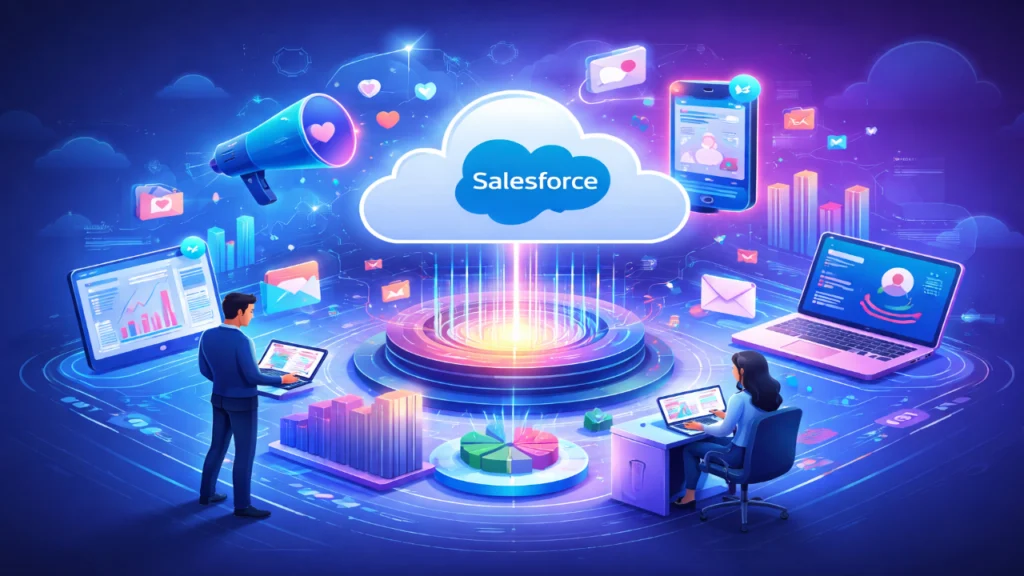
In today’s fast-evolving digital landscape, businesses are constantly seeking smarter ways to engage customers, personalise experiences, and drive measurable growth. As we step into 2026, Salesforce Marketing Cloud continues to lead the marketing automation space with cutting-edge innovations powered by AI, data intelligence, and omnichannel capabilities.
This comprehensive guide explores the top advantages of using Salesforce Marketing Cloud in 2026 and how it empowers businesses to stay ahead in a highly competitive market.
Table of Contents
1. Advanced AI-Powered Personalization
In 2026, Salesforce Marketing Cloud will feature deep integration with AI technologies such as Salesforce Einstein.
With AI-driven insights, businesses can:
- Predict customer behavior and preferences
- Deliver hyper-personalized content in real time
- Optimize email send times and content dynamically
This level of personalization ensures that every customer interaction feels relevant, increasing engagement and conversion rates significantly.
2. Unified Customer Data with Data Cloud
Modern marketing requires a single view of the customer, and that’s where Salesforce Data Cloud plays a crucial role.
Key benefits include the following:
- Real-time data unification across multiple sources
- Creation of rich customer profiles
- Improved segmentation accuracy
With unified data, marketers can make smarter decisions and create targeted campaigns that resonate with specific audiences.
3. Seamless Omnichannel Marketing
In 2026, customers interact with brands across multiple channels—email, social media, SMS, mobile apps, and websites. Salesforce Marketing Cloud enables seamless omnichannel engagement.
Core capabilities:
- Cross-channel campaign orchestration
- Consistent messaging across platforms
- Real-time customer journey tracking
This approach ensures that customers receive a cohesive brand experience, no matter where they interact.
4. Enhanced Customer Journey Automation
Automation has become more intelligent and flexible than ever. With Journey Builder in Salesforce Marketing Cloud, businesses can design complex customer journeys with ease.
Advantages include:
- Trigger-based and behavior-driven workflows
- Personalized journey paths for each user
- Automated responses based on real-time actions
This approach reduces manual effort while improving campaign efficiency and effectiveness.
5. Real-Time Analytics and Insights
Data-driven decision-making is essential for marketing success. Salesforce Marketing Cloud provides powerful analytics tools that deliver actionable insights.
Features include:
- Real-time campaign performance tracking
- Custom dashboards and reports
- AI-driven recommendations for optimization
Marketers can quickly identify what’s working and make adjustments to improve ROI.
6. Scalable and Flexible Architecture
As businesses grow, their marketing needs become more complex. Salesforce Marketing Cloud offers a highly scalable platform that adapts to evolving requirements.
Benefits:
- Supports businesses of all sizes
- Easily integrates with third-party tools
- Flexible APIs for custom development
This scalability ensures long-term value and adaptability.
7. Strong Integration Ecosystem
Salesforce Marketing Cloud seamlessly integrates with other Salesforce products and external systems.
Key integrations:
- CRM platforms for customer data synchronization
- E-commerce systems for personalized shopping experiences
- Advertising platforms for targeted campaigns
This interconnected ecosystem enables businesses to create a unified marketing strategy.
8. Improved Customer Engagement and Retention
With advanced targeting and personalization, businesses can build stronger relationships with their customers.
Outcomes:
- Higher engagement rates
- Improved customer loyalty
- Increased lifetime value
By delivering meaningful experiences, brands can retain customers more effectively in a competitive market.
9. Robust Data Security and Compliance
In 2026, data privacy and security are top priorities. Salesforce Marketing Cloud offers enterprise-grade security features to protect customer data.
Highlights:
- Compliance with global data protection regulations
- Secure data storage and access controls
- Regular updates to meet evolving standards
This process ensures that businesses can build trust with their customers while staying compliant.
10. AI-Driven Content Creation and Optimization
Content creation is becoming smarter with AI-powered tools. Salesforce Marketing Cloud helps marketers generate and optimize content efficiently.
Capabilities include:
- Automated email and ad copy suggestions
- A/B testing powered by AI
- Content performance predictions
This approach reduces the time required for content creation while improving effectiveness.
11. Better ROI and Marketing Efficiency
Ultimately, every business wants to maximise its return on investment. Salesforce Marketing Cloud helps achieve this objective through automation, analytics, and personalization.
Key impacts:
- Reduced marketing costs through automation
- Higher conversion rates with targeted campaigns
- Improved campaign performance tracking
Such an approach leads to better resource utilisation and measurable business growth.
12. Future-Ready with Continuous Innovation
Salesforce continues to innovate, ensuring that Marketing Cloud stays ahead of industry trends.
In 2026, advancements include:
- Deeper AI integration
- Enhanced predictive analytics
- Improved automation capabilities
This future-ready approach allows businesses to remain competitive and adapt to changing customer expectations.
Conclusion
In 2026, Salesforce Marketing Cloud stands out as a powerful, intelligent, and scalable marketing platform that enables businesses to deliver personalized, data-driven, and omnichannel experiences.
From AI-powered personalization and unified customer data to advanced automation and real-time analytics, the platform offers everything modern marketers need to succeed. By leveraging these advantages, businesses can not only improve customer engagement but also drive long-term growth and profitability.
As digital marketing continues to evolve, adopting a robust solution like Salesforce Marketing Cloud is no longer optional—it’s a strategic necessity for staying ahead in the competitive landscape.