
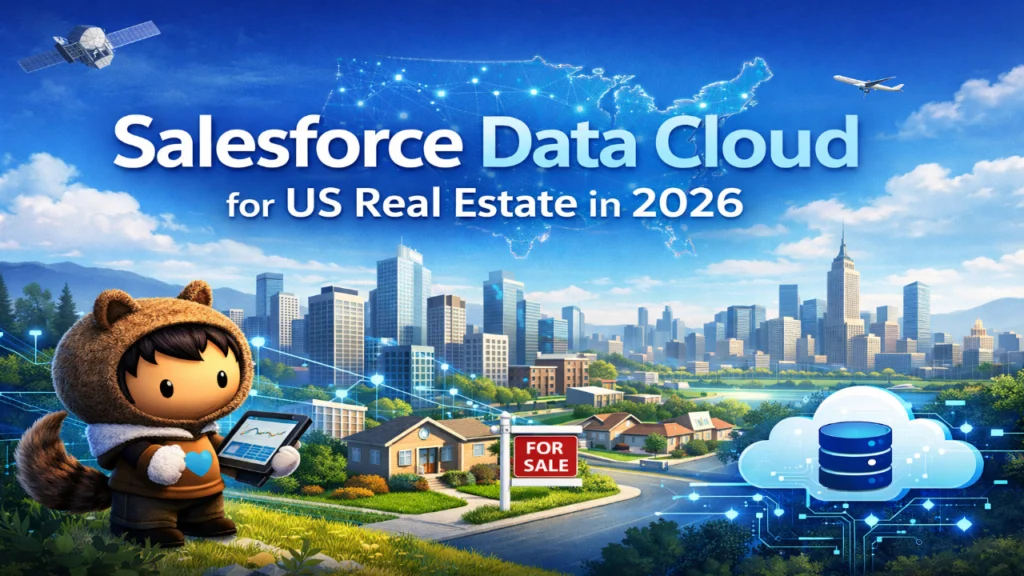
Introduction: Salesforce Data Cloud for US Real Estate in 2026
The US real estate industry is undergoing a massive digital transformation in 2026, driven by data, automation, and AI-powered decision-making. At the centre of this shift is Salesforce Data Cloud, a powerful platform that enables real estate companies to unify, analyze, and activate customer data at scale. From lead generation to closing deals and post-sale engagement, Data Cloud is redefining how real estate businesses operate in a competitive and fast-paced market.
This blog explores how Salesforce Data Cloud is transforming the US real estate market in 2026, highlighting its key capabilities, benefits, and real-world applications.
Table of Contents
Introduction: Salesforce Data Cloud for US Real Estate in 2026
The Evolution of Real Estate in the US
What is Salesforce Data Cloud?
Key Features of Salesforce Data Cloud for Real Estate1. Unified Customer Profiles
2. Real-Time Data Activation
3. AI-Powered Insights
4. Advanced Segmentation
5. Omnichannel Engagement
6. Integration with Salesforce Ecosystem
Use Cases in US Real Estate1. Smart Lead Management
2. Personalized Property Recommendations
3. Predictive Deal Closing
4. Marketing Campaign Optimization
5. Post-Sale Engagement
Benefits for Real Estate Companies1. Increased Efficiency
2. Better Decision-Making
3. Higher Conversion Rates
4. Improved Customer Experience
5. Scalability
Challenges and Considerations1. Data Quality
2. Implementation Complexity
3. Cost
4. Training and Adoption
Trends Shaping Real Estate in 20261. AI-Driven Automation
2. Data-First Strategy
3. Hyper-Personalization
4. Digital-First Buying Journey
Why Salesforce Data Cloud is a Game-Changer
Conclusion
The Evolution of Real Estate in the US
Traditionally, real estate relied heavily on manual processes, fragmented data, and relationship-driven sales. Agents managed leads through spreadsheets, emails, and disconnected CRM systems. However, with rising competition, digital-first buyers, and increasing expectations for personalized experiences, the industry needed a smarter solution.
In 2026, real estate companies are embracing platforms like Salesforce Data Cloud to centralise their data and gain a 360-degree view of their customers. This shift enables faster decisions, improved customer experiences, and higher conversion rates.
What is Salesforce Data Cloud?
Salesforce Data Cloud is a real-time data platform that unifies customer data from multiple sources (CRM systems, websites, social media, property portals, and third-party platforms) into a single, comprehensive view.
For real estate companies, this means:
Combining buyer and seller data in one place
Tracking customer interactions across channels
Leveraging AI for predictive insights
Delivering personalized communication at scale
Data Cloud acts as the backbone for modern real estate operations, enabling seamless integration between sales, marketing, and service teams.
Key Features of Salesforce Data Cloud for Real Estate
1. Unified Customer Profiles
Data Cloud creates a single source of truth by merging data from multiple touchpoints. Real estate agents can view:
Buyer preferences (location, budget, property type)
Past interactions and inquiries
Engagement history across channels
This eliminates data silos and ensures that every team works with accurate, updated information.
2. Real-Time Data Activation
In 2026, timing is everything in real estate. Data Cloud processes and updates data in real time, allowing agents to:
Respond instantly to new leads
Trigger automated follow-ups
Adjust marketing campaigns dynamically
This real-time capability significantly improves lead conversion rates.
3. AI-Powered Insights
With built-in AI capabilities, Data Cloud helps real estate companies:
Predict buyer intent
Score leads based on likelihood to convert
Recommend properties tailored to customer preferences
AI-driven insights allow agents to focus on high-value opportunities and close deals faster.
4. Advanced Segmentation
Data Cloud enables highly targeted audience segmentation. Companies can group customers based on:
Demographics
Behavior
Investment preferences
For example, luxury buyers, first-time homebuyers, and investors can each receive customised messaging and offers.
5. Omnichannel Engagement
Buyers in 2026 interact across multiple channels: email, SMS, websites, apps, and social media. Data Cloud ensures consistent communication across all touchpoints.
Agents can:
Send personalized property recommendations
Automate follow-ups
Maintain consistent messaging across channels
This creates a seamless and engaging customer journey.
6. Integration with Salesforce Ecosystem
Salesforce Data Cloud integrates seamlessly with other Salesforce products like Sales Cloud, Marketing Cloud, and Service Cloud.
This integration allows the following:
Sales teams to track deals
Marketing teams to run targeted campaigns
Service teams to provide post-sale support
The result is a fully connected real estate ecosystem.
Use Cases in US Real Estate
1. Smart Lead Management
Data Cloud captures leads from multiple sources such as property portals, websites, and social media. It automatically:
Deduplicates data
Enriches lead profiles
Assigns leads to the right agents
This ensures no opportunity is missed.
2. Personalized Property Recommendations
Using AI and unified data, agents can recommend properties that match buyer preferences. This improves:
Customer satisfaction
Engagement rates
Conversion rates
Buyers receive relevant listings instead of generic options.
3. Predictive Deal Closing
Data Cloud analyses historical data to predict which leads are most likely to convert. Agents can prioritise these leads and take timely actions to close deals faster.
4. Marketing Campaign Optimization
Marketing teams can track campaign performance in real time and optimize strategies based on the following:
Engagement metrics
Conversion rates
Customer behavior
This ensures better ROI on marketing spend.
5. Post-Sale Engagement
The relationship doesn’t end after a deal is closed. Data Cloud helps companies:
Send follow-up communication
Offer property management services
Promote future investment opportunities
This builds long-term customer relationships and repeat business.
Benefits for Real Estate Companies
1. Increased Efficiency
Automation and centralised data reduce manual work, allowing teams to focus on high-value tasks.
2. Better Decision-Making
Real-time insights and analytics enable faster and more informed decisions.
3. Higher Conversion Rates
Personalized experiences and predictive insights lead to more successful deals.
4. Improved Customer Experience
Customers receive relevant, timely, and personalized interactions throughout their journey.
5. Scalability
Data Cloud allows real estate companies to scale operations without increasing overhead.
Challenges and Considerations
While Salesforce Data Cloud offers significant advantages, companies must address certain challenges:
1. Data Quality
Accurate insights depend on high-quality data. Companies must ensure proper data management practices.
2. Implementation Complexity
Integrating multiple data sources and systems requires careful planning and expertise.
3. Cost
Salesforce solutions can be expensive, especially for smaller firms. However, the ROI often justifies the investment.
4. Training and Adoption
Teams need proper training to fully leverage the platform’s capabilities.
Trends Shaping Real Estate in 2026
1. AI-Driven Automation
AI is automating repetitive tasks, enabling agents to focus on relationship-building and closing deals.
2. Data-First Strategy
Companies are prioritising data as a core asset, using platforms like Data Cloud to drive growth.
3. Hyper-Personalization
Buyers expect tailored experiences, and Data Cloud makes this possible at scale.
4. Digital-First Buying Journey
From virtual tours to online transactions, the entire real estate journey is becoming digital.
Why Salesforce Data Cloud is a Game-Changer
Salesforce Data Cloud is not just a tool. It’s a strategic platform that empowers real estate companies to do the following:
Understand customers deeply
Act on insights in real time
Deliver exceptional experiences
In a competitive market like the US real estate industry, these capabilities provide a significant advantage.
Conclusion
In 2026, the success of real estate companies in the US depends heavily on their ability to leverage data effectively. Salesforce Data Cloud is playing a crucial role in this transformation by unifying data, enabling real-time insights, and powering personalized customer experiences.
From smarter lead management to predictive deal closing and seamless omnichannel engagement, Data Cloud is helping real estate businesses operate more efficiently and profitably.
As the industry continues to evolve, companies that invest in data-driven technologies like Salesforce Data Cloud will be better positioned to stay ahead of the competition and deliver outstanding value to their customers.
Founder and CEO of iTechCloud Solution, a Salesforce consulting and product partner since 2017. He sets engagement strategy and stays the commercial owner of every account, working with clients across Salesforce, AI and data from the first call through to go-live.
Connect on LinkedIn