

Introduction: Salesforce cuts jobs
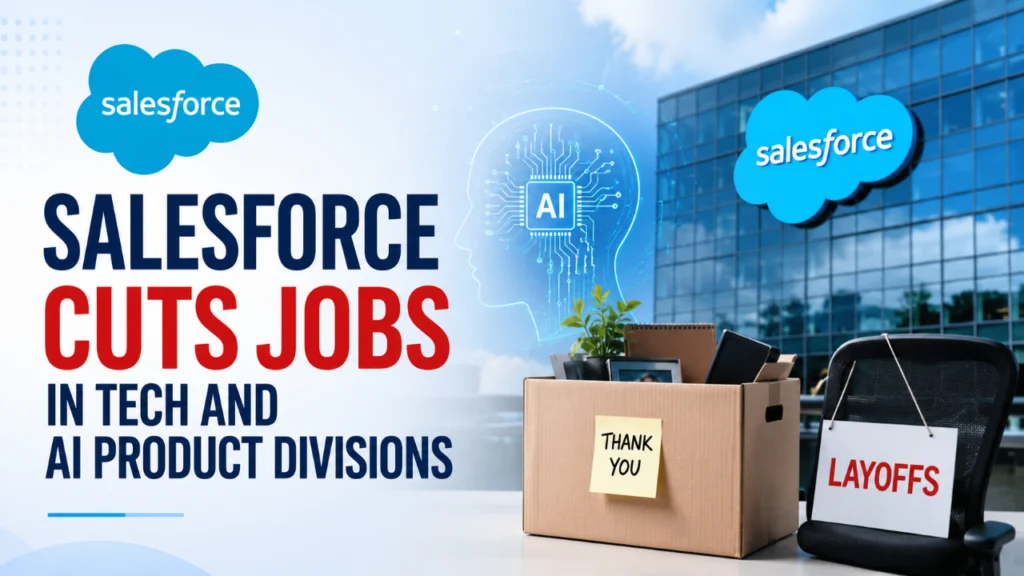
Salesforce is back in the news after reports emerged that the company has made another round of job cuts, this time affecting employees tied to its tech and AI product work. The latest reports say the layoffs touched teams linked to Agentforce, Mulesoft, and Marketing Cloud, with a California WARN notice listing 86 roles in sales, general administration, and technology/product functions. The cuts come after an earlier round in February 2026 that reportedly affected fewer than 1,000 employees.
What makes the company’s move especially important is the timing. Salesforce has spent the last year positioning Agentforce and Data 360 at the centre of its AI strategy, while also raising its fiscal 2026 outlook due to stronger enterprise demand for AI software. So even as the company pushes AI as a growth engine, it is still trimming parts of the organization to stay lean and responsive to changing demand.
Table of Contents
Introduction: Salesforce cuts jobs
What Happened
Why Salesforce Is Cutting Jobs
What This Means for Employees
What This Means for Salesforce’s AI Strategy
Broader Industry Context
Conclusion
What Happened
According to the latest reporting, Salesforce began a new round of layoffs in June 2026. The affected workers reportedly worked on the company’s Agentforce AI product, its Mulesoft integration platform, and its Marketing Cloud software. The reporting also says the cuts affected more than one geography, with additional layoffs in Washington state and internationally. In California, the WARN filing showed 86 cuts.
The latest reporting also says affected California employees remain on payroll until August 7, and severance depends on tenure and job level. Another report said Salesforce is offering relatively generous severance packages, with some U.S. employees eligible for up to 30 weeks of severance and additional benefits such as COBRA coverage.
This is not the first time Salesforce has reduced headcount in 2026. In February, Reuters reported that Salesforce had cut fewer than 1,000 roles, with the affected jobs spanning marketing, product management, data analytics, and the Agentforce AI team. Reuters also noted at the time that Salesforce had not immediately commented on the report.
Why Salesforce Is Cutting Jobs
The simplest explanation is that Salesforce is trying to align staffing with where it expects the business to go next. Across the tech industry, companies are using AI not only as a product strategy but also as an internal efficiency strategy. A recent Wall Street Journal report said AI has been cited as a leading reason for layoffs across U.S. companies this year, and the tech sector continues to lead announced job cuts.
Salesforce is part of that broader trend. The company has been investing heavily in AI, especially around Agentforce, but the market is now asking a harder question: which AI products are creating durable revenue, and which teams are still experimental? That pressure matters because investor expectations are high, and the company has already signalled that it wants AI to drive both growth and productivity.
There is also a financial logic behind the cuts. Salesforce reported strong fiscal 2026 third-quarter results in December 2025, including revenue of $10.3 billion, which grew 9% year over year, and raised its full-year revenue and profit outlook. Reuters reported that the raise was driven by strong enterprise demand for Agentforce, while Salesforce’s own earnings release highlighted momentum in Data 360 and AI-related activity.
In other words, Salesforce is not shrinking because it is overall a weak company. It is cutting selectively while still growing revenue, which suggests a classic restructuring move: keep investing in the highest-priority platforms while reducing roles that are less central to the next phase of the business. That interpretation is supported by the fact that the company’s earlier 2026 layoff round came alongside continued AI hiring and product expansion.
What This Means for Employees
For employees, the news is unsettling because it shows that even high-visibility AI teams are not immune to restructuring. Agentforce has been one of Salesforce’s most heavily marketed products, so cuts in or around that area may feel like a sharp reversal for workers who expected the AI push to create more opportunities, not fewer. The latest reporting also suggests that the impact was not limited to one function, as jobs in sales, administration, and product/technology were also affected.
The severance details also matter. A comparatively strong severance package can soften the immediate financial hit, but it does not change the larger message: Salesforce is recalibrating. For people inside the company, that can mean less certainty about which product lines are safe and which teams may be vulnerable if business priorities shift again.
What This Means for Salesforce’s AI Strategy
This layoff round does not mean Salesforce is abandoning AI. If anything, it suggests the company is trying to sharpen its AI strategy. Salesforce has said Agentforce and Data 360 are major growth drivers, and its fiscal 2026 results indicated that AI-related demand is real. Reuters reported that Agentforce and Data 360 together generated nearly $1.4 billion in annual recurring revenue, up 114% year over year, while Agentforce alone crossed $500 million in ARR in the third quarter.
At the same time, the cuts show that AI adoption does not automatically translate into unlimited staffing expansion. As companies automate more work, they often reorganise around fewer, more specialised roles. That pattern is becoming visible across the tech sector, where companies are using AI both to build products and to justify leaner operating models. Salesforce’s latest move fits that pattern closely.
There is also a market perception issue. Salesforce stock was reported to be down about 36% this year in the latest coverage, reflecting investor unease about whether AI tools could replace some traditional software functions, including parts of Salesforce’s own CRM ecosystem. That kind of pressure can push management to prove discipline through cost cuts, even while it continues to spend on AI.
Broader Industry Context
Salesforce is not the only company facing this situation. In 2026, technology companies have announced reductions related to AI adoption, restructuring, and efficiency goals. Recent examples include layoffs at Cloudflare, Coinbase, Atlassian, Fidelity, and Meta-related units, all connected in some way to redesigning teams around new technology priorities. The broader pattern is clear: companies want AI-driven output, but they are also reducing layers of management and reworking the job mix needed to support that output.
That context matters because Salesforce’s cuts are not an isolated event. They are part of a wider corporate response to AI, where businesses are trying to balance innovation, cost control, and shareholder expectations all at once. The result is a wave of “strategic” layoffs that may not always signal trouble, but they do signal a major shift in how technology companies are organised.
Conclusion
Salesforce’s latest job cuts show a company in transition. On one hand, its AI products are contributing to strong revenue growth, and management remains bullish on the long-term opportunity. On the other hand, the company is clearly making selective staffing changes to match its evolving priorities, especially around AI, product delivery, and operational efficiency.
For employees, the move is a reminder that even promising AI teams can be reshaped quickly. For the market, it is another sign that the AI boom is no longer just about launch announcements and product demos. It is now about hard decisions, tighter structures, and the pressure to turn AI investment into measurable business value. Salesforce’s latest layoffs are part of that new reality.
Part of the team turning Salesforce and AI strategy into shipped, measurable outcomes for enterprises across five regions.