
Table of Contents
Overview
Why Salesforce wanted Contentful
How this strengthens AI agent capabilities
What Contentful brings to the table
What this means for enterprises and marketers
Final takeaway: Salesforce acquires Contentful
Overview
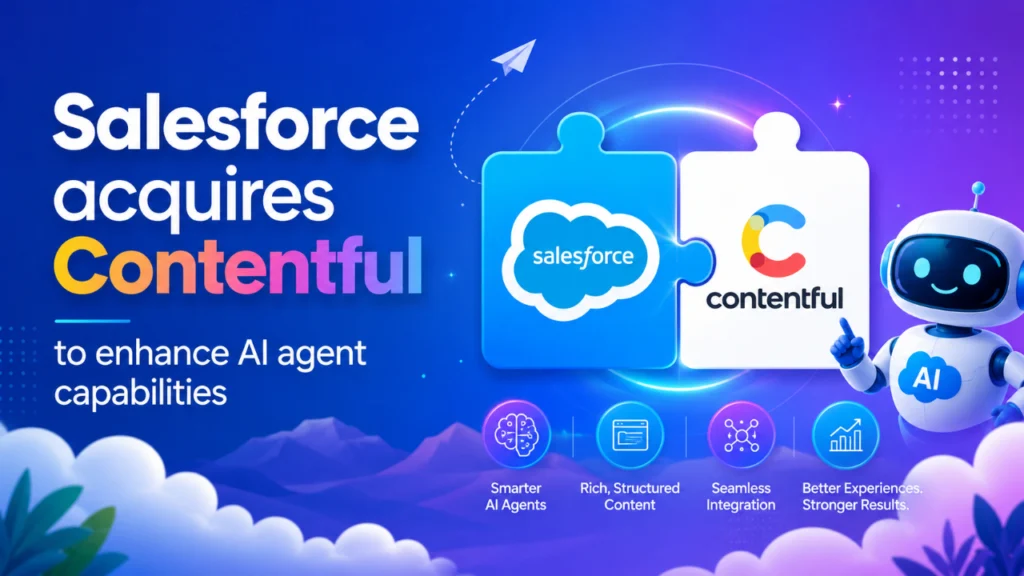
Salesforce’s move to acquire Contentful marks a major step in its push to unify data, AI, and content inside one enterprise experience stack. Contentful is widely known as a composable, API-first content platform, and Salesforce says it is trusted by over 4,800 brands. By bringing Contentful into its ecosystem, Salesforce aims to help businesses deliver personalized, AI-assembled experiences across channels such as web, email, mobile, sales, commerce, and service.
This matters because AI agents are only as useful as the context they can access. In Salesforce’s framing, Agentforce will be able to use Contentful’s structured content layer to query, assemble, and deliver content dynamically instead of relying on slow, manual publishing workflows. That means enterprises can move from fragmented content operations toward a more coordinated, context-aware experience model.
Why Salesforce wanted Contentful
Salesforce’s strategic goal is clear: make its platform stronger for the age of AI-driven customer experience. Contentful brings a content architecture that is already built for modern digital delivery, with structured content, composable APIs, and developer-friendly flexibility. Salesforce says this will enhance Headless 360 and help connect customer data from Data 360 with content delivery powered by Agentforce.
From a business perspective, this acquisition helps Salesforce close a gap that many enterprise platforms have struggled with: data and workflow are often deeply connected, while content remains scattered across tools. By adding Contentful, Salesforce can offer a more complete stack for brands that want to create consistent experiences across multiple channels without rebuilding their content systems from scratch. That is an inference based on the stated integration goals, but it follows directly from the companies’ announcements.
How this strengthens AI agent capabilities
The biggest headline is not just “Salesforce bought another software company.” The more important story is that AI agents need content infrastructure, not just data infrastructure. Salesforce says Contentful will become a native layer within Customer 360, making it accessible to Agentforce so agents can assemble relevant content dynamically and deliver it in real time. In practical terms, that supports more personalized responses, more consistent brand messaging, and faster content delivery at scale.
Contentful’s own founders echoed that theme in their announcement, saying the platform’s API-first architecture is well suited to the emerging “Agentic Web” and that joining Salesforce will help modern enterprises dynamically assemble rich digital experiences across channels. They also said the combination should give Agentforce the content layer it needs to make interactions more engaging.
For teams building AI-powered customer journeys, this is significant. A useful agent does not just answer questions; it also needs up-to-date product details, approved marketing language, localized content, and channel-specific formatting. Salesforce’s acquisition suggests it wants to make that content orchestration native, rather than leaving enterprises to stitch everything together through separate systems and custom integrations.
What Contentful brings to the table
Contentful was built around structured, headless content delivery, which means brands can manage content independently from presentation. The company says it has grown to support more than 2,000 customers by 2019, later doubling in scale, and it now handles 180 billion API calls per month. It also says it has an ecosystem of more than 20,000 apps and integrations. Those numbers help explain why Salesforce sees value in the platform.
That technical foundation is important because AI experiences are increasingly composable. Businesses need content that can be reused across web pages, mobile apps, in-product experiences, commerce journeys, and support channels. Contentful’s model fits that need well, and Salesforce is betting that combining it with its CRM, data, and AI products will create a more complete digital experience engine.
What this means for enterprises and marketers
For enterprises, this acquisition could simplify how they manage customer experiences. Instead of treating CRM, AI, and content as separate layers, Salesforce is trying to bring them together into one connected workflow. That may help organizations publish faster, keep brand messaging consistent, and personalize content more effectively across channels.
For marketers, the payoff could be especially strong. If Agentforce can access approved structured content directly, teams may spend less time manually repurposing assets and more time designing strategy, testing experiences, and improving conversion. In other words, the work shifts from content handling to content orchestration. That conclusion is an inference, but it is grounded in the companies’ stated goals for the deal.
There is also a broader industry signal here. Salesforce is clearly positioning itself not just as a CRM vendor but as an AI experience platform. Acquiring Contentful indicates that the company wants to own more of the stack required for agentic customer engagement, especially where structured content determines the quality of AI output.
Final takeaway: Salesforce acquires Contentful
The Salesforce Contentful acquisition aims to make AI agents more useful in real enterprise settings. Salesforce is adding the missing content layer that can help AgentForce deliver responses and experiences that are not only intelligent but also branded, structured, and channel-ready. The deal is still pending closure, but the strategic direction is already clear: Salesforce wants to connect customer data, content, and AI into one operating model for digital experience.
Founder and CEO of iTechCloud Solution, a Salesforce consulting and product partner since 2017. He sets engagement strategy and stays the commercial owner of every account, working with clients across Salesforce, AI and data from the first call through to go-live.
Connect on LinkedIn