

AI and Automation in Salesforce: Future Strategy 2026
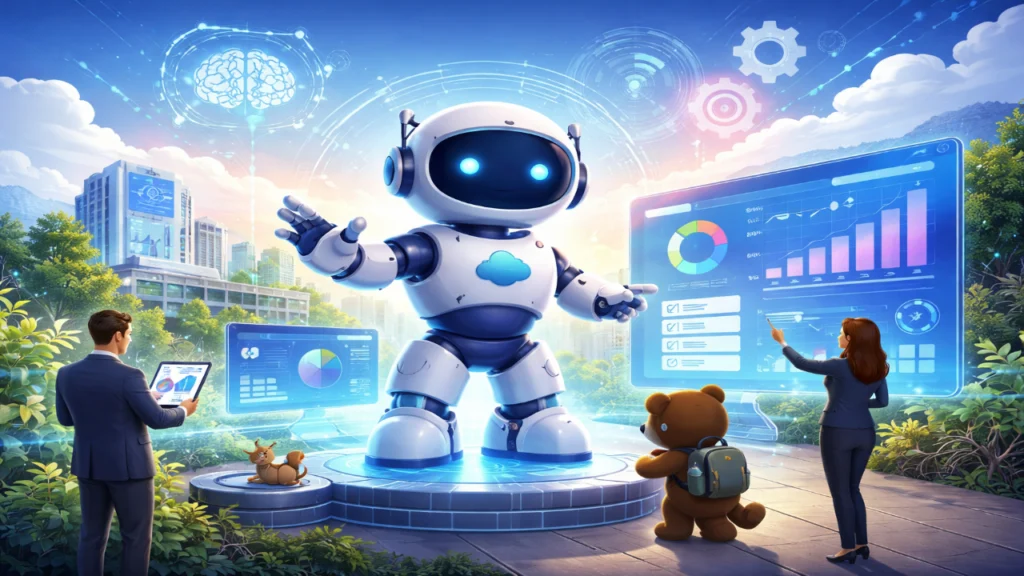
Introduction: AI and Automation in Salesforce
AI and automation have become indispensable within the Salesforce world. They’re not just optional-to-haves anymore; they’re critical for expanding businesses, streamlining operations, and enhancing the customer journey. Heading into 2026, companies are moving beyond simple automation, embracing intelligent, predictive, and even autonomous systems within Salesforce. This transformation is fundamentally reshaping the ways companies engage with their customers, manage data, and expand their operations.
This blog post takes a look at Salesforce’s upcoming AI and automation strategy, the key trends anticipated for 2026, and how businesses can leverage these developments to succeed in the future.
Table of Contents
The Evolution of AI in Salesforce
Salesforce has evolved from a traditional CRM platform into an AI-powered ecosystem. Earlier, automation was limited to workflows and rule-based processes. Today, AI enables predictive insights, natural language processing, and intelligent decision-making.
Key stages of evolution include:
- Rule-Based Automation – Workflow rules, process builder, and approval automation.
- Predictive Intelligence: AI-driven lead scoring, forecasting, and recommendations.
- Generative AI: automated content creation, email drafting, and customer interactions.
- Autonomous Systems: self-learning models that continuously optimize processes.
By 2026, Salesforce AI is expected to move deeper into autonomous operations, reducing manual intervention significantly.
Key AI and Automation Trends in 2026
1. Hyperautomation Across Salesforce
Hyperautomation combines AI, machine learning, robotic process automation (RPA), and advanced analytics to automate complex workflows end-to-end. In Salesforce, the term means the following:
- Automated data entry and cleansing
- Intelligent case routing
- End-to-end sales process automation
- Seamless integration across systems
Businesses adopting hyperautomation will achieve faster execution, reduced errors, and improved scalability.
2. Generative AI for Customer Engagement
Generative AI is transforming how businesses interact with customers. In 2026, Salesforce users can expect:
- AI-generated email responses
- Personalized marketing campaigns
- Automated chatbots with human-like conversations
- Dynamic content creation for multiple channels
Such functionality leads to more personalized and consistent customer experiences at scale.
3. AI-Powered Decision Intelligence
AI will move beyond recommendations to decision intelligence. Salesforce will provide:
- Real-time insights based on live data
- Predictive analytics for sales and service
- Risk detection and opportunity identification
- Automated next-best-action suggestions
This feature enables leaders to make faster and smarter business decisions.
4. Data Cloud and AI Integration
Data is the foundation of AI. Salesforce Data Cloud plays a crucial role in unifying customer data across multiple sources.
In 2026:
- Unified customer profiles will power AI models
- Real-time data synchronization will enhance automation
- AI models will continuously learn from updated data
This integration ensures accurate insights and highly personalized automation.
5. Intelligent Workflow Automation
Traditional workflows are evolving into intelligent ones. These workflows:
- Adapt based on user behaviour.
- Learn from historical data
- Automatically optimize processes
For example, sales pipelines can dynamically adjust based on deal probability, customer engagement, and historical success rates.
6. Low-Code and No-Code AI Tools
Salesforce is empowering non-technical users with low-code and no-code tools.
Benefits include:
- Faster deployment of automation
- Reduced dependency on developers
- Increased innovation across teams
By 2026, business users will be able to build AI-powered workflows without deep technical knowledge.
Benefits of AI and Automation in Salesforce
1. Improved Productivity
Automation reduces repetitive tasks, allowing teams to focus on high-value activities such as strategy and customer engagement.
2. Enhanced Customer Experience
AI enables personalized interactions, faster responses, and proactive service, leading to higher customer satisfaction.
3. Better Data Utilization
AI-driven insights help organizations unlock the full potential of their data.
4. Increased Revenue Growth
Predictive analytics and intelligent recommendations improve sales conversion rates and customer retention.
5. Cost Efficiency
Automation reduces operational expenses by minimising manual work and improving process efficiency.
Use Cases of AI and Automation in Salesforce
Sales Automation
- AI-based lead scoring
- Opportunity prediction
- Automated follow-ups
- Smart forecasting
Service Automation
- AI chatbots for customer support
- Automated case routing
- Sentiment analysis
- Knowledge base recommendations
Marketing Automation
- Personalized campaign targeting
- Customer journey automation
- Predictive segmentation
- Content generation
Operations Automation
- Workflow automation across departments
- Data synchronization
- Compliance monitoring
- Performance tracking
Challenges to Consider
While AI and automation offer significant benefits, businesses must address certain challenges:
1. Data Quality Issues
AI models rely on clean and accurate data. Poor data quality can lead to incorrect insights.
2. Implementation Complexity
Integrating AI into existing systems can be complex and requires proper planning.
3. Change Management
Employees may resist adopting new technologies. Proper training and communication are essential.
4. Security and Compliance
Organizations must ensure data privacy and comply with regulations while using AI.
The Future Strategy for Businesses
To succeed with AI and automation in Salesforce in 2026, businesses should follow a strategic approach:
1. Build a Strong Data Foundation
Ensure data accuracy, consistency, and integration across systems.
2. Start with High-Impact Use Cases
Focus on areas where AI can deliver immediate value, such as sales forecasting or customer support automation.
3. Invest in Training
Equip teams with the skills needed to use AI tools effectively.
4. Adopt a Scalable Architecture
Design systems that can grow with your business and support future AI advancements.
5. Monitor and Optimize Continuously
AI models should be regularly evaluated and improved based on performance.
The Role of AI Ethics and Governance
As AI adoption increases, ethical considerations become critical. Businesses must:
- Ensure transparency in AI decisions
- Avoid bias in AI models
- Protect customer data
- Maintain accountability in automated processes
Strong governance frameworks will be essential in 2026 and beyond.
Conclusion
AI and automation are transforming Salesforce into a powerful, intelligent platform that drives innovation and efficiency. By 2026, businesses that embrace AI-driven strategies will gain a competitive advantage through improved customer experiences, smarter decision-making, and streamlined operations.
The future of Salesforce lies in autonomous, data-driven systems that continuously learn and adapt. Organizations that invest in AI, build strong data foundations, and adopt a strategic approach to automation will be well-positioned for success in the evolving digital landscape.
Now is the time to move beyond basic automation and unlock the full potential of AI in Salesforce.