3 Essential Skills Salesforce Architects Need in the AI Era

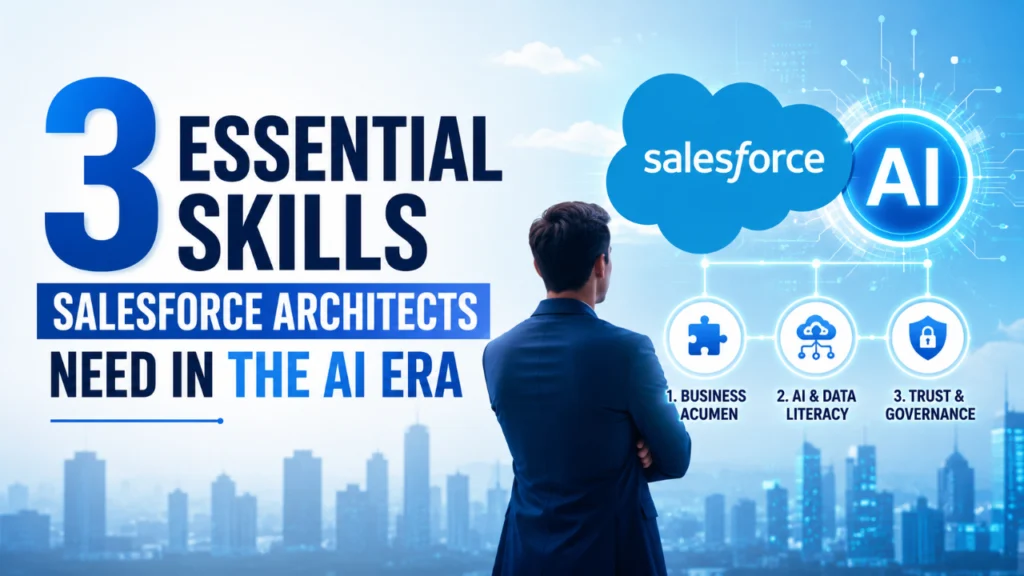
3 Essential Skills Salesforce Architects Need in the AI Era
3 Essential Skills Salesforce Architects Need in the AI Era

Artificial intelligence is transforming the Salesforce ecosystem faster than ever. From intelligent automation and predictive analytics to AI-powered customer interactions, organizations are rapidly adopting AI-driven solutions to improve efficiency, customer experience, and business outcomes. As a result, the role of the Salesforce architect is evolving beyond traditional system design and platform governance.

Today’s Salesforce architects are expected not only to understand the technical aspects of the platform but also to guide organizations through AI adoption, data strategy, and intelligent automation initiatives. While AI tools can automate many routine tasks, the need for skilled architects who can align technology with business goals has never been greater.

To remain valuable and future-ready, Salesforce architects must develop a new set of capabilities. Here are the three essential skills that will protect and strengthen Salesforce Architect careers in the AI era.

1. AI Strategy and Solution Architecture

AI is no longer a futuristic concept within Salesforce. It has become an integral part of customer relationship management, service operations, sales enablement, marketing automation, and business intelligence. Salesforce architects must understand how AI technologies fit into the broader enterprise landscape and how they can create measurable business value.

Why This Skill Matters

Many organizations are investing heavily in AI initiatives but struggle to identify the right use cases. Architects play a critical role in determining where AI can improve efficiency, automate processes, and enhance decision-making.

Instead of simply implementing technology, architects must evaluate business requirements and identify opportunities where AI can deliver meaningful outcomes. This includes recommending intelligent workflows, predictive analytics, conversational AI solutions, and automation strategies.

Key Areas to Master

Real-World Example

Consider a customer service organization handling thousands of support tickets daily. An architect can design a solution where AI automatically categorises cases, recommends resolutions, prioritises urgent issues, and assists service agents with real-time suggestions. This improves productivity and enhances customer satisfaction.

How to Build This Skill

Salesforce architects should actively explore AI-powered Salesforce products, experiment with intelligent automation use cases, and understand the business impact of AI implementations. Learning how AI models operate and how they integrate into Salesforce workflows will become increasingly important.

Architects who can connect business strategy and AI implementation will remain highly valuable in the years ahead.

2. Data Architecture and Data Governance

AI systems are only as effective as the data that powers them. Poor-quality, incomplete, or disconnected data can significantly reduce AI performance and lead to inaccurate insights. This makes data architecture one of the most important skills for modern Salesforce architects.

Organizations today generate data from multiple sources, including CRM platforms, marketing tools, customer service applications, websites, mobile apps, and third-party systems. Managing and organising this information is essential for successful AI initiatives.

Why This Skill Matters

AI relies on trusted, accurate, and well-structured data. Architects must ensure that they properly collect, store, govern, and make information accessible across the organization.

Without a strong data foundation, AI solutions may produce unreliable recommendations and poor business outcomes. As AI adoption grows, businesses will increasingly depend on architects to establish scalable data strategies.

Key Areas to Master

Real-World Example

Imagine a global company storing customer information across multiple systems. Duplicate records, inconsistent formats, and outdated information create significant challenges.

A Salesforce architect can design a centralised data strategy that consolidates customer information into a single, unified profile. AI systems can then use this trusted data to generate accurate insights, personalized recommendations, and predictive forecasts.

The Growing Importance of Data Cloud

As organizations focus on creating unified customer experiences, platforms like Data Cloud are becoming increasingly important. Architects who can connect and activate customer data across multiple touchpoints will gain a significant competitive advantage.

Data architecture is no longer just about database design. It is about enabling intelligent business decisions through trusted and accessible information.

How to Build This Skill

Architects should deepen their understanding of enterprise data management principles and modern data platforms. Learning advanced integration patterns, governance frameworks, and customer data strategies will help future-proof their careers.

Organizations will continue to seek architects who can transform fragmented information into strategic business assets.

3. Business Consulting and Leadership Skills

While AI can automate technical tasks, it cannot replace the human ability to understand business challenges, manage stakeholders, and drive organisational change. This is why consulting and leadership skills are becoming increasingly valuable for Salesforce architects.

Technical expertise alone is no longer enough. Architects must be able to communicate complex concepts in simple language, influence decision-makers, and guide teams through digital transformation initiatives.

Why This Skill Matters

AI projects often impact multiple departments, business processes, and customer interactions. Success depends on effective collaboration between executives, business users, developers, administrators, and external partners.

Architects frequently serve as the bridge between technology and business strategy. Their ability to align stakeholders around a common vision is critical to project success.

Key Areas to Master

Real-World Example

A company may want to introduce AI-driven sales forecasting across its global sales organization. The technical implementation may be straightforward, but achieving user adoption requires careful planning.

The architect must communicate benefits to leadership, address concerns from sales teams, establish governance policies, and ensure alignment across departments. Strong leadership skills make this process significantly more successful.

The Human Advantage

AI can analyze data, generate recommendations, and automate workflows. However, it cannot fully understand organisational culture, business priorities, or stakeholder dynamics.

Architects who excel at relationship building and strategic thinking will remain indispensable regardless of technological advancements.

How to Build This Skill

Participate in business discussions, present solutions to leadership teams, and take ownership of strategic initiatives. Improving communication, negotiation, and leadership abilities will significantly increase long-term career value.

The architects who thrive in the AI era will be those who combine technical expertise with strong business acumen.

Preparing for the Future

The Salesforce ecosystem is entering a new era where AI is becoming deeply embedded in every aspect of customer engagement and business operations. While automation will continue to evolve, it is unlikely to eliminate the need for experienced Salesforce architects. Instead, it will redefine the skills required for success.

Architects who focus exclusively on platform configuration and technical implementation may face increasing competition from AI-powered tools. However, those who develop expertise in AI strategy, data architecture, and business leadership will continue to play a critical role in enterprise transformation.

The future belongs to architects who can:

Conclusion

The AI era is not a threat to Salesforce architects—it is an opportunity. As businesses accelerate their adoption of intelligent technologies, the demand for skilled professionals who can design, govern, and lead AI-driven transformations will continue to grow.

By mastering these areas, Salesforce Architects can position themselves as strategic advisors rather than technical implementers. The organizations of the future will need professionals who understand both technology and business, and Salesforce architects who embrace these skills will remain among the most valuable experts in the industry.
Top 10 Salesforce Summer 26 Updates Every Admin and Developer Must Know

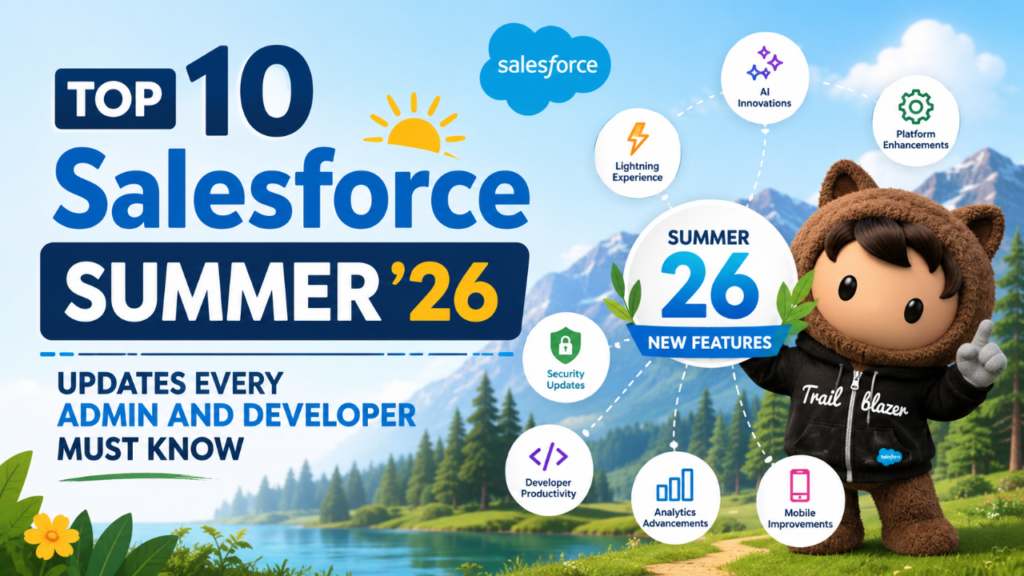
Top 10 Salesforce Summer 26 Updates Every Admin and Developer Must Know

Top 10 Salesforce Summer 26 Updates Every Admin and Developer Must Know

Introduction: Salesforce Summer 26 Updates

The Salesforce Summer ’26 release represents a significant milestone in the platform’s evolution, introducing features that change how admins and developers build, deploy, and maintain enterprise applications. This release marks a key step toward operational maturity and AI-powered productivity, with mandatory security migrations and production-ready AI agent capabilities. Whether you’re managing field-level security across hundreds of profiles or writing Apex code, the Summer ’26 update includes changes that directly impact your work. Here are the top ten updates you need to know about.

1. Agentforce Agents Directly in Flow Builder

The most groundbreaking feature in Summer ’26 is the ability to create and use Agentforce agents directly in Flow Builder. This feature fundamentally changes how admins approach automation by collapsing the divide between deterministic automation and agentic automation. Admins can now deploy AI-powered agents directly in their flows to handle various tasks without leaving the Flow Builder interface. You can select from existing agents or create task-specific agents with custom instructions and actions, all within the Flow Builder canvas. This integration allows organisations to use AI capabilities for smarter, context-aware automation workflows that adjust to complex business scenarios.

2. Enhanced Flow Builder Date Operators

Flow Builder introduces a comprehensive set of new operators specifically for date fields, making temporal logic significantly easier to implement. The new operators include “Is Today”, “Is Tomorrow”, “Is On”, and even the ability to reference anniversaries. This is particularly valuable for business use cases like birthday reminders, renewal communications, and time-sensitive workflow triggers. Admins can now build more sophisticated date-based logic without relying on formula fields or complex conditional structures, streamlining automation design and reducing configuration errors.

3. Radio Button Group Component in Flow Screens

Following the success of the Visual Picker component introduced in Summer ’25, Salesforce has now introduced a new Radio Button Group component that provides a more user-friendly alternative to standard radio buttons. This new component takes up less screen real estate while delivering a cleaner, more modern user experience. Admins can now create more visually appealing and intuitive screen flows that better match modern UI/UX standards, improving user adoption and reducing support requests related to form usability.

4. Default-Secure Apex Code with User Mode Execution

One of the most significant developer-facing changes is that all new Apex code written using API version 67 will have improved security behaviours designed to make Apex and SOQL secure by default. Database operations will now run in user mode rather than system mode by default, meaning that queries will respect the end user’s field-level security and sharing rules. Additionally, if a class using this version has no sharing declaration, it will now default to “with sharing” instead of “without sharing.” While this change may require developers to refactor existing code that relied on system mode privileges, it represents a major step forward in platform security and helps organizations prevent unauthorised data access vulnerabilities.

5. Multiline Strings and String Templates in Apex

Apex development becomes more intuitive with the introduction of multiline strings and string templates. Developers can now write cleaner, more readable code that handles complex string operations more elegantly. Multiline strings eliminate the need for verbose string concatenation or builder patterns in simple cases, making the code easier to maintain and reducing common string-handling errors. These improvements may seem incremental but contribute significantly to developer productivity and code quality in large-scale implementations.

6. Customizable Apex Action Configuration in Flow Builder

Developers who build Apex actions for Flow now have powerful new customisation capabilities through InvocableActionExtension metadata enhancements. These improvements include the ability to add custom property editors to individual action inputs, define picklists for action parameters, assign metadata types, and add custom headers to the configuration page. These enhancements make it significantly easier to create user-friendly, guided experiences for Flow actions, reducing configuration errors and improving adoption rates. Managed package developers particularly benefit from these improvements, as they can now provide fully featured, guided user experiences that help customers adopt their tools more effectively.

7. Field Access Summary for Permission Management

The new Field Access Summary tab in Object Manager finally provides admins with a comprehensive view of field-level security across all profiles, permission sets, and permission set groups that they have long desired. This feature eliminates the tedious process of running multiple reports and cross-referencing them in spreadsheets. The Field Access Summary provides instant visibility into security configuration and serves as the fastest way to sanity-check what actually landed in the org, especially for teams that use Metadata API deployments for their security model. This single feature alone has the potential to save security-conscious administrators countless hours of manual auditing work.

8. Mandatory SAML Framework Migration

This change is a critical update that demands immediate attention from administrators managing single sign-on. Salesforce is retiring the single-configuration SAML framework and requires migration to the multiple-configuration SAML setup before enforcement. Failing to complete this migration before the deadline risks SSO failures, unauthorised data access, and potential compliance violations. Admins must map all identity providers, thoroughly test SSO flows, and complete migration well before the deadline. This is not an optional enhancement—it’s a mandatory security update that affects every org using SAML authentication.

9. Salesforce Web Console for In-Org Development

Summer ’26 introduces the Salesforce Web Console, a lightweight browser-based IDE built directly into Salesforce orgs. This represents the natural evolution of the legacy Developer Console and is available across all org types, including free and developer orgs. While it’s not a replacement for teams standardised on VS Code with Salesforce CLI, it provides a faster path for quick ad-hoc fixes and serves as an excellent learning surface for new developers who don’t yet want to install a local development toolchain. The Web Console democratises development by making the development experience more accessible to non-traditional developers and administrators who are exploring development work.

10. AI-Powered Debugging with Ask Agentforce

Flow debugging and troubleshooting reach a new level with the Ask Agentforce beta feature. This generative AI capability can diagnose both design-time issues in saved flows and runtime failures in active flows, identify root causes, and suggest remediation options in plain language. The system can even automatically apply fixes through the Fix Issue option. This feature significantly reduces the time admins and developers spend troubleshooting flow problems, making them more productive and allowing them to focus on higher-value strategic work rather than debugging common issues.

Additional Considerations

Beyond these ten major updates, the Summer ’26 release includes several other notable improvements: Flow Orchestration no longer has usage-based licensing limitations, making it a standard platform feature; developers gain access to the Agent Builder API for programmatically creating and configuring Agentforce agents; and the ability to restrict login access to the SOAP API provides enhanced security control over API authentication.

Security remains a paramount focus throughout this release, with multiple mandatory migrations and new permission controls requiring admin attention. Organizations should plan their sandbox testing and deployment schedules carefully, as production rollouts occur across multiple waves beginning May 15 through mid-June 2026.

Preparing for Summer ’26

Admins and developers should take advantage of the pre-release Developer Edition environments to explore these features thoroughly before they hit production. Understanding these changes early allows your team to plan for feature adoption, identify potential impacts on existing customisations, and prepare training materials for your user base. The Summer ’26 release represents significant investment by Salesforce in both AI capabilities and operational maturity, making it one of the most developer-centric and admin-friendly updates in recent memory.

The key to successfully adopting these updates lies in early exploration, thorough testing, and clear communication across your technical and business teams. Start your evaluation today to ensure your organization is ready to leverage these powerful new capabilities when they arrive in your production environment.

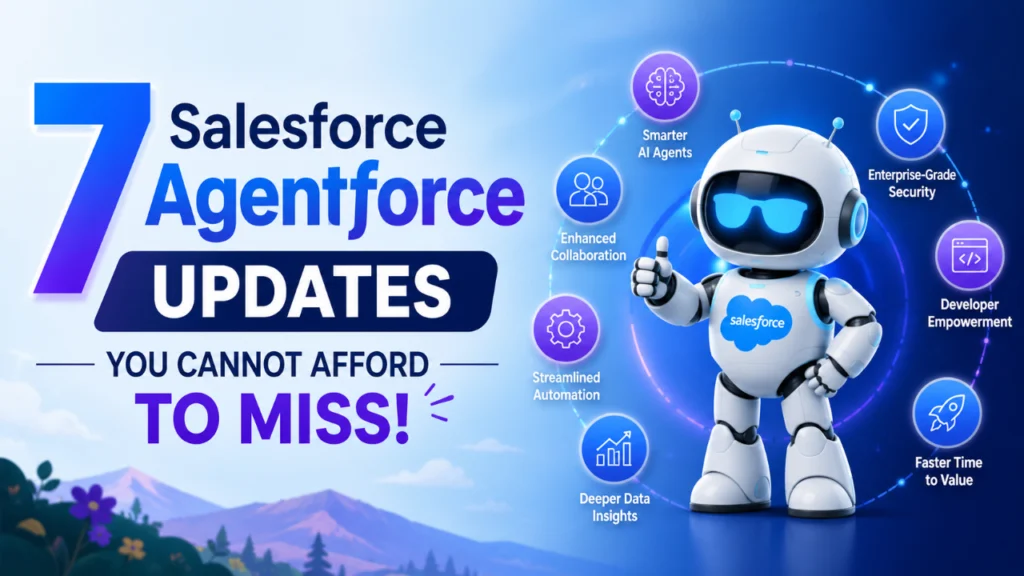
7 Salesforce Agentforce Updates You Cannot Afford to Miss

7 Salesforce Agentforce Updates You Cannot Afford to Miss

7 Salesforce Agentforce Updates You Cannot Afford to Miss

Introduction: Salesforce Agentforce Updates

Salesforce has been moving fast with Agentforce, and the latest updates show a clear direction: more autonomy, better control, stronger voice experiences, and easier deployment across business teams. Instead of being just another AI feature, Agentforce is being shaped into a practical enterprise platform that connects data, workflows, and agents in one system. The newest releases make it clear that Salesforce wants AI agents to do real work, not just answer questions.

1. Agentforce 2dx made agents more proactive

One of the biggest shifts came with AgentForce 2DX. Salesforce introduced it as a version of Agentforce that goes beyond user-initiated chat and lets AI agents operate behind the scenes. That means agents can take action proactively, support customer and employee workflows, and work with less constant human supervision. This was an important step because it moved Agentforce from a reactive assistant model toward a more embedded digital labour model.

For businesses, that change matters because many routine tasks happen outside a chat window. A proactive agent can help with lead follow-up, service routing, task creation, and workflow triggers without waiting for someone to type a prompt. In practical terms, Agentforce 2dx opened the door for more automation across the full flow of work.

2. Agentforce 3 added stronger visibility and control

Salesforce then launched Agentforce 3 to address one of the biggest blockers to AI adoption: observability. The release introduced Agentforce Command Center, which Salesforce describes as a complete observability solution for tracking and optimizing agent activity. This is important because businesses need agents who work and know how they behave, what they do, and where they need improvement.

This update makes Agentforce more enterprise-ready. When teams can monitor performance, review activity, and refine behavior, they are more likely to trust the system and scale it confidently. For organizations deploying AI in customer service, sales, or operations, control is just as important as capability. Agentforce 3 shows that Salesforce understands that balance.

3. Hindi voice support expanded Agentforce for Indian users

A major regional update came when Salesforce expanded Agentforce Voice with Hindi language support. The company said the update enables businesses to engage customers in one of India’s most widely spoken languages while keeping AI agent actions governed by deterministic guardrails. That combination is powerful because it supports both accessibility and reliability.

For Indian businesses, this feature is more than a language toggle. Hindi support can help customer service teams reach more users naturally, especially in voice-first interactions where tone and fluency matter. It also indicates that Salesforce is tailoring Agentforce for real market needs rather than offering only a global, one-size-fits-all product.

4. Agentforce 360 pushed the platform toward a unified AI layer

Another notable update is the broader Agentforce 360 platform direction. Salesforce has positioned Agentforce 360 as a trusted platform that connects humans, data, and AI agents in one place. The platform messaging highlights a unified voice experience, low-code agent building, and support for actions across channels and systems.

This matters because many businesses struggle with fragmented AI tools. One tool handles chat, another handles automation, and a third handles analytics. Salesforce is clearly trying to unify these layers so teams can build, manage, and deploy agents in a more consistent way. That makes adoption simpler for admins, developers, and operations teams alike.

5. Agent Script gave builders more precise control

Salesforce also introduced Agent Script, a scripting language for AI agents designed to blend deterministic rules with agentic reasoning. In simple terms, this means builders can give agents more exact instructions when workflows need predictable outcomes. That is especially useful in business processes where consistency is critical.

This is a meaningful update because it addresses a common concern with AI agents: unpredictability. By giving teams more control over logic and behavior, Salesforce is making Agentforce more suitable for serious enterprise use cases. The result is a better balance between flexibility and reliability.

6. Agent Force Sales brought more automation to prospecting

Salesforce’s recent Agentforce Sales release added new autonomous prospecting functionality. The company highlighted this capability as one of the major features in its latest release, signalling that sales teams are a key use case for Agentforce. Instead of relying only on manual prospect list building and repetitive outreach preparation, the platform increasingly supports work that automation can accelerate.

This is especially valuable for revenue teams that need to move quickly and stay organised. Salespeople spend a large share of time on preparation work, and even small efficiency gains can create meaningful impact. With Agentforce Sales, Salesforce is showing that AI agents can help sellers spend more time selling and less time assembling routine workflows.

7. Language support and service readiness continue to expand

Beyond Hindi, Salesforce has also documented broader language support for Agentforce and Agentforce Service Agent, including several international languages in its help resources. That suggests the product is being prepared for more multilingual, global deployments. Support documentation matters here because it confirms that language expansion is part of the product’s operational readiness, not just a marketing message.

This trend is important for companies with diverse customer bases. A multilingual agent platform can improve accessibility, reduce friction in support interactions, and make AI more useful across regions. It also indicates that Agentforce is evolving from a launch product into a broader enterprise system with deeper localisation and support options.

Final takeaway

The latest Salesforce Agentforce updates point to one clear message: AI agents are becoming more operational, more measurable, and more business-ready. Agentforce 2DX made agents proactive; Agentforce 3 added visibility and control. Hindi voice support expanded reach. Agentforce 360 strengthened the platform vision; Agent Script improved precision; and the latest sales release brought more automation into revenue workflows. Together, these updates show that Salesforce is building Agentforce as a serious enterprise layer for modern work.

Salesforce Launches Agentforce Voice with Hindi Support

Salesforce Launches Agentforce Voice with Hindi Support

Salesforce Launches Agentforce Voice with Hindi Support

Introduction: Salesforce Launches Agentforce Voice with Hindi Support

Salesforce expanded its Agentforce Voice offering with Hindi language support on May 19, 2026, announcing the launch during Agentforce World Tour Mumbai 2026. The update positions itself as a major step toward making AI-driven customer experiences more natural, multilingual, and inclusive for India’s diverse audience. Salesforce says the new capability helps businesses engage customers in Hindi while maintaining strong control, consistency, and enterprise-grade guardrails.

This launch matters because India is one of the world’s largest language markets, and voice remains one of the most intuitive ways for people to interact with technology. Salesforce’s announcement frames Hindi support not as a simple translation layer, but as a deeper move toward voice-first AI that can operate across Bharat with greater relevance and scale.

What Salesforce Announced

The core announcement is the release of Agentforce Voice in Hindi, built on Salesforce’s Agentforce platform. According to Salesforce, this version combines conversational AI, enterprise data, and business workflows, allowing companies to move beyond rigid call-centre scripts and toward action-orientated customer engagement. The company also says the system includes built-in controls and deterministic guardrails, allowing businesses to decide how agents behave, when they act, and when human oversight is required.

Salesforce contrasts this approach with traditional IVR systems, which often rely on fixed decision trees and limited customer pathways. In its view, Hindi voice support represents a shift from basic automation to a more autonomous, intelligent model where the AI can understand context, reason about next steps, and carry out tasks more effectively.

Why Hindi Support Is Important

Salesforce highlights the scale of Hindi as a business language. The company says there are well over 528 million native Hindi speakers and nearly 692 million people who speak Hindi as a first, second, or third language, which it describes as about 57% of India’s population. That makes Hindi a powerful gateway for reaching millions of users who prefer local-language digital experiences.

This is especially important for organizations serving customers in Tier 2 and Tier 3 markets, where language familiarity can strongly influence trust, comfort, and adoption. Salesforce says the new voice capability can help businesses extend AI deeper into these markets while improving access for users who are more comfortable speaking Hindi than English.

Key Features of Agentforce Voice in Hindi

One of the most notable features is Salesforce’s support for natural code-switching between Hindi and Hinglish. The platform is engineered to understand when people move between Hindi and English mid-conversation, which is common in real customer interactions across India. That helps the voice assistant feel less mechanical and more natural.

Salesforce also says Agentforce Voice does more than transcribe speech. It uses action-orientated reasoning, meaning it is designed to understand intent and help complete complex tasks rather than simply capturing words. This is relevant for customer service because many conversations involve multiple steps, clarifications, and decisions that go beyond a basic FAQ response.

Another important point is the promise of 24/7 voice-enabled support. Salesforce says the new feature can help organizations scale customer service more efficiently, reduce friction across customer journeys, and improve access for Hindi-speaking and non-English-preferring users at any time of day.

Business Value for Indian Enterprises

Salesforce positions this launch as especially useful for industries that depend heavily on customer conversations. The company specifically points to opportunities in financial services, telecom, retail, and public sector use cases. For these sectors, Hindi voice support could reduce wait times, improve first-contact resolution, and make AI support more practical for large and diverse audiences.

The real business advantage is not just automation, but consistency. Salesforce emphasises that enterprises can define policies, boundaries, and human escalation points, which helps keep customer interactions secure and aligned with company rules. That is especially valuable in regulated industries where accuracy, trust, and compliance matter just as much as speed.

In simple terms, the update helps companies serve customers in the language they actually use, while still keeping the control that enterprise teams need. That balance between flexibility and governance is one of the main themes behind the launch.

A Step Toward More Inclusive AI

Salesforce also says the Hindi launch is part of a broader multilingual strategy. The company notes that Agentforce Voice already supports 25+ languages, and it plans to add more Indian subcontinent languages in the coming months. This suggests that Hindi is being treated as an important starting point rather than the final destination.

That direction is significant because language remains one of the biggest barriers to digital inclusion. When AI tools can understand local languages and mixed-language speech patterns, they become more accessible to everyday users, not just to English-speaking customers or technical teams. Salesforce’s launch reflects a broader shift in enterprise AI toward local relevance, cultural nuance, and practical usability.

Leadership Perspective

Salesforce India leadership described the launch as part of a wider vision for conversational, inclusive AI in India. The message behind the announcement is that AI in India should not only be powerful but also rooted in local context and able to interact naturally in the languages people use every day. Salesforce also tied the launch to its larger idea of the “agentic enterprise,” where humans and AI agents work together across customer service and operations.

That framing shows the company is thinking beyond a single product update. It is presenting Hindi voice support as part of a bigger transformation in how businesses use AI to serve customers, improve efficiency, and expand digital reach across India.

Conclusion

Salesforce’s launch of Agentforce Voice with Hindi support is a meaningful milestone for enterprise AI in India. It combines voice automation, multilingual understanding, code-switching support, and enterprise guardrails in a way that real customer environments can use. By focusing on Hindi, Salesforce is addressing one of the most important language segments in the country and making AI more practical for large-scale, everyday use.

Overall, the announcement signals a future in which language and geography do not limit customer service. For Indian businesses, it opens the door to more accessible, efficient, and human-like voice experiences. For customers, it promises faster support in the language they are most comfortable using. That is why this launch stands out as more than a feature release — it is a strategic step toward inclusive, voice-first AI in Bharat.

Salesforce Invests $300M in Anthropic for AI Coding

Salesforce Invests $300M in Anthropic for AI Coding

Salesforce Invests $300M in Anthropic for AI Coding

Introduction: Salesforce Invests $300M

Salesforce’s latest AI move shows how quickly enterprise software is changing. In May 2026, CEO Marc Benioff said Salesforce is on track to spend about $300 million on Anthropic tokens this year, with most of that usage tied to coding and software development work. Although headlines often describe this as an “investment”, the latest reporting makes an important distinction: this is primarily a large usage spend on Anthropic’s AI models, not a simple one-time funding announcement.

That distinction matters because it reveals Salesforce’s strategy. Rather than treating AI as an add-on, the company is making it part of everyday engineering, support, marketing, and collaboration workflows. Benioff said AI agents have already made Salesforce more efficient across service, support, distribution, and marketing, and he also hinted that Slack will gain new coding-related capabilities.

Why Salesforce Is Putting So Much Weight on Anthropic

Salesforce’s move is not happening in isolation. The company and Anthropic expanded their strategic partnership in October 2025 to focus on trusted AI for regulated industries, including financial services, healthcare, cybersecurity, and life sciences. Salesforce said Claude is now a foundational model for the Agentforce 360 platform, and the two companies are deeply integrating Claude with Slack and planning to bring Agentforce 360 into Claude as well.

That relationship grew even more visible in early 2026, when Salesforce said it was bringing trusted context and AI actions to Claude through deeper Slack integration. The goal is to let teams move more naturally between brainstorming, collaboration, and execution while keeping Slack as the secure system of record for conversations and control.

For Salesforce, that makes Anthropic especially valuable. Claude is not just a chatbot sitting beside the product stack; it is becoming part of the workflow fabric inside Salesforce and Slack. That is why the usage spend is so large: the models are being used at scale, inside real business systems, for real production work.

The 2026 Update: AI Coding Is Now a Core Business Tool

The biggest 2026 angle is coding. Benioff said Salesforce will likely use $300 million worth of Anthropic tokens this year, and he specifically framed the spend around coding. He also described Anthropic’s coding agents as “awesome” and said they make everything cheaper to build.

This aligns with broader product trends at Anthropic. In February 2026, Reuters reported that Anthropic launched Claude Opus 4.6, an upgraded model with stronger coding and finance performance, better reliability, and support for prompts up to 1 million tokens. Reuters also noted that Anthropic previewed agentic task coordination inside Claude Code, underscoring the company’s push into advanced coding workflows.

In practical terms, this means AI coding is no longer about generating a few lines of code. It is becoming part of the software lifecycle: drafting, debugging, testing, analysing, and assisting teams inside business applications. Salesforce’s spending suggests the company sees enough productivity gain to justify a very large token budget, which is a strong signal for the entire enterprise software market.

What This Means for Salesforce Employees and Engineering Teams

Benioff’s comments suggest a major shift in how Salesforce thinks about labour and productivity. He said AI agents have already increased efficiency significantly, and past reporting has shown the company cutting support staff after adopting automation more deeply. He also said Salesforce is exploring ways to make coding easier inside Slack, which hints that the company wants more employees to participate in technical work, even if they are not traditional engineers.

That does not necessarily mean engineers disappear. It means their role changes. In this model, engineers become reviewers, architects, and supervisors of AI-generated work, rather than being the only people writing code from scratch. Salesforce’s own strategy appears to be moving toward a blended workforce where humans set direction and AI accelerates execution.

This approach matches Salesforce’s broader AgentForce 360 release. The company describes Agentforce 360 as bringing together humans, applications, AI agents, and data, with features for faster agent development, more control, voice interactions, and better context grounding. That gives Salesforce a framework for embedding Anthropic’s models into the centre of enterprise operations rather than keeping them in a side tool.

Why Anthropic Is Winning Enterprise Attention

Anthropic is becoming a major enterprise AI player in its own right. In September 2025, the company said its annualised run-rate revenue had grown from $87 million at the start of 2024 to over $5 billion by August 2025, and it described itself as having top market share in enterprise AI. The company also said its Series F funding valued it at $183 billion post-money.

That growth helps explain why major software companies are building around Claude. Anthropic’s strength is not only general-purpose chat but also reliability, enterprise trust, and increasingly strong coding performance. Reuters’ February 2026 reporting on Claude Opus 4.6 reinforced that point by highlighting better coding results, longer task execution, and multi-agent coordination.

For Salesforce, that makes Anthropic a strategic partner rather than a commodity vendor. The better Claude performs in enterprise settings, the more Salesforce can build premium workflows around it, especially in industries where data sensitivity and compliance matter.

The Bigger Picture for Enterprise AI in 2026

This development indicates the direction of enterprise AI. First, AI budgets are shifting from experimental pilots to operational line items. A $300 million token spend is not a test; it is a sign of deep production adoption.

Second, the competition is moving from “Which model is the smartest?” to “Which model can be embedded most safely and effectively into enterprise workflows?” Salesforce and Anthropic are clearly betting that trust, integration, and workflow control matter as much as raw model capability. Their regulated-industry push and Slack integration reflect that strategy.

Third, coding is becoming one of the clearest commercial use cases for frontier AI. When a company like Salesforce says it expects to spend hundreds of millions of dollars on AI tokens mainly for coding, that suggests AI is now a serious part of software production economics, not just a productivity novelty.

Conclusion

Salesforce’s $300 million Anthropic spend in 2026 is best understood as a sign of where enterprise software is heading: toward AI-native development, deeper automation, and tighter integration between communication tools, business systems, and coding assistants. The partnership between Salesforce and Anthropic has already expanded into regulated industries, Slack, Agentforce 360, and Claude-powered workflows, and the latest updates show that 2026 is the year this collaboration becomes operationally significant.

Contact Us
Loading
Your message has been sent. Thank you!
© Copyright iTechCloud Solution 2024. All Rights Reserved.