

Why US Mid-Market Firms Switch HubSpot to Salesforce in 2026
Introduction: US Mid-Market Firms Switch HubSpot to Salesforce in 2026
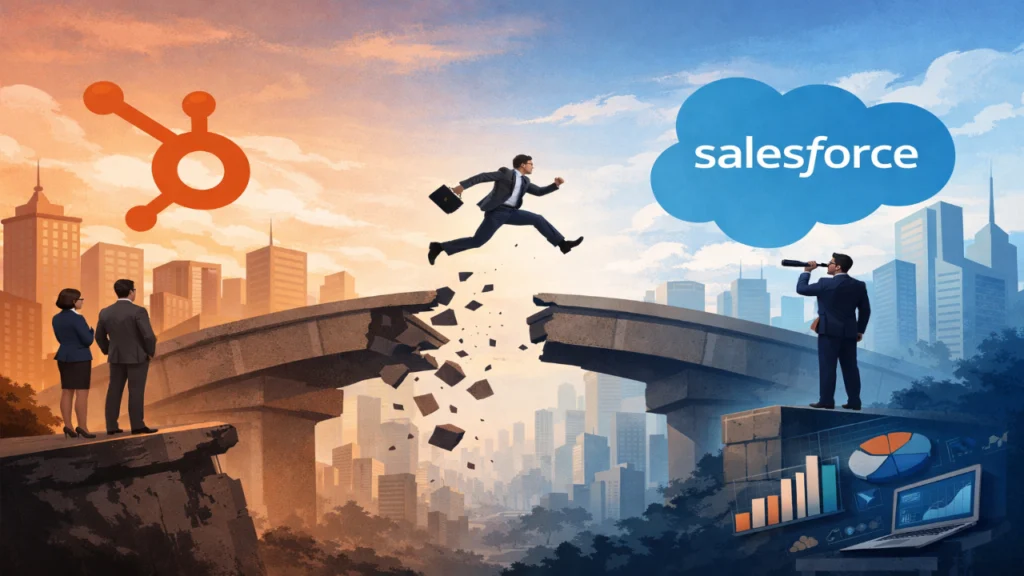
In 2026, a noticeable shift is happening across the US mid-market business landscape. Companies that once relied on HubSpot as their primary CRM are increasingly migrating to Salesforce. This transition is not driven by trends alone—it reflects deeper changes in how businesses scale, manage complexity, and leverage technology for growth.
While HubSpot continues to dominate the small business and startup segment due to its simplicity and marketing-first approach, mid-market firms—typically companies with 50 to 500 employees—are outgrowing its capabilities. As operations expand, customer journeys become more complex, and revenue expectations rise, businesses require a CRM that is more powerful, customisable, and scalable.
This blog explores the key reasons why US mid-market firms are making the switch from HubSpot to Salesforce in 2026.
Table of Contents
1. Growth Brings Complexity That HubSpot Struggles to Handle
HubSpot is widely appreciated for its user-friendly interface and quick setup. For small teams, it offers an all-in-one platform that combines marketing, sales, and service tools. However, as companies grow, their workflows evolve beyond basic CRM needs.
Mid-market firms often deal with the following:
- Multiple sales pipelines
- Regional teams and territories
- Complex approval processes
- Diverse customer segments
At this stage, HubSpot’s simplicity becomes a limitation. Businesses begin to encounter restrictions in workflow automation, data structuring, and customisation.
Salesforce, on the other hand, is designed to handle complexity at scale. It allows organizations to build custom objects, advanced workflows, and multi-layered processes tailored to their operations.
2. Demand for Advanced Customization
Customisation is one of the biggest reasons companies switch to Salesforce.
Mid-market firms need CRM systems that reflect their unique business models. This list includes:
- Custom data structures
- Industry-specific workflows
- Role-based permissions
- Automated approval hierarchies
Salesforce excels in this area. It enables businesses to design their CRM exactly the way they want, rather than adapting their processes to fit the tool.
In contrast, HubSpot offers limited customisation. While it provides flexibility for standard use cases, it cannot match Salesforce when it comes to deep configuration and enterprise-grade customisation.
3. Superior Integration Ecosystem
As companies scale, they rely on multiple tools—ERP systems, marketing platforms, analytics tools, billing systems, and more. Seamless integration between these tools becomes critical.
Salesforce leads significantly in this area. It offers access to thousands of integrations through its ecosystem, enabling businesses to connect virtually any software in their tech stack.
HubSpot also supports integrations, but its ecosystem is comparatively smaller. For mid-market firms with complex tech stacks, this limitation can create inefficiencies and data silos.
Salesforce’s ability to act as a central hub for all business systems makes it a preferred choice for growing organizations.
4. Data-Driven Decision Making with Advanced Analytics
Modern businesses rely heavily on data to drive decisions. Mid-market firms need detailed insights into the following:
- Sales performance
- Customer behavior
- Revenue forecasting
- Team productivity
Salesforce provides highly advanced reporting and analytics capabilities. Its dashboards can track almost every aspect of business performance, offering deep insights and customisation options.
HubSpot provides basic reporting tools that work well for smaller teams. However, as data complexity increases, companies often find these tools insufficient.
In 2026, where AI and predictive analytics play a critical role, Salesforce’s advanced analytics capabilities give it a clear edge.
5. Scalability for Long-Term Growth
One of the biggest concerns for mid-market firms is choosing a CRM that they won’t outgrow.
People often see HubSpot as a great starting point. But as companies expand, they begin to hit limitations in the following:
- Feature scalability
- Data handling capacity
- Workflow complexity
Salesforce is built with scalability in mind. It supports businesses from early-stage growth to enterprise-level operations without requiring a platform change.
This “future-proof” nature is a major reason why companies switch. Instead of migrating multiple times, they prefer investing in a platform that can grow with them.
6. AI and Automation Capabilities in 2026
Artificial intelligence is transforming CRM systems in 2026. Businesses are looking for platforms that can automate repetitive tasks, predict customer behaviour, and enhance decision-making.
Salesforce has made significant advancements in AI-driven CRM with tools that support the following:
- Automated workflows
- Intelligent lead scoring
- Predictive analytics
- AI-powered customer interactions
These capabilities allow businesses to improve efficiency and reduce manual work.
HubSpot also offers AI features, but Salesforce’s ecosystem and depth in automation provide a more comprehensive solution for mid-market firms aiming for operational efficiency.
7. Multi-Team and Multi-Region Management
Mid-market companies often operate across multiple departments and regions. Managing such operations requires a CRM that can handle:
- Territory management
- Team segmentation
- Access control
- Regional workflows
Salesforce is specifically designed to support multi-team and multi-region environments. It allows businesses to create structured systems for managing different teams while maintaining centralised control.
HubSpot, while effective for smaller teams, lacks the same level of flexibility for large-scale operations.
8. Total Cost of Ownership Over Time
At first glance, HubSpot appears more affordable, especially with its free and lower-tier plans. However, as businesses scale, costs increase significantly due to:
- Add-ons
- Premium features
- Marketing tools
- Contact-based pricing
Salesforce may have a higher initial cost, but it often becomes more cost-effective for larger organizations that need advanced features and integrations.
For mid-market firms, the decision is less about upfront cost and more about long-term value. Investing in a scalable and powerful CRM like Salesforce often results in better ROI over time.
9. Shift from Marketing-Centric to Revenue-Centric Strategy
HubSpot is known for its strong marketing capabilities. It is ideal for inbound marketing, lead generation, and campaign management.
However, as companies grow, their focus shifts from marketing to revenue optimisation. This list includes:
- Complex sales processes
- Customer lifecycle management
- Revenue forecasting
- Account-based selling
Salesforce is better suited for this transition. It provides robust tools for managing the entire revenue lifecycle, making it the preferred choice for mid-market firms moving toward a revenue-driven strategy.
10. The “Outgrowing HubSpot” Phenomenon
A common pattern seen in 2026 is the following:
- Start with HubSpot (easy setup, low cost)
- Scale operations and increase complexity
- Migrate to Salesforce for advanced capabilities
This journey reflects the natural evolution of growing businesses.
HubSpot serves as a strong entry-level CRM, but Salesforce becomes the long-term solution for companies aiming for sustained growth and operational excellence.
Conclusion
The shift from HubSpot to Salesforce among US mid-market firms in 2026 is not just a trend—it is a strategic move driven by growth, complexity, and the need for advanced capabilities.
HubSpot remains an excellent choice for startups and small businesses due to its simplicity and marketing strengths. However, as organizations scale, they require a CRM that can handle complex workflows, integrate with diverse systems, and provide profound insights.
Salesforce meets these demands with its unmatched customisation, scalability, and ecosystem. For mid-market firms aiming to future-proof their operations and drive long-term growth, the transition to Salesforce is a logical and often necessary step.
In the evolving CRM landscape of 2026, the decision is no longer about choosing the easiest tool—it is about choosing the most powerful platform for the future.