

The Future Outlook for Salesforce Cross-Cloud Data Models

Introduction: Salesforce Cross-Cloud Data Models
Salesforce Cross-Cloud Data Models are evolving rapidly to unify data across clouds like Sales Cloud, Service Cloud, and Marketing Cloud, enabling real-time AI-driven insights. Their future outlook points to deeper integration with Agentforce and zero-copy architectures for seamless, secure data activation by 2026 and beyond.
Table of Contents
Core Evolution of Cross-Cloud Models
Cross-cloud data models in Salesforce centre on Data Cloud, which harmonises customer profiles into a “golden record” accessible across all clouds without duplication. This zero-copy approach connects directly to external lakes like Snowflake or AWS S3, allowing Einstein AI to query data in place for faster personalisation and governance. By 2026, these models will power Agentforce agents that autonomously handle tasks like lead qualification using unified, real-time data.
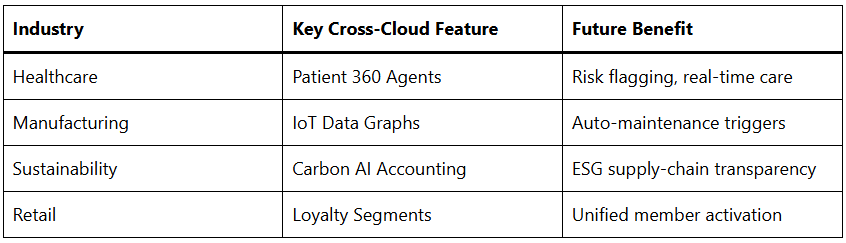
Real-time data activation ensures marketing, sales, and service teams share one customer view, eliminating silos. Enhanced governance features, including customer-managed keys and Private Connect, restrict sensitive data sharing, aligning with compliance needs. Industry-specific enhancements, such as Health Cloud’s Patient 360, leverage these models for proactive risk flagging.
Agentic AI Integration
The shift to agentic AI marks a pivotal future trend, where autonomous agents built on cross-cloud data execute complex workflows. Data Cloud’s unified profiles feed Agentforce for actions like claims processing, reducing human oversight. Predictions for 2026 highlight 282% AI adoption growth, with agents relying on cross-cloud harmonisation for adaptive engagement.
Data graphs and model builders enable no-code custom AI models, processing relationships in milliseconds without SQL. This empowers businesses to train industry-tailored agents, boosting accuracy in sectors like manufacturing via IoT-triggered maintenance. Cross-cloud features like Flow logging and Visual Remote Assistant integration amplify agent intelligence.
Zero-Copy and Real-Time Pipelines
Zero-copy architecture remains foundational, avoiding data movement for cost savings and security. Future enhancements expand connectors to Stripe and Google Drive, unifying streams into Data 360 profiles queryable across clouds. Real-time harmonisation syncs customer, product, and operational data, fuelling Einstein for predictive insights.
Data Spaces segregate info by compliance needs, while Tableau semantics standardise semantics for AI readiness. These pipelines support Composable CRM, integrating with MuleSoft for modular ERP links. By late 2026, expect millisecond graph processing to dominate, enabling proactive decisions.
Industry-Specific Advancements
Vertical clouds deepen with pre-built connectors and models for tailored AI. Healthcare sees Patient 360 agents spotting care gaps; manufacturing adopts asset-as-a-service via IoT data models. Loyalty Management and Net Zero Cloud integrate for segment searches and ESG reporting.
Sustainability Cloud automates carbon accounting across clouds, ingesting supply-chain data into unified models. This turns compliance into operational metrics, vital for regulated markets. Future outlooks predict generic CRM obsolescence, favouring these specialised models.
Governance and Security Horizons
Enhanced governance addresses data quality hurdles, with 2026 reports noting poor data as a top barrier. Shield Platform Encryption and external key management secure cross-cloud flows. Consent tools ensure ethical use, building trust for AI personalisation.
Private Connect limits external cloud shares, while data processing engines handle complex transformations. Model Builders offer drag-and-drop for secure custom models. Outlook: Full interoperability with zero trust by 2027.
Challenges and Adoption Strategies
Fragmented data persists as a hurdle, but Data Cloud’s core services like identity resolution mitigate it. Organisations must invest in Salesforce consulting for safe implementations. Phased adoption starting with zero-copy pilots accelerates ROI.
Scalability demands robust metadata frameworks for cross-cloud usability. Training on Flows and Einstein integration is key. By 2026, Data Cloud becomes non-negotiable for AI success.
Strategic Roadmap for 2026-2028
Prioritise Data Cloud activation for Agentforce readiness. Build composable architectures with MuleSoft for ERP harmony. Leverage industry clouds for competitive edges.
Invest in data spaces for compliance agility. Monitor Forrester’s leadership nods for cross-cloud strengths. Long-term: Autonomous ecosystems where models self-optimise via AI feedback loops.
Cross-cloud data models position Salesforce as the AI CRM backbone, driving unified intelligence. Businesses adopting now will lead in agentic eras, turning data into action at scale.