

The Future of AI Skills and Salesforce Workforce Trends
AI is reshaping the Salesforce ecosystem, driving demand for new skills, automating routine tasks, and altering workforce dynamics. As Salesforce integrates advanced AI like Agentforce and Einstein, professionals must adapt to thrive in this evolving landscape.
Table of Contents
Salesforce’s AI Evolution
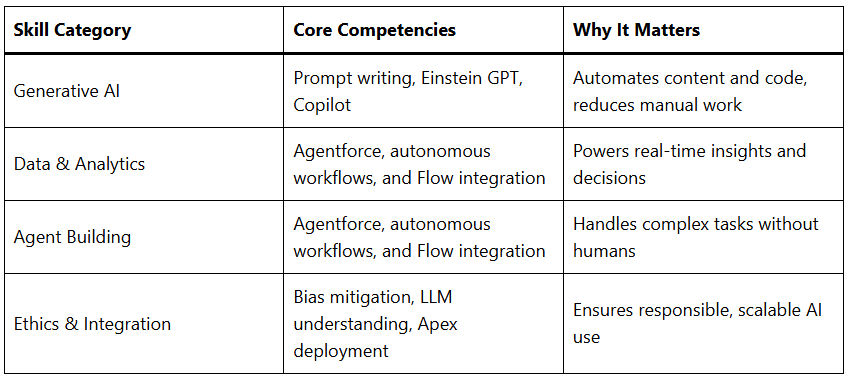
Salesforce has positioned AI at the core of its platform, with innovations like Agentforce 2.0 that enable autonomous agents to handle complex workflows, update CRM records, and resolve customer issues independently. These agents integrate with Data Cloud, Slack, and MuleSoft for end-to-end automation, slashing research time by 34% and content creation by 36% for sales teams. Einstein GPT and Copilot further empower users by generating content, code suggestions, and predictive insights, marking a shift to an AI-first CRM architecture.
Impact on Workforce Dynamics
AI adoption has led to workforce reductions, with Salesforce cutting 4,000 customer support jobs in 2025 as Agentforce handled half of the interactions, and nearly 1,000 more in early 2026 across Agentforce, marketing, and data teams. CEO Marc Benioff noted the need for fewer heads due to AI efficiencies, redeploying some to sales while trimming support from 9,000 to 5,000. Despite layoffs, top performers using AI agents are 1.7x more productive, signaling a hybrid human-AI model that boosts efficiency by 60% per MIT research.
Essential AI Skills for Professionals
Key skills include generative AI and prompt engineering for Einstein GPT, data preparation for analytics, and AI ethics to mitigate bias. Professionals need expertise in natural language processing, AI integration via Apex and Flow, and building autonomous agents for lead qualification and ticket resolution. Additional demands cover Einstein Discovery for predictions, Prompt Builder, and critical thinking to innovate alongside AI.
Emerging Job Roles and Opportunities
New roles like AI Specialists, Solution Architects, and Data Scientists are surging, focusing on Agentforce implementation and AI-driven personalization. Demand grows for Marketing Cloud experts in AI chatbots and Commerce Cloud developers for recommendations, alongside hybrid low-code/pro-code developers. By 2026, 40% of enterprise apps will feature AI agents, creating opportunities in composable architectures and Hyperforce infrastructure.
Strategies for Upskilling
Salesforce professionals should pursue certifications in Einstein, Data Cloud, and Agentforce via Trailhead, mastering prompt engineering and AI ethics. Hands-on practice with real-world examples, like Einstein Conversation Insights for call analysis, builds practical expertise. Continuous learning in low-code automation and industry-specific AI applications positions workers for hybrid teams where humans oversee AI outputs.
Challenges and Ethical Considerations
While AI drives growth, challenges include job displacement in support roles and the need for ethical practices to address privacy and bias. Only 1 in 10 workers currently have in-demand AI skills, highlighting a global gap that Salesforce is addressing through platforms like Einstein. Organizations must balance automation with upskilling to avoid labor shortages in high-skill areas.
Outlook for 2026 and Beyond
Salesforce’s 2026 vision features AI agents as mainstream, with Data Cloud enabling zero-delay activation and Slack AI for collaboration. AI spending will surge, transforming CRM into intelligent platforms for personalized experiences and predictive operations. Professionals blending AI literacy with domain expertise will lead, as hybrid teams redefine productivity in the Salesforce workforce.