

Tata Salesforce Strategy 2026: Powering Enterprise AI Growth
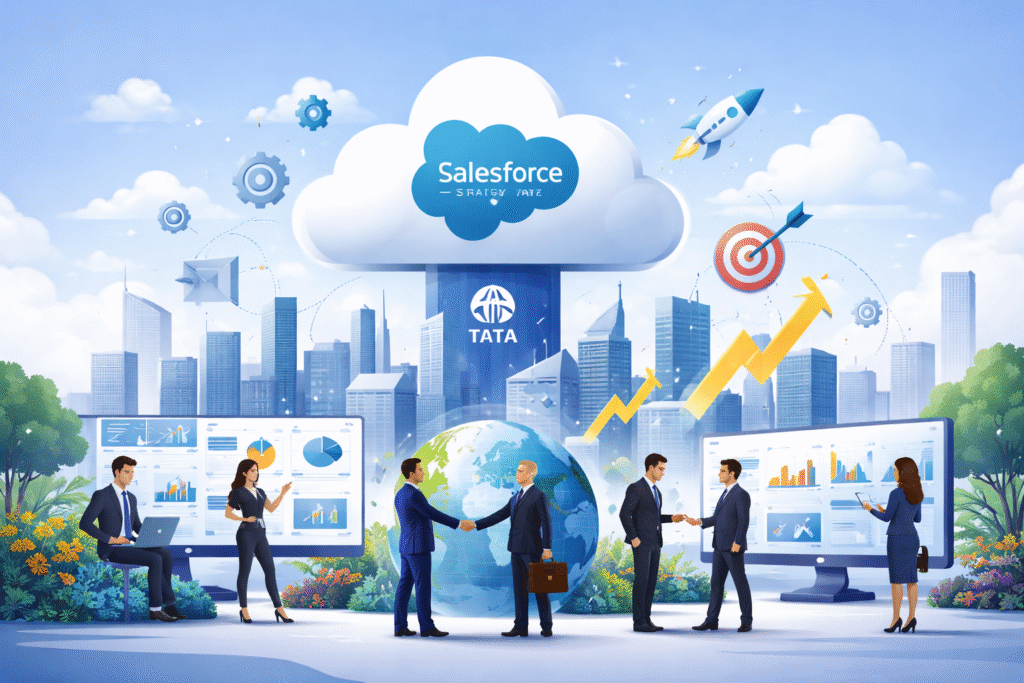
Introduction: Tata Salesforce Strategy 2026
As enterprises accelerate their digital transformation journeys, the convergence of cloud platforms, artificial intelligence (AI), and industry-specific solutions is reshaping how organizations operate and compete. By 2026, enterprises are expected to move beyond experimentation and embed AI deeply into core business processes. Against this backdrop, Tata Group’s Salesforce strategy for 2026 represents a forward-looking blueprint designed to power enterprise AI growth at scale.
Leveraging Tata’s global delivery strength, industry expertise, and Salesforce’s rapidly evolving AI-first ecosystem, the strategy focuses on creating intelligent, connected, and trusted digital enterprises. This blog explores how Tata’s Salesforce Strategy 2026 is positioned to enable AI-driven transformation across industries, geographies, and business functions.
Table of Contents
Strategic Vision: AI at the Core of Enterprise Transformation
At the heart of Tata’s Salesforce Strategy 2026 lies a clear vision: AI should be embedded, actionable, and enterprise-ready, not experimental or siloed. The strategy aligns with Salesforce’s evolution into an AI-first CRM platform through innovations such as Einstein AI, Data Cloud, and industry clouds.
Tata’s approach moves beyond traditional CRM implementations to focus on end-to-end enterprise intelligence. This includes connecting customer data, operational systems, and AI insights into a unified platform that enables faster decision-making, personalized engagement, and operational efficiency.
By 2026, Tata aims to help enterprises transition from fragmented digital tools to intelligent, AI-powered ecosystems built on Salesforce.
Salesforce as the Enterprise AI Platform
Salesforce has evolved from a customer relationship management tool into a comprehensive enterprise platform. Tata’s strategy leverages this evolution by positioning Salesforce as the central AI and data nervous system for enterprises.
Key platform pillars include:
- Salesforce Einstein AI for predictive insights, automation, and generative AI use cases
- Salesforce Data Cloud to unify structured and unstructured data in real time
- Industry Clouds tailored for sectors such as BFSI, healthcare, manufacturing, telecom, and retail
- Hyperautomation through low-code tools like Flow, MuleSoft, and Tableau
Tata’s Salesforce practice integrates these capabilities with enterprise systems, ensuring AI insights flow seamlessly across the organization.
Enterprise AI Use Cases Driving Business Value
Tata Salesforce Strategy 2026 is strongly use-case driven, focusing on measurable business outcomes rather than technology adoption alone.
1. Intelligent Customer Engagement
AI-powered personalization is a central theme. By unifying customer data across touchpoints, enterprises can deliver:
- Real-time personalized offers
- Predictive customer service responses
- AI-driven sales recommendations
- Proactive churn prevention
Tata helps enterprises operationalize these capabilities using Salesforce AI tools combined with domain-specific intelligence.
2. AI-Enabled Sales and Revenue Growth
Sales organizations increasingly rely on AI to prioritize opportunities and improve win rates. Tata’s strategy focuses on:
- Predictive lead and opportunity scoring
- AI-guided sales actions
- Automated forecasting and pipeline intelligence
- Generative AI for sales content and proposals
By 2026, AI-driven sales processes are expected to become standard, and Tata positions Salesforce as the core platform enabling this shift.
3. Smarter Service Operations
Customer service is undergoing a major transformation with AI-powered automation and self-service. Tata’s Salesforce strategy supports:
- AI chatbots and virtual agents
- Predictive case routing
- Automated knowledge management
- Proactive issue resolution
This results in faster resolution times, reduced service costs, and improved customer satisfaction.
4. Data-Driven Decision Making with Trusted AI
AI is only as effective as the data behind it. Tata emphasizes trusted, governed, and ethical AI, especially for regulated industries.
Through Salesforce Data Cloud and Tableau, enterprises gain:
- Unified, real-time data visibility
- Explainable AI insights
- Strong data governance and compliance
- Enterprise-grade security
This focus on trust is critical as AI adoption scales across the enterprise.
Industry-Focused Salesforce Solutions
Tata Salesforce Strategy 2026 is its industry-first approach. Rather than generic implementations, Tata delivers tailored solutions aligned with sector-specific challenges.
BFSI (Banking, Financial Services & Insurance)
AI-driven customer onboarding, risk analytics, personalized financial products, and regulatory compliance solutions.
Healthcare & Life Sciences
Patient engagement platforms, AI-assisted care coordination, real-time analytics, and compliance-ready data management.
Manufacturing
Connected customer experiences, AI-enabled demand forecasting, dealer management, and after-sales service intelligence.
Retail & Consumer Goods
Omnichannel personalization, demand prediction, loyalty optimization, and AI-powered merchandising insights.
This verticalized approach ensures faster time-to-value and higher ROI.
India as a Global AI Delivery Hub
India plays a strategic role in Tata Salesforce Strategy 2026. With its deep talent pool and growing AI ecosystem, India is positioned as a global delivery and innovation hub for Salesforce-led AI solutions.
Key focus areas include:
- Building AI-ready Salesforce talent at scale
- Developing accelerators and industry templates
- Supporting global enterprises with cost-effective, high-quality delivery
- Driving innovation in generative AI and automation
This strengthens Tata’s ability to serve both Indian enterprises and global clients.
Generative AI and the Future of Work
Generative AI represents a major shift in enterprise technology. Tata’s strategy embraces Salesforce’s generative AI capabilities to transform how work gets done.
Use cases include:
- AI-generated customer communications
- Automated report generation
- Intelligent workflow recommendations
- AI copilots for sales, service, and marketing teams
By 2026, these capabilities are expected to significantly boost productivity and reduce manual effort across business functions.
Ecosystem Partnerships and Innovation
Tata’s Salesforce Strategy 2026 is built on a strong ecosystem of partnerships. These include collaborations with Salesforce, hyperscalers, ISVs, and AI technology providers.
This ecosystem approach enables:
- Faster adoption of new Salesforce innovations
- Integration with enterprise platforms like ERP and data lakes
- Continuous innovation through co-creation models
Such partnerships ensure enterprises remain future-ready as technology evolves.
Change Management and AI Adoption at Scale
Technology alone does not guarantee success. Tata emphasizes change management, training, and adoption as core components of its strategy.
This includes:
- Role-based AI training programs
- Human-in-the-loop AI models
- Governance frameworks for responsible AI use
- Ongoing optimization and performance tracking
By focusing on people and processes, Tata ensures sustainable AI adoption.
Roadmap to 2026 and Beyond
Looking ahead, Tata Salesforce Strategy 2026 outlines a clear roadmap:
- 2024–2025: Scaling AI pilots, data unification, and industry cloud adoption
- 2025–2026: Enterprise-wide AI operationalization and generative AI maturity
- Beyond 2026: Autonomous enterprise processes powered by AI and real-time intelligence
This roadmap positions enterprises to remain competitive in an increasingly AI-driven world.
Key Takeaway:
Tata Salesforce Strategy 2026: Powering Enterprise AI Growth represents a comprehensive and future-ready approach to digital transformation. By combining Salesforce’s AI-first platform with Tata’s global scale, industry expertise, and delivery excellence, the strategy enables enterprises to move from isolated AI experiments to enterprise-wide intelligence.
As AI becomes a core business capability rather than a differentiator, Tata’s Salesforce-led approach helps organizations unlock smarter engagement, faster decisions, and sustainable growth. For enterprises aiming to thrive in the AI era, this strategy offers a clear, trusted, and scalable path forward.