

Salesforce Workforce Changes and Layoff Insights
Salesforce has undergone multiple rounds of workforce reductions since 2023, driven by economic pressures, operational streamlining, and accelerating AI adoption, with nearly 1,000 layoffs reported in early 2026. These changes reflect a broader tech industry trend toward efficiency amid AI advancements like Agentforce. CEO Marc Benioff has openly linked many cuts to AI automation replacing routine tasks.
Table of Contents
Layoff Timeline
Salesforce’s workforce shifts began prominently in early 2023 with a major 10% reduction affecting about 8,000 employees, citing over-hiring during the pandemic and a challenging economic environment. In 2024, smaller waves followed: around 700 roles in January and 300 more in July, part of ongoing restructuring to optimize growth.
By 2025, AI emerged as a key driver, with CEO Benioff confirming 4,000 customer support jobs cut—from 9,000 to 5,000 heads—as AI agents handled 50% of customer interactions, reducing costs by 17%. Additional cuts included over 250 in San Francisco across tech, product, and admin teams in September 2025.
In early 2026 (February), nearly 1,000 roles were eliminated, targeting marketing, product management, data analytics, and Agentforce AI teams, amid executive reshuffles.
Key Reasons
Economic downturns and post-pandemic adjustments prompted initial 2023-2024 layoffs, as customers adopted a measured approach to purchases, forcing Salesforce to trim excess headcount from rapid 2021-2022 hiring (from 57,000 to 73,000).
AI integration accelerated changes from 2025 onward: Agentforce and AI agents automated support, sales leads, and routine tasks, allowing redeployment to high-value areas like sales while eliminating redundancies. Benioff emphasized “radical augmentation,” where AI handles repetitive work, boosting productivity without proportional hiring.
Recent 2026 cuts align with AI focus and leadership realignments, including departures like EVP Adam Evans, to streamline Agentforce-Slack integration.
AI’s Role
Salesforce’s Agentforce platform exemplifies AI-driven efficiency: agents now contact every lead (over 100 million backlog cleared) and manage half of customer conversations. This led to 4,000 support reductions, with Benioff stating, “I need fewer heads” due to AI’s speed and scale.
While support roles shrank, AI preserved sales jobs requiring human nuance, redeploying many staff. Broader tech trends show AI linked to 54,000+ cuts industry-wide in 2025. Salesforce raised 2026 revenue forecasts despite cuts, crediting AI demand.
Workforce Trends
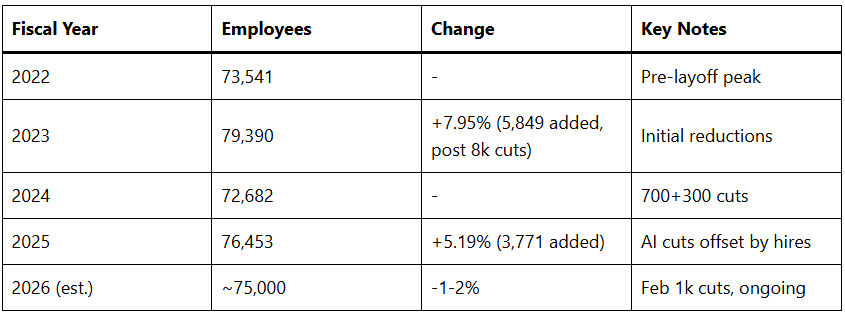
Overall headcount stabilized around 76,000 after fluctuations, shifting to AI specialists, architects, and sales over support.
Employee Impacts
Layoffs surfaced via LinkedIn posts, affecting global teams but concentrated in hubs like San Francisco (262 cuts) and Seattle. Severance supported transitions, with some rehiring or redeployment to sales/customer success.
Market shifts favor certified pros in AI integration; freelance demand rises for flexible expertise. Benioff stresses humans remain vital for complex interactions, countering full AI replacement fears.
Future Outlook: Salesforce Workforce Changes and Layoff Insights
Salesforce prioritizes AI-led growth, with Agentforce central despite cuts, forecasting higher 2026 profits. Expect continued optimization: fewer routine roles, more AI-savvy hires amid tech’s evolution. For professionals, upskilling in Agentforce, certifications, and sales-AI hybrids offers resilience.