

Salesforce Real Estate CRM vs Traditional CRMs in 2026
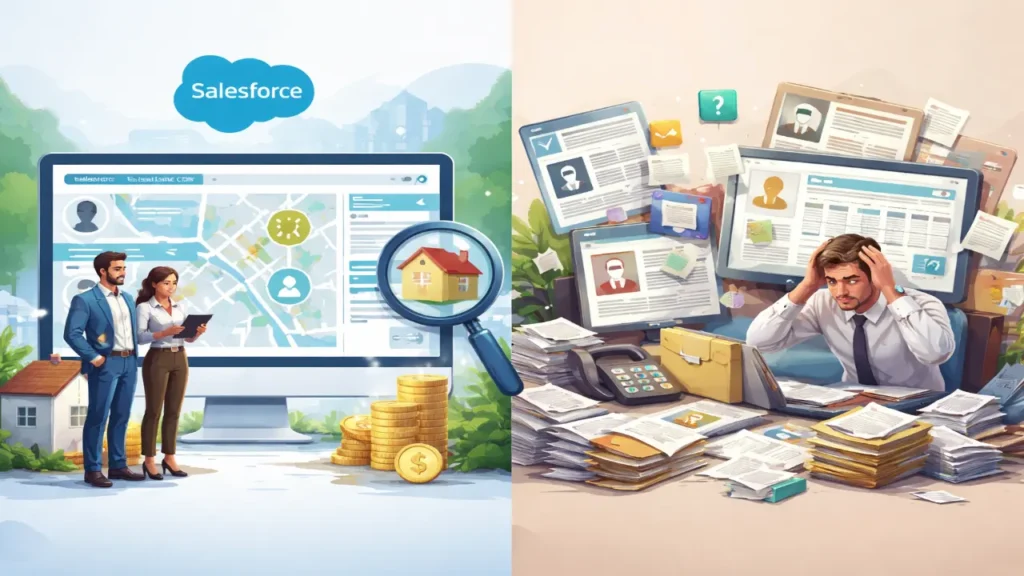
Introduction: Salesforce Real Estate CRM vs Traditional CRMs
The real estate industry in 2026 is more data-driven, customer-centric, and competitive than ever before. Brokers, agents, and real estate firms are no longer just managing listings and contacts; they are orchestrating complex buyer journeys, handling omnichannel communication, leveraging AI-driven insights, and ensuring regulatory compliance. In this evolving landscape, the choice of CRM plays a critical role.
Traditional CRMs have long been used to store contacts, track deals, and manage basic sales activities. However, real estate-specific needs have pushed organizations toward more advanced, industry-focused platforms. Salesforce Real Estate CRM, built on the Salesforce ecosystem, has emerged as a powerful alternative, offering deep customization, automation, and intelligence tailored to real estate workflows.
This blog explores the differences between Salesforce Real Estate CRM and traditional CRMs in 2026, helping decision-makers understand which solution best aligns with modern real estate business requirements.
Table of Contents
What is Salesforce Real Estate CRM?
Salesforce Real Estate CRM is not a single off-the-shelf product but a flexible, cloud-based platform designed to adapt to real estate operations. Built on Salesforce Sales Cloud and enhanced with industry-specific data models, automation, and AI, it supports residential, commercial, and property management use cases.
Key Characteristics of Salesforce Real Estate CRM
- Highly customizable data models for properties, listings, clients, and transactions
- AI-powered insights for lead scoring, opportunity forecasting, and customer behavior analysis
- Advanced automation using workflows and flows
- Seamless integration with marketing, service, analytics, and third-party systems
- Scalable architecture suitable for individual agents to large brokerages
By 2026, Salesforce has further strengthened its real estate capabilities through AI copilots, real-time analytics, and unified customer data.
Understanding Traditional CRMs
Traditional CRMs are generally designed for broad sales and customer management use cases. They focus on core CRM functions such as contact management, pipeline tracking, task management, and basic reporting.
Common Features of Traditional CRMs
- Contact and account management
- Deal or opportunity tracking
- Basic email and activity logging
- Standard reports and dashboards
- Limited automation capabilities
While these systems may work for small teams or simple sales cycles, they often fall short when applied to the complex, long-cycle, and relationship-driven nature of real estate transactions.
Core Differences Between Salesforce Real Estate CRM and Traditional CRMs
Customization and Flexibility
One of the most significant differences in 2026 is the level of customization.
Salesforce Real Estate CRM
Salesforce allows organizations to design custom objects for properties, units, leases, developers, investors, and more. Business logic can be tailored to match unique workflows, whether it is pre-sales, site visits, negotiations, or post-sale engagement. This flexibility ensures the CRM aligns perfectly with how real estate businesses operate.
Traditional CRMs
Traditional CRMs usually provide fixed data structures with limited customization. Adapting them to real estate-specific processes often requires workarounds, external tools, or manual processes, which reduce efficiency and scalability.
Lead Management and Conversion
In real estate, leads come from multiple sources and require timely follow-ups.
Salesforce Real Estate CRM
Salesforce excels in advanced lead management. AI-driven lead scoring helps agents prioritize high-intent buyers and investors. Automated assignment rules ensure leads reach the right agent instantly. Follow-up reminders, nurture journeys, and predictive insights improve conversion rates.
Traditional CRMs
Most traditional CRMs support basic lead capture and assignment. However, they lack intelligent scoring, predictive insights, and advanced automation, making it harder to handle high lead volumes efficiently.
Customer Experience and Relationship Management
Salesforce Real Estate CRM
In 2026, customer experience is a key differentiator. Salesforce provides a unified view of every client, including interactions, preferences, site visits, communications, and transaction history. This 360-degree view enables personalized engagement across the entire lifecycle, from first inquiry to repeat investment.
Traditional CRMs
Traditional CRMs typically store limited interaction data. Customer insights are often fragmented, making it difficult for agents to deliver highly personalized experiences.
Automation and Workflow Management
Salesforce Real Estate CRM
Salesforce automation capabilities are far more advanced. Complex workflows can be automated, such as:
- Site visit scheduling and follow-ups
- Document approvals and contract stages
- Payment milestone reminders
- Post-sale service requests
This reduces manual work and ensures consistency across teams.
Traditional CRMs
Automation in traditional CRMs is usually limited to simple triggers like task creation or email notifications. As business complexity grows, these systems struggle to keep up.
AI and Analytics in 2026
Salesforce Real Estate CRM
AI is a defining factor in 2026. Salesforce leverages AI to provide predictive analytics, deal forecasting, and intelligent recommendations. Agents can understand which properties are likely to close faster, which clients need attention, and what actions drive better outcomes. Advanced dashboards and real-time analytics help leadership track performance, marketing ROI, and sales velocity.
Traditional CRMs
Most traditional CRMs offer basic reporting with minimal predictive capabilities. Insights are largely historical, limiting their usefulness for strategic decision-making.
Scalability and Performance
Salesforce Real Estate CRM
Salesforce is built to scale. Whether managing hundreds or millions of records, the platform maintains performance and reliability. This makes it ideal for growing brokerages, developers, and multinational real estate firms.
Traditional CRMs
Traditional CRMs may perform well for small teams but often face limitations as data volume and user count increase. Scaling usually requires system upgrades or migration to a more robust platform.
Integration Ecosystem
Salesforce Real Estate CRM
Salesforce offers a vast ecosystem that integrates seamlessly with marketing automation, customer support, analytics, payment systems, and external property platforms. This creates a connected digital ecosystem where data flows smoothly across departments.
Traditional CRMs
Integration options are typically limited. Connecting with external systems may require custom development or third-party connectors, increasing cost and complexity.
Security and Compliance
Salesforce Real Estate CRM
In 2026, data security and compliance are critical. Salesforce provides enterprise-grade security, role-based access control, audit trails, and compliance-ready infrastructure. This is especially important for real estate firms handling sensitive financial and personal data.
Traditional CRMs
While traditional CRMs offer basic security features, they may not meet the advanced compliance and governance needs of large or regulated organizations.
Cost Considerations
Salesforce Real Estate CRM
Salesforce is often perceived as more expensive. However, when factoring in automation, scalability, reduced manual effort, and higher conversion rates, the long-term return on investment is significant for mid to large real estate businesses.
Traditional CRMs
Traditional CRMs generally have lower upfront costs and are suitable for small teams with limited requirements. However, hidden costs arise as businesses outgrow the platform and require additional tools or migration.
Which CRM Is Right for Real Estate in 2026?
The choice depends on business size, complexity, and growth plans.
Salesforce Real Estate CRM Is Ideal For
- Growing and enterprise-level brokerages
- Developers managing complex projects
- Firms requiring deep customization and automation
- Businesses focused on data-driven decision-making and premium customer experience
Traditional CRMs Are Suitable For
- Individual agents or small teams
- Simple sales processes
- Limited budgets and short-term needs
Conclusion
In 2026, the gap between Salesforce Real Estate CRM vs traditional CRMs is wider than ever. Traditional CRMs continue to serve basic needs but struggle to support the complexity, scale, and intelligence required by modern real estate businesses.
Salesforce Real Estate CRM stands out as a future-ready platform, offering unmatched customization, AI-driven insights, automation, and scalability. For real estate organizations aiming to deliver exceptional customer experiences and sustain long-term growth, Salesforce-based solutions provide a clear competitive advantage.