

Salesforce No-Code Automation: What’s Next in 2026
Introduction: Salesforce No-Code Automation
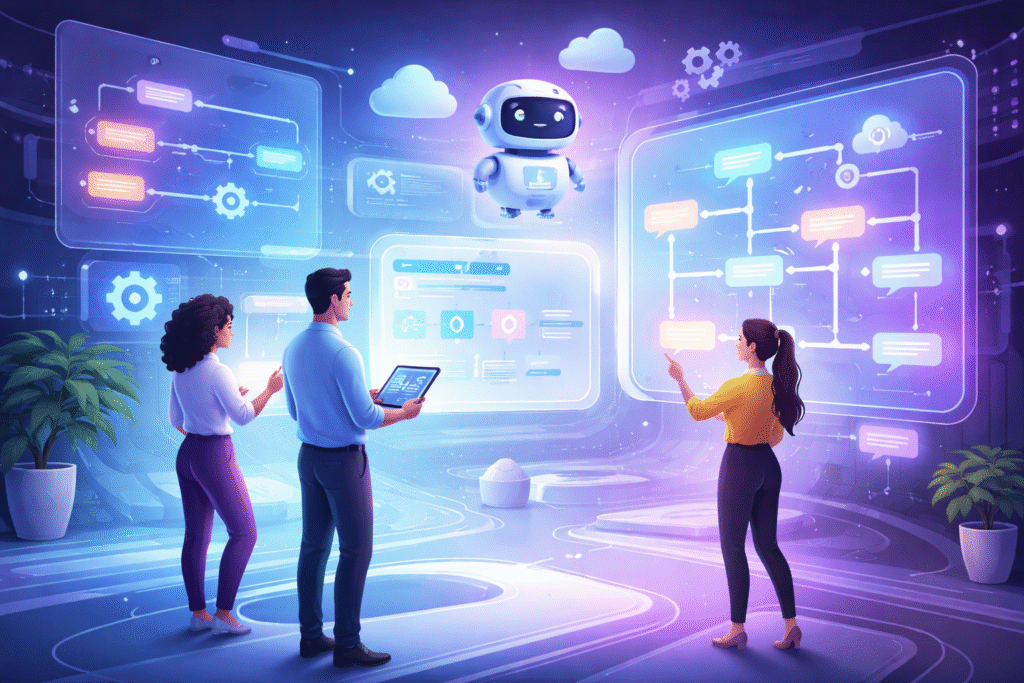
In the past few years, Salesforce has been at the forefront of empowering businesses with automation tools that don’t require extensive coding knowledge. As we look ahead to 2026, the no-code automation landscape is poised for remarkable evolution, driven by advancements in AI, integration capabilities, and user-centric design. The following explores key trends, innovations, and strategic implications for businesses leveraging Salesforce no-code automation in 2026.
Table of Contents
1. The Rise of AI-Driven Automation
By 2026, AI will be deeply integrated into Salesforce no-code tools. This means workflows, process builder alternatives, and automation sequences will be smarter, predictive, and adaptive. AI will analyze patterns in customer interactions, sales trends, and operational data to suggest automation rules, optimize processes, and even trigger actions automatically. Businesses will be able to rely on AI not just for recommendations but for creating fully functional automated processes without manual configuration.
2. Hyper-Personalized Customer Journeys
No-code automation will make it easier than ever to deliver personalized experiences at scale. Salesforce will enable users to automate workflows based on individual customer behavior, lifecycle stage, and preferences. For example, a lead interacting with a product demo might automatically trigger a series of customized follow-up emails, notifications to the sales team, and suggested content delivery all without writing a single line of code.
3. Cross-Platform Integrations Made Simple
As businesses increasingly use multiple SaaS platforms, Salesforce no-code automation in 2026 will focus on seamless integration across systems. Using drag-and-drop interfaces, businesses will connect Salesforce to marketing platforms, finance tools, e-commerce systems, and collaboration apps effortlessly. This will eliminate data silos and create unified automated workflows across the entire organization.
4. Event-Driven Automation
Automation will no longer be limited to pre-defined schedules or static triggers. Event-driven automation will allow businesses to react instantly to real-time events. For instance, when a customer interacts with a website, opens an email, or raises a support ticket, Salesforce automation will immediately process the event and initiate the corresponding workflow. This real-time responsiveness will enhance customer satisfaction and operational efficiency.
5. Low-Code/No-Code Hybrid Environments
By 2026, Salesforce will increasingly support hybrid environments where no-code automation tools coexist with low-code options. This hybrid model allows power users and developers to extend the capabilities of no-code workflows when needed. Businesses can start with no-code automation for standard processes and gradually incorporate low-code customizations for complex scenarios, ensuring flexibility without sacrificing speed.
6. Analytics and Automation Insights
Automation without insights is incomplete. Salesforce will enhance no-code automation tools with embedded analytics to monitor workflow efficiency, detect bottlenecks, and predict future outcomes. Users will receive actionable recommendations to refine automation strategies, ensuring processes are continuously optimized and aligned with business objectives.
7. Democratization of Process Automation
One of the most significant trends is the democratization of automation. No-code tools will empower every team from marketing and sales to HR and finance to create, manage, and optimize automated workflows independently. This reduces reliance on IT teams, accelerates implementation, and fosters innovation across the organization.
8. Security, Compliance, and Governance
As automation grows, so do risks related to data security and compliance. Salesforce will enhance governance features in no-code automation, allowing administrators to define access controls, approval processes, and audit trails for automated workflows. This ensures that as automation becomes more pervasive, it remains secure and compliant with global standards.
9. AI Chatbots and Conversational Automation
Conversational AI and chatbots will be increasingly integrated into no-code automation workflows. By 2026, Salesforce users will automate not just backend processes but also customer-facing interactions. Intelligent chatbots will engage customers, gather information, and trigger internal processes in real-time, creating a seamless automation ecosystem.
10. Future Outlook: The Business Impact
By 2026, Salesforce no-code automation will no longer be optional — it will be a strategic differentiator. Businesses leveraging these tools will enjoy faster go-to-market times, higher operational efficiency, improved customer experiences, and a more empowered workforce. Organizations that fail to adopt advanced no-code automation risk falling behind competitors that harness AI-driven, cross-platform, and hyper-personalized automated workflows.
Conclusion
The future of Salesforce no-code automation in 2026 promises a shift from manual, repetitive workflows to intelligent, adaptive, and predictive automation. With AI, real-time responsiveness, cross-platform integration, and democratized process creation, businesses will achieve unprecedented agility. For companies aiming to stay competitive, investing in Salesforce no-code automation is not just about efficiency—it’s about transforming the way work is done across the enterprise.