

Salesforce Marketing Cloud vs Marketing Cloud Next: Which Is Better?
Introduction: Salesforce Marketing Cloud vs Marketing Cloud Next
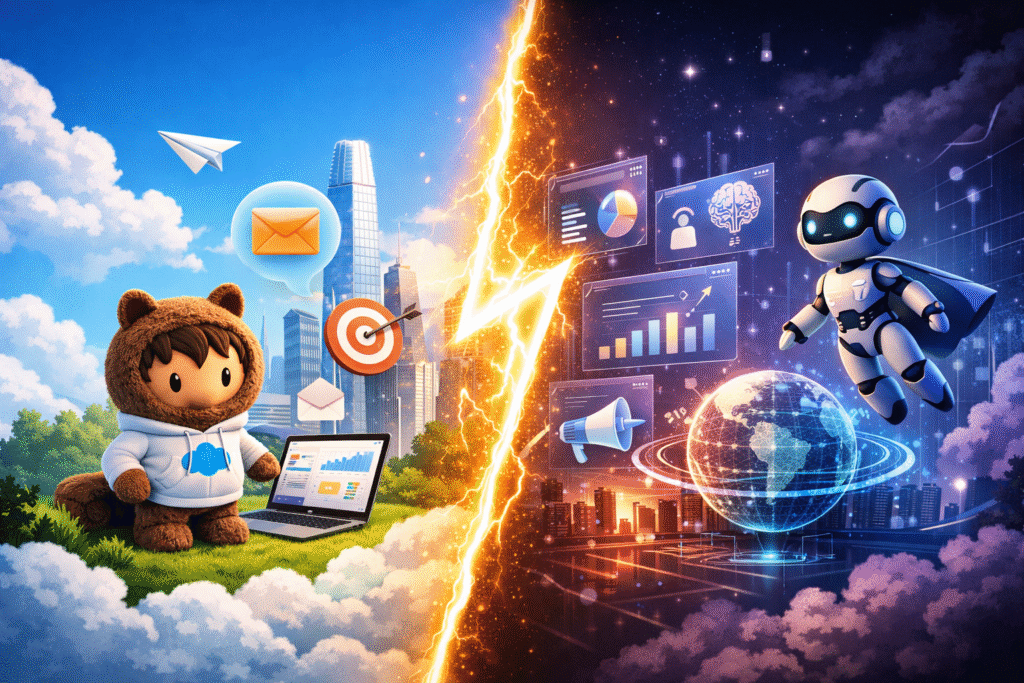
Salesforce has long been a leader in digital marketing technology, empowering businesses to deliver personalized, data-driven customer journeys at scale. For years, Salesforce Marketing Cloud (Classic) has been the backbone of enterprise marketing automation. Now, Salesforce is evolving that vision with Marketing Cloud Next, a modern, AI-native platform built on Salesforce Data Cloud and Agentforce.
This shift has created an important question for marketers, decision-makers, and Salesforce partners:
Salesforce Marketing Cloud vs Marketing Cloud Next — which one is better, and which should you choose?
This blog provides a deep comparison, covering architecture, features, AI capabilities, scalability, and future readiness to help you make the right decision.
Table of Contents
Understanding Salesforce Marketing Cloud (Classic)
Salesforce Marketing Cloud (often referred to as Classic Marketing Cloud) is a powerful digital marketing platform designed to manage customer engagement across multiple channels.
Core Capabilities of Salesforce Marketing Cloud
Classic Marketing Cloud is built around a set of specialized studios:
- Email Studio – Campaign creation, segmentation, and automation for email marketing
- Journey Builder – Multi-step, rule-based customer journeys
- Mobile Studio – SMS, push notifications, and mobile messaging
- Advertising Studio – Social and digital advertising orchestration
- Personalization (Interaction Studio) – Real-time personalization
- Analytics Builder – Campaign performance tracking
For years, these tools have helped enterprises manage large-scale campaigns and complex customer journeys.
Strengths of Salesforce Marketing Cloud (Classic)
1. Proven and Enterprise-Ready
Salesforce Marketing Cloud Classic is a mature and battle-tested platform trusted by global enterprises across industries.
2. Deep Multi-Channel Campaign Management
It supports email, SMS, push notifications, social ads, and web personalization, all managed from a single ecosystem.
3. Powerful Journey Builder
Journey Builder allows marketers to design rule-based workflows using triggers, decision splits, and timed actions.
4. Strong Ecosystem and Integrations
Classic Marketing Cloud integrates well with Sales Cloud, Service Cloud, Commerce Cloud, and third-party tools.
Limitations of Salesforce Marketing Cloud (Classic)
Salesforce Marketing Cloud Classic has notable limitations in today’s AI-driven marketing landscape.
1. Data Silos
Customer data often lives in separate data extensions, requiring manual synchronization and complex SQL queries.
2. Limited Real-Time Capabilities
Journeys are largely batch-based rather than real-time, limiting instant personalization.
3. AI Is Add-On, Not Native
Einstein features exist but are layered on top, not deeply embedded across the platform.
4. Technical Complexity
Advanced use cases often require SQL, scripting, and developer involvement.
What Is Marketing Cloud Next?
Marketing Cloud Next is Salesforce’s next-generation marketing platform designed for the AI era. It represents a fundamental architectural shift rather than a simple upgrade.
Instead of operating as a standalone marketing tool, Marketing Cloud Next is deeply integrated with Salesforce Data Cloud and Agentforce, enabling real-time, AI-powered customer engagement.
Key Vision Behind Marketing Cloud Next
Salesforce Marketing Cloud Next is built around three core principles:
- Unified Customer Data
- AI-First Marketing Execution
- Real-Time Personalization at Scale
This platform is designed to move marketers from campaign execution to intelligent, autonomous engagement.
Marketing Cloud Next Features Explained
1. Native Integration with Salesforce Data Cloud
Unlike Classic Marketing Cloud, Marketing Cloud Next is built directly on Salesforce Data Cloud, meaning:
- Real-time customer profiles
- Unified data from CRM, web, mobile, commerce, and external sources
- Zero data duplication
This eliminates traditional data silos and enables instant activation.
2. AI-Powered Marketing with Agentforce
Marketing Cloud Next leverages Agentforce AI agents to automate marketing decisions, such as:
- Dynamic audience creation
- Predictive journey paths
- Content recommendations
- Next-best-action selection
AI is no longer optional—it is embedded into every workflow.
3. Real-Time, Event-Driven Journeys
Instead of batch-based journeys, Marketing Cloud Next supports:
- Event-triggered interactions
- Real-time personalization
- Adaptive journeys that evolve based on customer behavior
This enables brands to react instantly to customer actions.
4. Simplified User Experience
Marketing Cloud Next is designed for marketers, not developers:
- Low-code / no-code interfaces
- Reduced dependency on SQL
- Intuitive segmentation and activation
This significantly shortens campaign setup time.
5. Privacy, Trust, and Compliance by Design
Built on Salesforce’s trusted platform, Marketing Cloud Next includes:
- Consent-aware engagement
- Data governance controls
- Enterprise-grade security
This makes it ideal for compliance-heavy industries.
Salesforce Marketing Cloud vs Marketing Cloud Next: Detailed Comparison
Architecture Comparison
- Classic Marketing Cloud: Separate platform with data extensions
- Marketing Cloud Next: Native Data Cloud architecture
Marketing Cloud Next eliminates data replication and sync delays.
AI Capabilities Comparison
- Classic: Einstein features as add-ons
- Next: AI embedded across segmentation, journeys, and content
Marketing Cloud Next clearly leads in AI maturity.
Journey Orchestration
- Classic: Rule-based, scheduled journeys
- Next: Real-time, adaptive, AI-driven journeys
Next enables continuous, intelligent engagement.
Data Management
- Classic: Manual data modeling and SQL
- Next: Unified profiles with zero-copy architecture
Marketing Cloud Next drastically simplifies data operations.
Scalability and Future Readiness
- Classic: Stable but approaching architectural limits
- Next: Built for future AI innovation
Marketing Cloud Next is Salesforce’s long-term strategic direction.
Salesforce Marketing Cloud Next vs Classic: Which Should You Choose?
Choose Salesforce Marketing Cloud (Classic) If:
- You already have a mature implementation
- Your campaigns are primarily batch-based
- You rely heavily on existing journeys and custom SQL
- Immediate migration is not a priority
Classic remains a strong platform for stable, well-defined marketing operations.
Choose Marketing Cloud Next If:
- You want real-time personalization
- AI-driven automation is a priority
- You plan to leverage Salesforce Data Cloud
- You want a future-ready marketing platform
Marketing Cloud Next is ideal for organizations focused on innovation and scale.
Migration Strategy: From Classic to Marketing Cloud Next
Salesforce positions Marketing Cloud Next as an evolution, not a forced replacement. Many organizations will adopt a phased approach, starting with:
- Data Cloud unification
- AI-powered segmentation
- Select real-time use cases
Over time, workloads gradually move from Classic to Next.
Which Is Better?
There is no one-size-fits-all answer, but the strategic direction is clear.
- Salesforce Marketing Cloud Classic is reliable, proven, and powerful
- Marketing Cloud Next is intelligent, real-time, and future-ready
If your goal is short-term stability, Classic works well.
If your goal is long-term growth, AI-driven marketing, and competitive advantage, Marketing Cloud Next is the better choice.
Key Takeaway:
The comparison between Salesforce Marketing Cloud vs Marketing Cloud Next is not just about features it’s about mindset. Salesforce is moving from campaign-centric marketing to autonomous, AI-powered customer engagement. Marketing Cloud Next represents the future of digital marketing on Salesforce. Businesses that adopt it early will be better positioned to deliver personalized, connected, and intelligent customer experiences at scale.