

Salesforce in Russia: 2026 Adoption Challenges & Trends
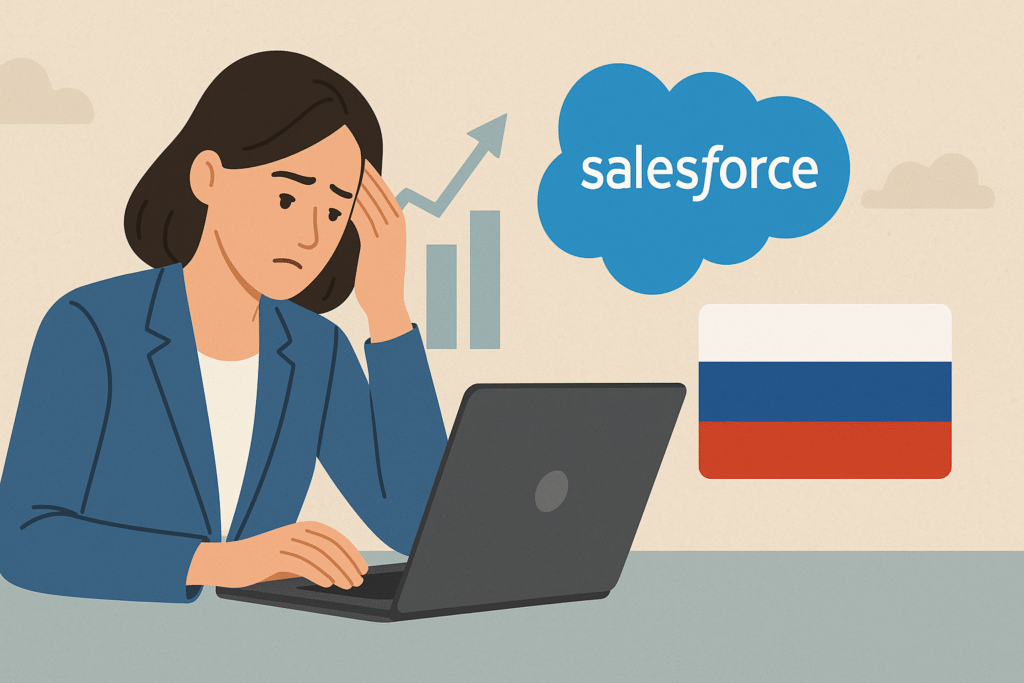
Introduction: Salesforce in Russia
As the world moves toward digital transformation, customer relationship management (CRM) platforms like Salesforce have become central to how organizations engage customers, streamline operations, and drive data-driven decisions. Globally, Salesforce has the largest CRM market share, yet in certain regions—notably Russia—its journey has been complicated and uncertain. By 2026, Salesforce adoption in Russia will reflect not only technological trends but also the intersection of regulatory restrictions, geopolitical factors, local options, and digital modernization goals.
This blog explores key challenges, barriers to adoption, and emerging trends shaping Salesforce’s presence and potential future in the Russian market.
Table of Contents
1. The Background: Salesforce and the Russian Market
Salesforce had a modest but growing presence in Russia. Large multinational corporations operating in the country—especially in finance, manufacturing, and IT—were using Salesforce to manage customer data, marketing automation, and analytics.
However, after 2022, geopolitical tensions and sanctions caused significant changes. Many Western technology providers, including Salesforce, have halted or limited operations in Russia due to compliance with international regulations and export restrictions. This created a vacuum in the enterprise CRM space that local vendors and open-source solutions began to fill.
By 2026, the CRM landscape in Russia will be developing independently, but demand for world-class cloud-based tools such as Salesforce is strong among global companies and Russian companies seeking modernization.
2. The Current State of Salesforce in Russia (2025–2026)
As of 2026, Salesforce’s direct commercial activity in Russia is highly restricted. Official support, new licenses, and cloud services hosted under Salesforce’s infrastructure are generally unavailable to Russian-based companies. Nonetheless, several parallel trends define the current state:
- Legacy Users Continue – Some enterprises that implemented Salesforce before 2022 continue using existing systems in limited or self-managed modes.
- Offshore Access – Multinational companies operating Russian branches manage their Salesforce environments from servers or teams located abroad.
- Local Workarounds – Russian organizations experiment with Salesforce-like architectures, including local CRMs (Bitrix24, amoCRM, RegionSoft, and 1C CRM) or hybrid open-source models.
- Consulting and Integration Shift – Former Salesforce consulting partners in Russia have pivoted to integration, migration, or data transformation services that bridge Salesforce with local tools.
This dual ecosystem—restricted official access but strong conceptual influence—defines Salesforce’s evolving footprint in the region.
3. Key Challenges to Salesforce Adoption in Russia
a. Regulatory and Geopolitical Barriers
One of the most significant hurdles is regulatory compliance. Western cloud platforms face export restrictions, and Russian data protection laws (especially Federal Law No. 152-FZ on Personal Data) require that all citizen data be stored on local servers. Since Salesforce’s infrastructure is primarily hosted outside Russia, this creates a legal contradiction for local usage.
Additionally, international sanctions and limitations on cross-border software payments make it challenging for Russian entities to purchase, license, or maintain Salesforce systems.
b. Cloud Infrastructure Limitations
Salesforce operates as a multi-tenant SaaS model, meaning its core servers are globally distributed. Without a local data center or government-approved cloud presence in Russia, adoption remains technically constrained.
Many businesses prefer on-premise or hybrid CRMs that can operate independently of external hosting, giving local players a distinct advantage.
c. Currency and Payment Restrictions
Following banking restrictions and SWIFT disconnections, payments for international SaaS subscriptions are often blocked or heavily regulated. This has stifled Salesforce’s transactional accessibility, leading organizations to seek local payment-friendly solutions.
d. Localization and Language Support
While Salesforce supports Russian language interfaces, deep localization—including integration with Russian ERP systems, accounting standards, and tax reporting tools—is limited compared to domestic CRMs.
e. Perception and Political Climate
Technology procurement in Russia increasingly favors digital sovereignty—using domestically produced or state-certified software. Consequently, even companies that could technically use Salesforce may avoid it to align with national policy or public sentiment.
4. Emerging Trends Shaping the 2026 Landscape
Despite these challenges, the Russian enterprise CRM market is not stagnant. Several key trends are redefining how Salesforce and its ecosystem concepts evolve in Russia.
a. Rise of Local Salesforce Equivalents
Russian tech companies have accelerated the creation of Salesforce-inspired platforms that replicate its core functionalities—cloud CRM, automation, analytics, and AI-driven customer insights.
Examples include:
- Bitrix24 – Offers collaboration, CRM, and project management in one platform.
- amoCRM – Focuses on sales pipeline automation for SMEs.
- RegionSoft CRM – Tailored for industrial and regional enterprises.
- 1C CRM – Integrated with Russia’s most widely used accounting system.
These platforms are promoted as sovereign alternatives to Salesforce, supporting local compliance and hosting within Russian data centers.
b. Open-Source and Hybrid Adoption
Enterprises seeking flexibility are turning to open-source CRM systems like SuiteCRM or Odoo, customized to meet internal data requirements. Some firms integrate these with Salesforce’s global architecture via offshore instances, maintaining a hybrid international setup.
c. Demand for AI-Powered CRM Capabilities
Despite restrictions, AI-driven CRM tools—predictive analytics, chatbot integrations, and customer sentiment analysis—remain top priorities. Russian software vendors are heavily investing in AI models trained on local datasets, attempting to match Salesforce Einstein’s capabilities.
d. Growth of Integration and Migration Services
Consulting firms are increasingly offering Salesforce migration services, helping companies move data to local CRMs while preserving workflow logic and analytics quality. Many former Salesforce-certified specialists in Russia now work in CRM modernization consultancies or as freelance developers serving offshore clients.
e. International Companies Maintaining Salesforce Through Offshore Operations
Multinational corporations with branches in Russia—especially in pharmaceuticals, logistics, and manufacturing—often retain Salesforce usage by hosting instances outside Russian jurisdiction. This allows continuity of CRM data globally while isolating sensitive Russian operations in compliance with local law.
5. Potential Pathways for Salesforce by 2026 and Beyond
Although Salesforce’s direct re-entry into the Russian market remains uncertain due to global politics, several strategic pathways could shape its future trajectory:
- Indirect Presence via Global Partners
Salesforce could continue supporting multinational companies that include Russian subsidiaries, maintaining limited access through third-party integrators or European data hubs. - Localized Partnership Models
If regulations evolve, Salesforce may form joint ventures with Russian IT providers to deliver localized, compliant CRM versions—similar to how other Western firms have adapted in restricted markets. - API-Level Collaborations
Some Russian CRMs already offer Salesforce API compatibility, allowing cross-platform synchronization without breaching hosting laws. This trend could enable limited interoperability rather than full adoption. - Inspiration Rather Than Implementation
Salesforce’s philosophy of customer centricity, automation, and analytics will continue influencing Russian CRM development—even if the platform itself is absent. Many domestic tools mirror its UX design, data model, and workflow automation principles.
6. Market Outlook: Russia’s CRM Ecosystem by 2026
By 2026, Russia’s CRM ecosystem is likely to be dominated by domestic and open-source platforms, while Salesforce remains indirectly influential. The CRM adoption trends indicate:
- 70% of enterprises prefer local or hybrid CRMs to comply with data sovereignty.
- 20% of multinational firms maintain offshore Salesforce environments.
- 10% of innovative startups explore Salesforce through remote or sandbox use for global integration.
While Salesforce may not hold direct market share, its architectural and strategic influence persists through trained professionals, legacy systems, and conceptual imitation.
The Russian CRM market itself is projected to grow by 12–15% annually due to increasing digitalization of sales, e-commerce expansion, and AI-driven personalization efforts. This expansion benefits all CRM vendors—including those inspired by Salesforce’s ecosystem.
7. Key Takeaway:
Salesforce’s story in Russia is a reflection of how technology, geopolitics, and regulation intertwine in the modern digital economy. The platform that once symbolized global cloud innovation now faces significant barriers in one of the world’s largest emerging markets.
However, its indirect impact remains powerful—shaping the strategies of Russian developers, influencing corporate digital transformation, and defining how organizations think about customer engagement.
By 2026, while Salesforce may not be physically present in Russia, its legacy as a CRM model, design philosophy, and global best practice framework continues to guide local innovation. The challenge ahead is not about technology capability—but about how businesses, regulators, and global systems align to rebuild bridges between innovation and compliance.
In essence, Salesforce in Russia (2026) is less about a single platform and more about the evolution of CRM ideology—one that blends local adaptability with global aspiration.