

Salesforce ERP vs CRM: Key Differences & Business Use Cases
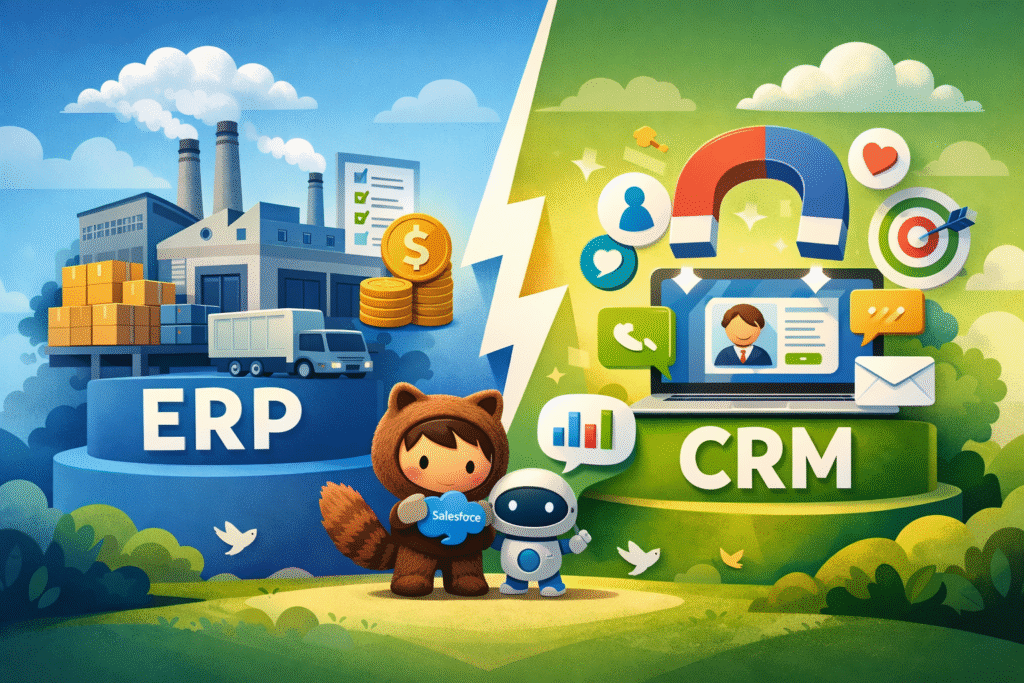
Introduction: Salesforce ERP vs CRM
In today’s fast-moving digital business environment, companies rely heavily on software platforms to manage operations, customers, and growth. Two of the most commonly discussed systems are ERP (Enterprise Resource Planning) and CRM (Customer Relationship Management). While they are often mentioned together, they serve very different purposes.
Salesforce is globally known as a powerful CRM platform, but with its expanding ecosystem, many businesses now compare Salesforce CRM vs ERP solutions to decide what best fits their needs. Understanding the differences between ERP and CRM and how Salesforce fits into this picture can help organizations make smarter technology decisions.
This blog explores the key differences between Salesforce ERP and CRM, explains how each system works, and highlights real-world business use cases to help you choose the right solution.
Table of Contents
What Is CRM? Understanding Salesforce CRM
A CRM (Customer Relationship Management) system focuses on managing customer interactions throughout the entire customer lifecycle. Its primary goal is to improve relationships, increase sales, and enhance customer satisfaction.
Salesforce CRM is designed to help businesses track leads, manage accounts, automate sales processes, and deliver personalized customer experiences. It acts as a centralized hub where sales, marketing, and service teams collaborate using real-time customer data.
Core Features of Salesforce CRM
Salesforce CRM offers a wide range of tools, including:
- Lead and opportunity management
- Sales forecasting and pipeline tracking
- Marketing automation and campaign management
- Customer service and case management
- AI-driven insights and analytics
- Custom workflows and automation
At its core, Salesforce CRM answers one critical question:
How can we attract, engage, and retain customers more effectively?
What Is ERP? Understanding ERP Systems
An ERP (Enterprise Resource Planning) system focuses on managing internal business operations. It integrates core functions such as finance, procurement, manufacturing, inventory, human resources, and supply chain management into a single platform.
Unlike CRM, which is customer-centric, ERP systems are operations-centric. Their main goal is to streamline internal processes, reduce operational costs, and improve efficiency across departments.
Common ERP Capabilities
Typical ERP systems include:
- Financial management and accounting
- Inventory and warehouse management
- Procurement and vendor management
- Manufacturing and production planning
- Human resource management
- Compliance and reporting
ERP answers a different question:
How can we run our internal business operations more efficiently?
Salesforce ERP vs CRM: The Core Difference
The biggest difference between Salesforce ERP vs CRM lies in their focus and purpose.
- CRM systems like Salesforce focus on external interactions customers, prospects, and sales opportunities.
- ERP systems focus on internal operations finance, supply chain, and resource planning.
Salesforce itself is not a traditional ERP, but it integrates seamlessly with ERP platforms or extends functionality through apps and custom solutions.
Salesforce ERP vs CRM: Feature Comparison
Focus Area
- Salesforce CRM: Customer relationships, sales growth, and service quality
- ERP Systems: Internal processes, financial control, and operational efficiency
Primary Users
- Salesforce CRM: Sales teams, marketing teams, customer support agents
- ERP Systems: Finance teams, operations managers, supply chain teams, HR departments
Data Management
- Salesforce CRM: Customer data, interactions, leads, and engagement history
- ERP Systems: Financial records, inventory levels, production data, and employee information
Business Objective
- Salesforce CRM: Increase revenue and improve customer experience
- ERP Systems: Reduce costs and optimize internal workflows
Can Salesforce Be Used as an ERP?
Salesforce is primarily a CRM platform, but many businesses use it to support ERP-like functions through:
- Custom objects and automation
- AppExchange solutions
- Integration with third-party ERP systems
- Industry-specific Salesforce clouds
For example, Salesforce can manage orders, contracts, and billing workflows, but it typically relies on ERP platforms for deep financial accounting or manufacturing processes.
This is why most enterprises choose Salesforce CRM integrated with an ERP system, rather than replacing ERP entirely.
Business Use Cases for Salesforce CRM
1. Sales Pipeline Management
Salesforce CRM helps sales teams track leads, manage opportunities, and forecast revenue accurately. Businesses can visualize the entire sales pipeline and identify bottlenecks in real time.
2. Marketing Campaign Optimization
Marketing teams use Salesforce to segment audiences, personalize campaigns, and measure performance across channels, resulting in higher conversion rates.
3. Customer Support & Service
Salesforce Service Cloud enables businesses to manage customer cases, automate responses, and provide omnichannel support, improving customer satisfaction and loyalty.
4. B2B Relationship Management
For B2B companies, Salesforce CRM helps manage long sales cycles, multiple decision-makers, and ongoing account relationships effectively.
Business Use Cases for ERP Systems
1. Financial Management
ERP systems centralize accounting, budgeting, and financial reporting, ensuring accuracy and compliance.
2. Inventory and Supply Chain Control
Manufacturing and retail businesses use ERP to manage inventory levels, suppliers, and logistics, reducing waste and delays.
3. Workforce Management
ERP platforms help HR teams manage payroll, employee records, and workforce planning.
4. Operational Efficiency
ERP systems streamline internal processes by reducing manual work and ensuring consistent data across departments.
Salesforce ERP vs CRM: Which One Does Your Business Need?
Choosing between Salesforce ERP vs CRM depends on your business goals.
- If your priority is sales growth, customer engagement, and service quality, Salesforce CRM is essential.
- If your focus is financial control, supply chain efficiency, and internal operations, an ERP system is critical.
In reality, most growing businesses need both. CRM drives revenue by managing customers, while ERP supports scalability by managing operations.
Why Businesses Integrate Salesforce CRM with ERP
Many organizations integrate Salesforce CRM with ERP systems to get the best of both worlds.
Benefits of Integration
- Unified customer and financial data
- Faster order-to-cash cycles
- Improved forecasting and reporting
- Better collaboration between sales and operations
- Enhanced customer experience
This integrated approach ensures that sales teams have real-time visibility into inventory and pricing, while finance teams gain insight into customer demand.
The Future of Salesforce ERP vs CRM
As technology evolves, the line between ERP and CRM continues to blur. Salesforce is expanding its platform with AI, automation, and industry-specific solutions, making it more powerful beyond traditional CRM.
However, ERP systems will remain essential for deep operational and financial management. The future lies in intelligent integration, where Salesforce CRM acts as the front-office system and ERP handles back-office operations.
Key Takeaway:
Salesforce ERP vs CRM is crucial for making the right technology investment. Salesforce CRM excels at managing customer relationships, driving sales, and improving service experiences. ERP systems, on the other hand, focus on internal efficiency, financial accuracy, and operational control.
Rather than choosing one over the other, most businesses achieve the best results by combining Salesforce CRM with an ERP system. This approach creates a connected ecosystem that supports growth, efficiency, and long-term success. By aligning CRM and ERP capabilities with your business strategy, you can build a scalable, customer-centric organization ready for the future.